The divergence of the position vector field is . At height , the horizontal cross-section is a disk of area . By the divergence theorem, the outward flux integral is three times the enclosed volume:ThereforeA direct check separates the two pieces of the surface integral. On the unit sphere, the outward unit normal is , so and the curved contribution is . On the top disk, , giving . Their sum is the same flux.
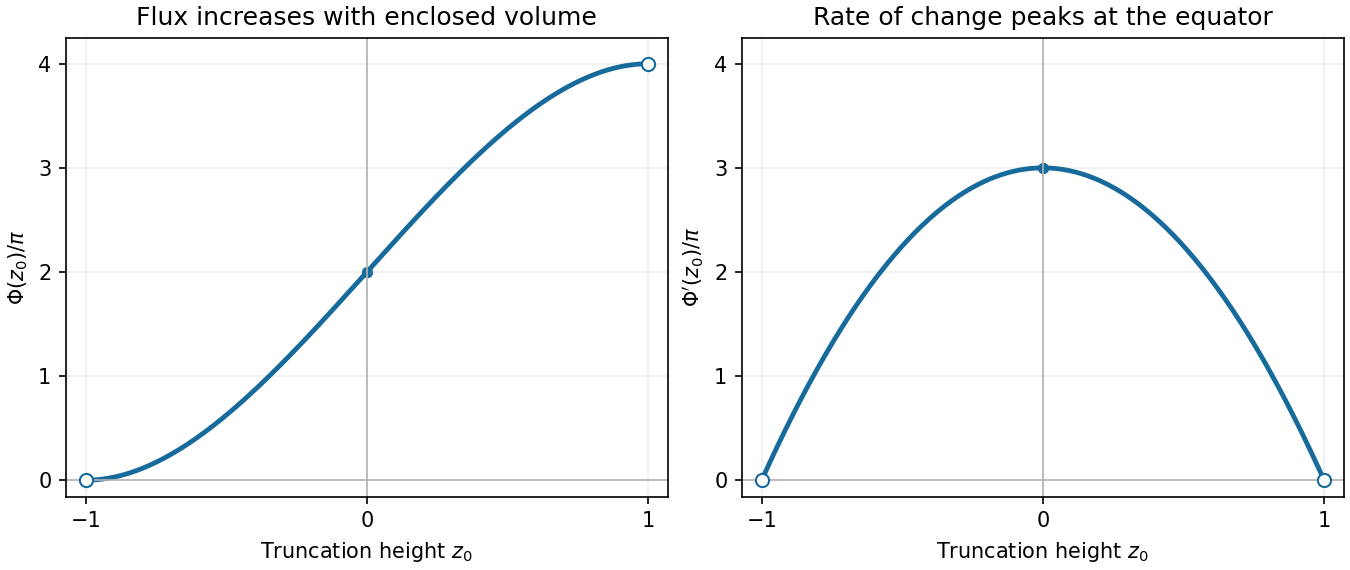
Differentiate the flux:On , is strictly increasing. Its limiting endpoint values are and , and . It has horizontal limiting tangents at the endpoints, curves upward for , curves downward for , and has an inflection point at zero.
The derivative graph is a downward-opening parabola, approaching zero at both endpoints and attaining its maximum at .

Articles by others on the same topic
There are currently no matching articles.