The divergence of the position vector field is . At height , the horizontal cross-section is a disk of area . By the divergence theorem, the outward flux integral is three times the enclosed volume:ThereforeA direct check separates the two pieces of the surface integral. On the unit sphere, the outward unit normal is , so and the curved contribution is . On the top disk, , giving . Their sum is the same flux.
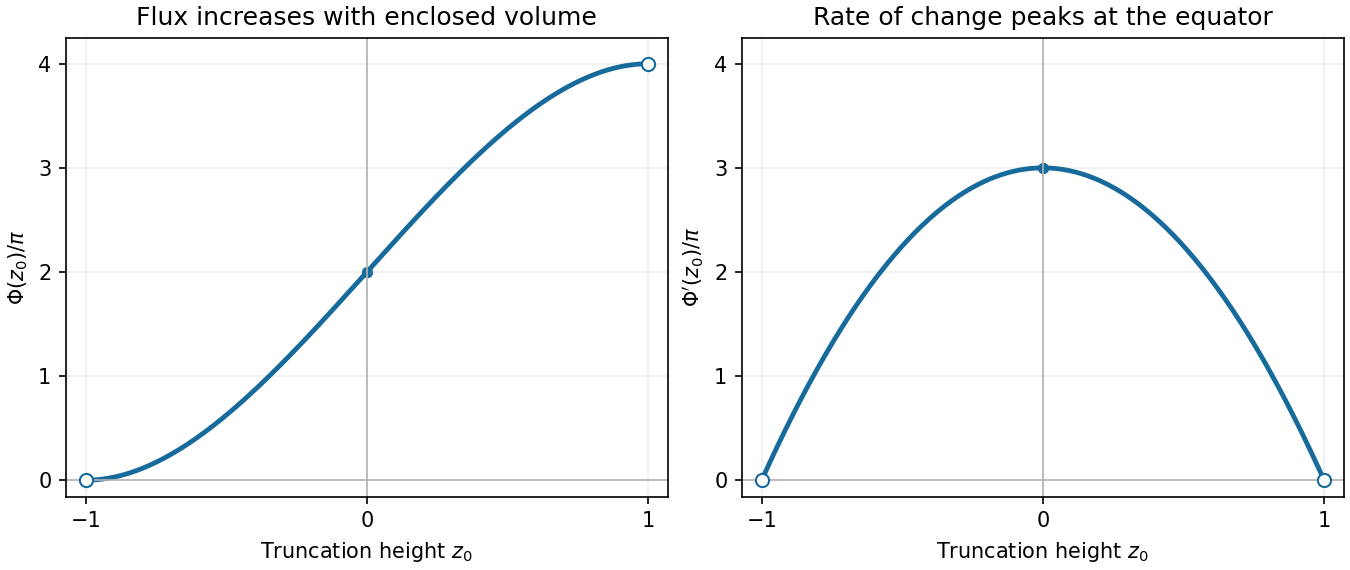
Differentiate the flux:On , is strictly increasing. Its limiting endpoint values are and , and . It has horizontal limiting tangents at the endpoints, curves upward for , curves downward for , and has an inflection point at zero.
The derivative graph is a downward-opening parabola, approaching zero at both endpoints and attaining its maximum at .

Use the two pieces of the surface integral directly; this avoids introducing an unnecessary second derivative of . On the unit sphere, and . A spherical band between heights and has area , so the curved flux isby the fundamental theorem of calculus. On the horizontal top disk, and the area is . ThusAs usual for these surface integrals, the first derivative is assumed sufficiently integrable for the displayed fundamental theorem of calculus evaluation; a continuous first derivative suffices. Mere pointwise differentiability without such an integrability assumption need not make an ordinary flux integral exist.
Articles by others on the same topic
There are currently no matching articles.