For the normal modes of an equilateral spring triangle, the complement of the three rigid motions has dimension three. One convenient mutually orthogonal basis isThese vectors are also orthogonal to , and each has squared length . Their geometry comes from applying symmetric linear deformations to the equilibrium triangle: is uniform expansion, stretches one axis while compressing the other, and is the second independent shear pattern. Their extensions areInsert each row into the force equations. For example, gives and , with the same proportionality in every component. The other two rows similarly give force times their displacement vector. Thusand the remaining normal modes and normal frequencies areAny orthogonal pair spanning the same two-dimensional shear subspace is equally valid, because its eigenvalue is repeated. The six displayed vectors are nonzero and mutually orthogonal, so they supply all six independent normal modes without solving a characteristic polynomial.
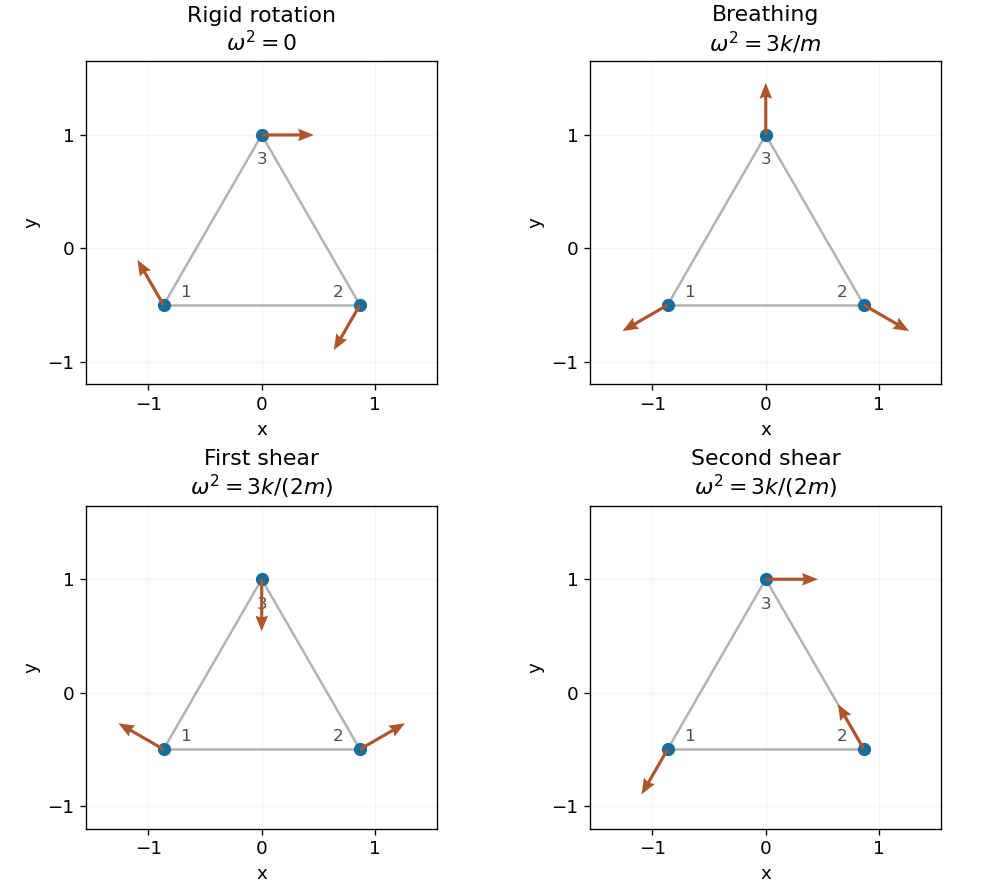

For explicit normal coordinates, normalize by and by , and write . Since all masses are equal,Positive-frequency coordinates have ; the three rigid coordinates have the linear form found above.
Articles by others on the same topic
There are currently no matching articles.