A normal mode is a fixed displacement pattern whose components share a common harmonic time dependence in the equations for small oscillations. Its normal frequency is the associated oscillation frequency; below, denotes the angular frequency, so the frequency in cycles per unit time is . A normal coordinate is the amplitude of one such pattern, chosen so that the linear equations decouple. For mass matrix and stiffness matrix , the patterns solve . Zero eigenvalues describe free rigid motions rather than periodic restoring oscillations.
Use the equilibrium coordinates specified in the paper; their distances from the origin are one and their mutual separation is . Let be the small displacements. Each initially unstretched spring has, to first order, extension equal to the relative displacement projected along its original bond. Choose the three oriented extensionsThe kinetic energy is exact in these displacement coordinates, while the potential energy needed for small oscillations is its quadratic part:The factor in the equilibrium bond length cancels when forming the unit bond directions. Applying the Euler-Lagrange equation, or differentiating for the force on each mass, givesThe total force vanishes componentwise, as expected for three masses coupled only by internal spring forces.
Order coordinates as . For either uniform displacement, or , every relative displacement and every extension vanishes. These normal modes have zero normal frequency and represent two independent planar translations.
For , substitution givesThus too. A small rigid rotation through angle moves equilibrium position by . With the specified positions this displacement is , identifying the third vector as infinitesimal rigid rotation. HenceA zero-frequency normal coordinate obeys , so . This permits a constant displacement or a uniform velocity at the level of the linearized equations. In particular, the rotational pattern preserves lengths to first order; finite-angle rotation follows a curved path outside a single linear displacement pattern.
For the normal modes of an equilateral spring triangle, the complement of the three rigid motions has dimension three. One convenient mutually orthogonal basis isThese vectors are also orthogonal to , and each has squared length . Their geometry comes from applying symmetric linear deformations to the equilibrium triangle: is uniform expansion, stretches one axis while compressing the other, and is the second independent shear pattern. Their extensions areInsert each row into the force equations. For example, gives and , with the same proportionality in every component. The other two rows similarly give force times their displacement vector. Thusand the remaining normal modes and normal frequencies areAny orthogonal pair spanning the same two-dimensional shear subspace is equally valid, because its eigenvalue is repeated. The six displayed vectors are nonzero and mutually orthogonal, so they supply all six independent normal modes without solving a characteristic polynomial.
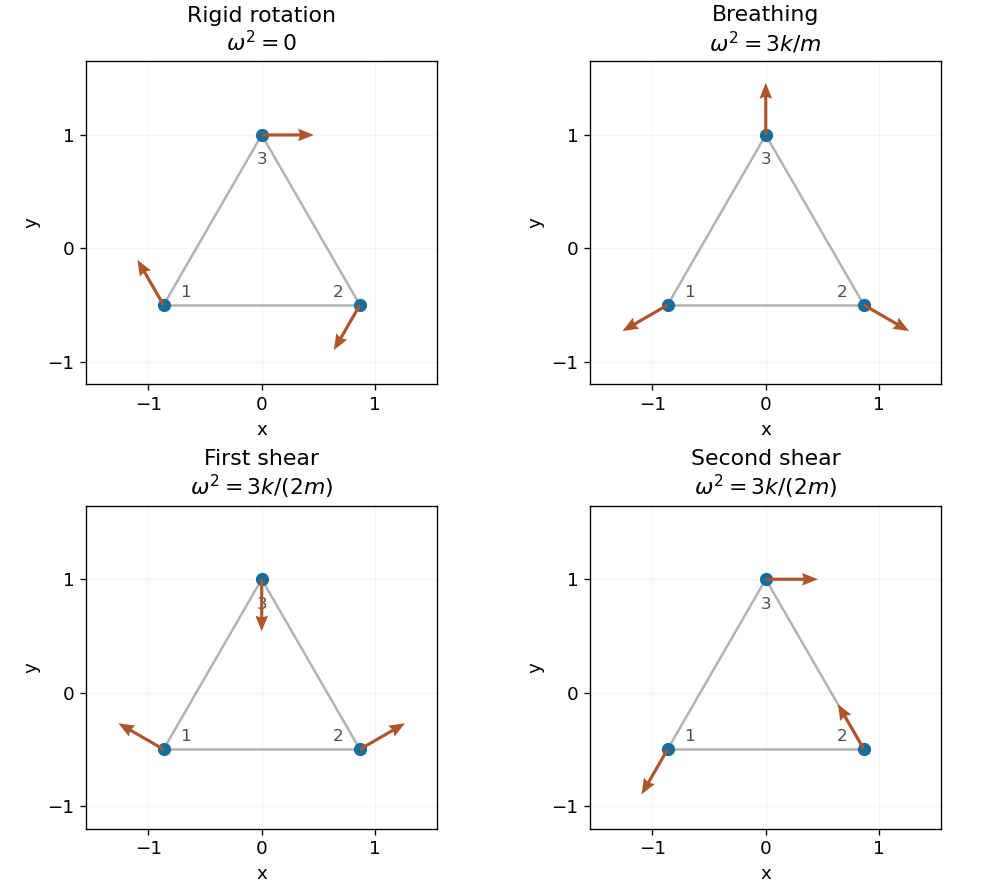

For explicit normal coordinates, normalize by and by , and write . Since all masses are equal,Positive-frequency coordinates have ; the three rigid coordinates have the linear form found above.
Articles by others on the same topic
There are currently no matching articles.