A normal mode has all coordinates following one fixed displacement pattern with a common time factor. Its normal frequency is that factor's oscillation frequency; normal mode coordinates are amplitudes in a basis of such patterns, making the linear equations independent. A zero-frequency mode can instead have constant velocity along a symmetry direction.
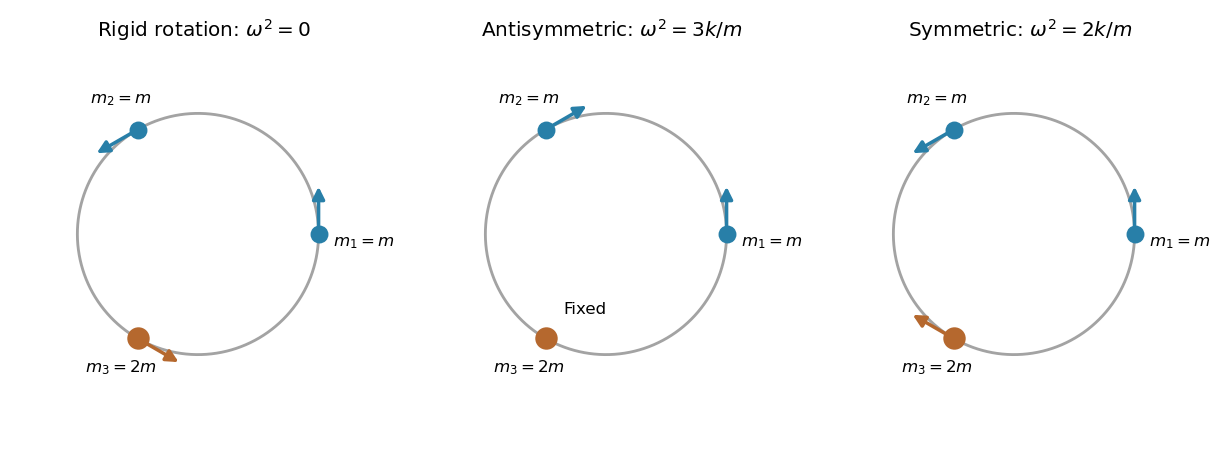
For the unit circle, each angular displacement equals its corresponding arc displacement. The kinetic energy and change in potential energy areAny common spring prestress changes only the constant , because the sum of the three arc lengths is fixed. The Euler-Lagrange equations giveThese are the normal modes of three beads connected by springs on a circular hoop, with third mass . For , their three mode vectors and squared angular frequencies areThe zero mode rotates the entire configuration without stretching a spring. The antisymmetric mode moves the equal masses oppositely while leaving the third fixed. In the symmetric mode the equal masses move together against the third, with zero total angular momentum. These vectors are orthogonal in the mass inner product with matrix .
Writing gives independent equations , , . In particular , retaining possible slow common rotation. For , the two positive frequencies coincide at ; their two-dimensional space is all patterns with .

Articles by others on the same topic
There are currently no matching articles.