Write . A rotationally symmetric fundamental solution of the Laplace equation is harmonic for . The Laplace equation in polar coordinates reduces to , so . Integrate over a disk of radius around the source. The divergence theorem givesTaking therefore givesChanging the reference length inside the logarithm merely adds a constant. Notice the sign convention: the potential equation in this question is , whereas this Green function satisfies . Thus the point-source potential used below is .
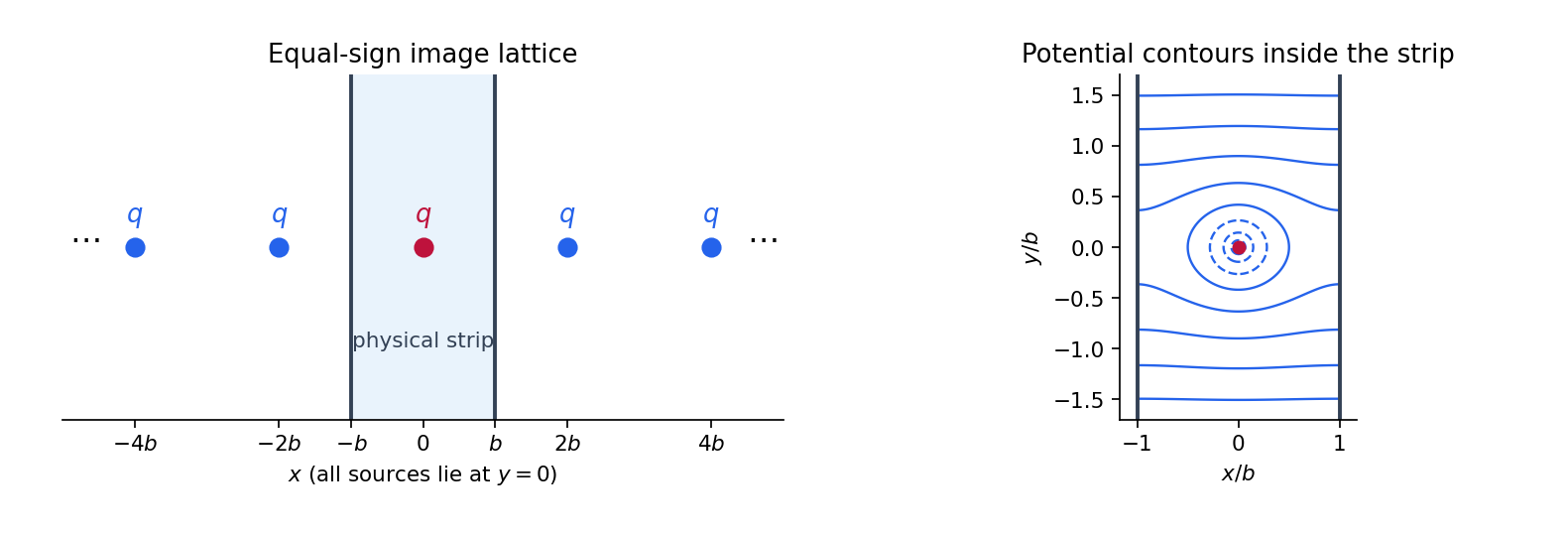
For the two insulating walls, successive Euclidean reflections in and generate sources of strength at for every integer . Only lies inside the physical strip. This is the Neumann image lattice for a point source in a strip. SetThe raw sum of logarithmic potentials diverges by additive constants. A well-defined potential is obtained by pairing opposite images and subtracting their constant reference terms:Each paired summand is on compact subsets away from the source. The series therefore has local uniform convergence, as do the required derivative series. It givesIn the corresponding -derivative, the images pair as and at , and as and at . Their opposite horizontal separations make the derivatives cancel. Thus both homogeneous Neumann boundary conditions hold. The constructed solution is even in ; without a condition at infinity the side conditions alone would allow further homogeneous harmonic functions.
For fixed , uniform convergence on permits integration term by term. The th term has integralHere is the ordinary real inverse trigonometric function, taking values in . Summing from to makes a telescoping series:The source flux splits equally between the upper and lower parts of the strip. The next two parts give the single-wall constructions that underlie the image lattice.

For the grounded wall, use an image charge at . Define the Euclidean distances and . The method of images givesThe real source has the required Dirac delta function coefficient, and the image is outside the domain. On , , so exactly. This verifies the Dirichlet boundary condition rather than only its derivative.
For the insulating wall, the image instead has the same strength . With the distances defined above,It has the required source in the physical domain. Its normal derivative isAt the terms are and , so they cancel. The Neumann boundary condition leaves the additive constant free.
Articles by others on the same topic
There are currently no matching articles.