The Lagrangian is , and the Euler-Lagrange equations areAt a rest equilibrium , for all three coordinates. The Taylor expansion therefore starts asThe symmetric Hessian matrix is the matrix of the quadratic potential energy. If a quadratic coefficient vanishes along a direction, higher-order terms can be the first nonconstant terms there; equilibrium by itself does not imply strict stability.
Write . Terms involving the variation of are cubic in small displacements and velocities, so the quadratic small oscillation Lagrangian isA normal mode has fixed displacement ratios, . Its angular frequency is an eigenfrequency, or normal frequency, and satisfies the generalized eigenvalue problem for small oscillationsHere is positive definite for independent physical coordinates and positive masses. A stable quadratic minimum makes ; a negative value would describe exponential instability rather than oscillation.
For the suspended bar, let and denote the actual incremental spring constants of the upper and each lower spring. The physical displacement of the bar is , while the lower spring extensions change by and . ConsequentlyThe linear gravitational and elastic terms cancel at the loaded equilibrium. Expanding the remaining squares gives the small-oscillation mass and stiffness matricesThusSource convention: the printed matrix is obtained by setting and . Although the PDF prose calls spring constants, that matrix treats them as elastic parameters whose ratios to the stated lengths are the incremental stiffnesses. If they are read literally as Hooke-law spring constants, the divisions by should instead be omitted. The numerical case has , so this discrepancy does not affect its results.
With the numerical parameters, andUse the exchange symmetry of the lower masses to find the vertical modes of a horizontally constrained suspended bar. The antisymmetric vector obeys , giving . In the symmetric sector put and . The two independent equations areTheir determinant gives , so . Taking , the full set isIn the lowest normal mode, all three masses move in phase, with the lower masses moving about times as far as the bar. In the antisymmetric normal mode, the bar stays still and the lower masses move equally in opposite directions; their changing forces on the bar cancel. In the highest normal mode, the lower masses move together against the bar, with magnitude about of its displacement. Any small motion is a superposition of these three modes.
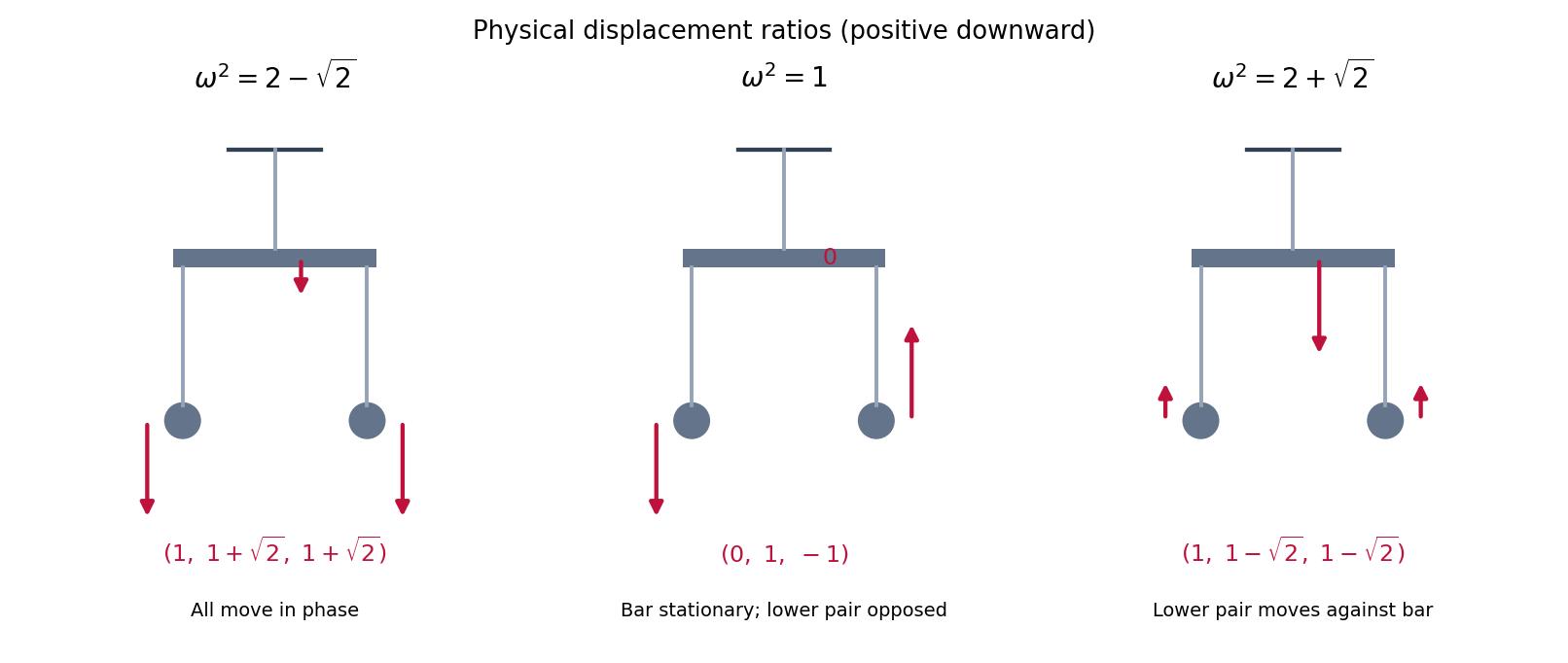
Relative vertical displacements in the three normal modes, with the bar constrained to remain horizontal
. Details. 
Articles by others on the same topic
There are currently no matching articles.