By Fermat principle, a light ray makes optical travel time stationary. Multiplication by the constant vacuum speed of light does not change the stationary paths, so the functional can be taken to be the refractive index integrated over arc length. The constant denoted below is an integration constant, not that vacuum speed.
The integrand has no explicit dependence on , so part (i) givesFor positive refractive index and a regular graph with , squaring and then restoring the sign of yieldsIt is the continuous-medium version of Snell's law, expressing conserved horizontal optical momentum. The Euler-Lagrange equation establishes stationarity; on a monotone-height segment, convexity of the integrand in also gives a minimum among graphs with fixed endpoints.
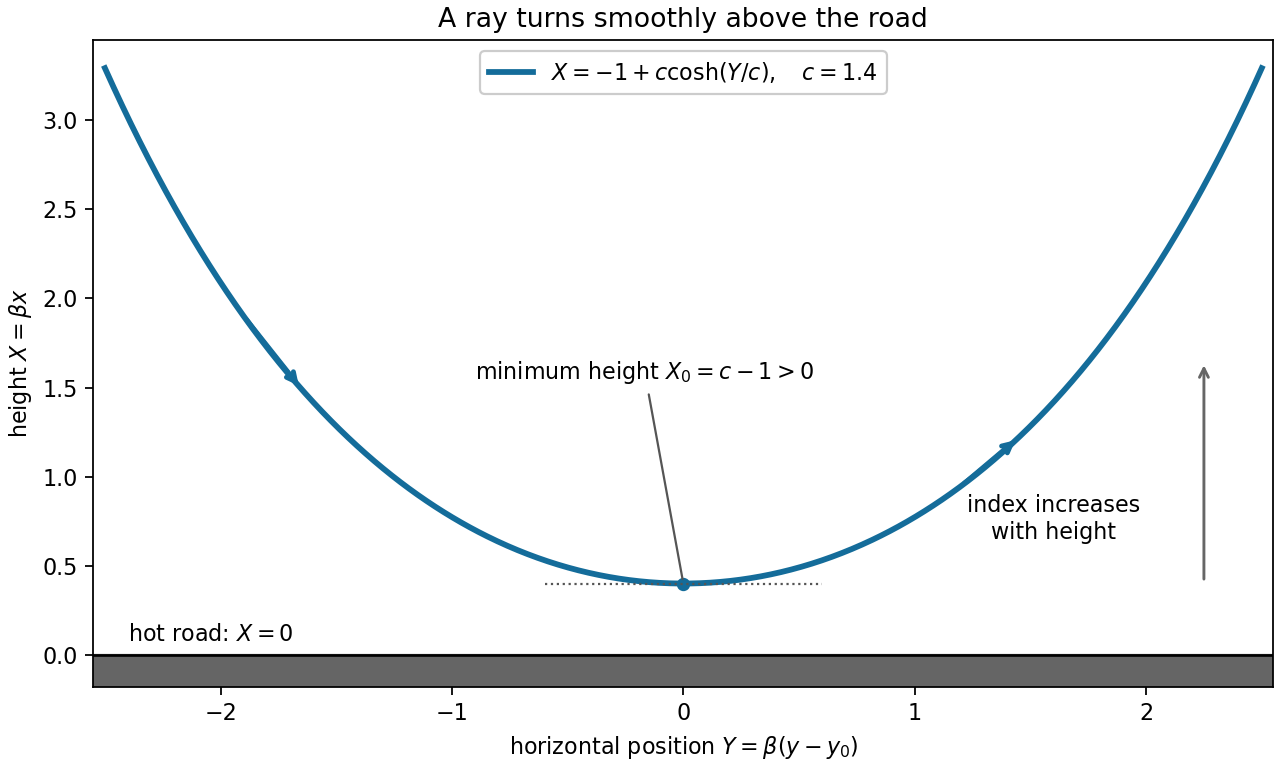
For the displayed form take and . Substitute in the first integral:Inverting the hyperbolic cosine gives the catenary light ray in a linear refractive indexThe minimum occurs at and , so the integration constant has the specified meaning. The integral above describes the graph branch; the other sign of the square root continues it smoothly to the other side of the turning point in .
The signed-constant qualification matters: for in part (a), integration reverses horizontal direction, and the positive prefactor in the full catenary is , with minimum height . The printed expression presupposes . The separate case gives constant, a vertical ray. At the turning point diverges, so is not a single regular graph across it, although is smooth.
For , the catenary has a positive minimum height above the road. Its derivatives areThus the light ray is symmetric about , descends towards a horizontal tangent at its minimum, and then rises. It never intersects the road. This smooth upward bending in the refractive index gradient produces an inferior mirage, without reflection at the road.

Articles by others on the same topic
There are currently no matching articles.