The triangular function is real and even, so its Fourier transform reduces to a cosine integral:For , one integration by parts gives . Therefore the Fourier transform of a triangular function isThe zero-frequency value is the removable limit and also the area of the triangle. The transform is a squared sinc function, which explains its nonnegativity despite the oscillating Fourier exponential.
Under regularity and integrability conditions permitting the limits to pass through the integral, apply the difference quotient directly in time:For the spatial derivative, translate the integration variable in the first term:ConsequentlyThe second calculation is the Translation property of the Fourier transform applied to a difference quotient. These are the Fourier transform of a derivative identities. The stated decay removes boundary terms in the alternative integration-by-parts derivation; rigorous interchange of limits also requires suitable control, for example integrable derivatives. The formulas extend to tempered distributions.
Apply the identities from part (ii) twice. The second time derivative becomes and the second spatial derivative becomes . The Fourier transform method for the wave equation therefore givesFor each fixed wavenumber , this is a harmonic oscillator equation with angular frequency . At its solutions are affine in time rather than two independent oscillatory exponentials.
Zero initial velocity selects the cosine solution of the transformed equation:with the removable value one at . Since , the Fourier shift theorem giveswhere . This is triangular pulse splitting under the wave equation, a special case of the D'Alembert formula.
The two half-height triangles move in opposite directions at speed . Their sum initially reproduces the full triangle; once their supports are disjoint. The field vanishes outside , consistent with finite propagation speed. For it simply remains .
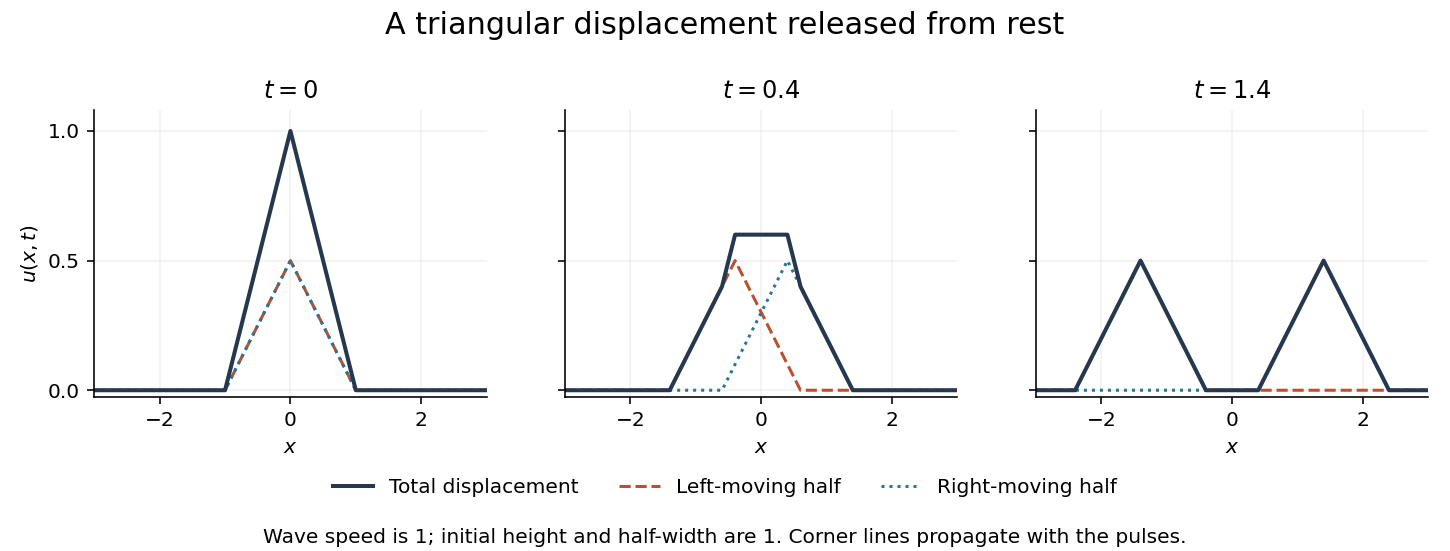
A triangular displacement released from rest splits into two translating half-amplitude pulses; their overlap adds
. Details. 
Because the triangular profile has slope discontinuities, this is a weak solution rather than a globally twice differentiable solution. The initial velocity is zero in the distributional or square-integrable sense, and pointwise away from the initial corners. A classical pointwise time derivative need not exist at those corners; for example near . The initial conditions must be interpreted consistently with this nonsmooth displacement.
Articles by others on the same topic
There are currently no matching articles.