Take downward vertical distances from the support. The climber positions are , and . Their kinetic energy is thereforeIntegrating the tension-extension relation gives the elastic potential energy for each taut rope. Because downward displacement lowers gravitational potential,An arbitrary additive constant in is immaterial. This is the vertical-motion model implicit in using only rope lengths as generalized coordinates; swinging angles are not additional degrees of freedom in this model.
The Euler-Lagrange equations giveFor example, differentiating with respect to collects contributions from all three climbers, because changing moves all of them. At equilibrium, all accelerations vanish, soThe top rope supports the total weight, while each lower rope supports only its own climber. These extensions are positive, consistent with the taut-rope tension law.
Set . The equilibrium equations cancel the constant gravitational and elastic terms, leaving the small-oscillation mass and stiffness matricesThe off-diagonal mass terms arise because rope-length coordinates are not absolute climber displacements. For any nonzero velocity vector, , so is a positive-definite matrix.
Within the vertical Hookean model, the displacement equations are exactly linear while all ropes stay taut. Small amplitudes ensure that none reaches the slack regime .
Exchange symmetry of climbers 2 and 3 gives , for which . HenceThe physical displacements are , so climber 1 is stationary and the other two move vertically with equal amplitudes in opposite directions. Their changes in force on climber 1 cancel.
For the remaining symmetric modes, put and let . The eigenproblem becomes , . Eliminating gives . Therefore . Since ,For clarity, their relative physical climber displacements, rather than rope-length amplitudes, areThe lower mode moves all climbers in phase; the higher mode moves the lower pair against the top climber. These are the normal modes of three vertically suspended masses with a branched spring connection.
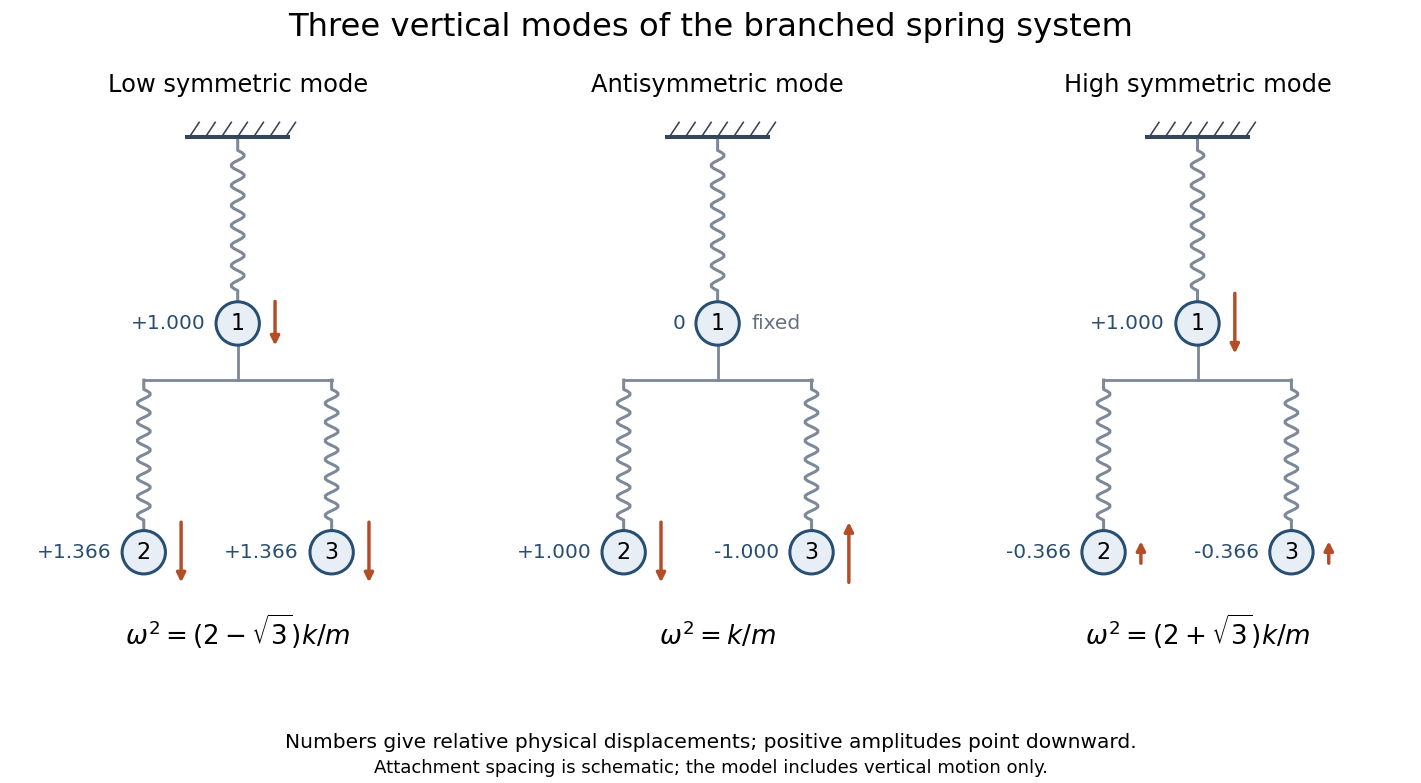
Relative physical climber displacements in the three vertical normal modes; branch spacing is schematic
. Details. 
Articles by others on the same topic
There are currently no matching articles.