For a piecewise continuously differentiable contour , define its contour integral byadding the integrals over the finitely many smooth pieces if necessary. Continuity of along the contour makes each integrand integrable. The derivative supplies both the direction and the complex line element; replacing it by its modulus would give a different integral with respect to arc length.
For , and . The triangle inequality for an integral applied to the parametrized contour integral givesThis is the circular-contour instance of the estimation lemma.
Use the continuous argument on the positive-axis slit plane and defineThis analytic logarithm on the positive-axis slit plane is holomorphic, satisfies and , and has . That value fixes the branch uniquely on the connected domain. For positive real , the two boundary limits areThe jump, rather than a pole of the integrand, is what the keyhole argument exploits.
The Cauchy integral theorem for a star-shaped domain says: if is open and star-shaped and is holomorphic on , then for every closed contour in . Equivalently, has a complex antiderivative on . Star-shaped means that there is one point of from which every straight segment to another point of remains in .
Apply the Cauchy integral theorem to on the slit plane, which is star-shaped about . For fixed , first let . The upper bank is traversed from to one and the lower bank from one to , so their limiting sum isThe outer arc tends to the positively oriented unit-circle integral, interpreting the logarithm by its one-sided boundary values at the cut. On the inner arc, and is bounded near zero. Its integral is therefore and tends to zero. The sum of all four contour pieces is zero. Letting givesThe integral around the full circle is a piecewise integral of the branch's boundary values; is not a single holomorphic function across the cut-crossing point. This is the centred logarithmic keyhole identity.
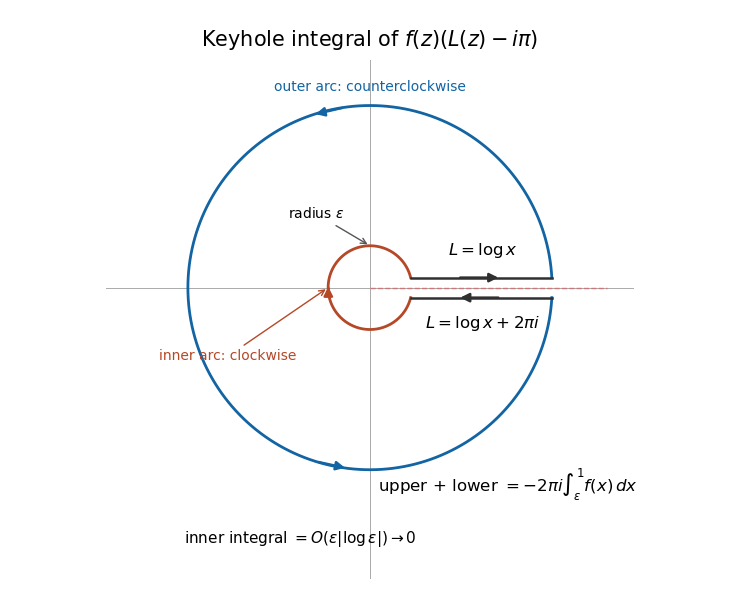

Along with , the chosen branch has . Use part (iii) and the circular estimate in part (a):The second step uses . The single branch-cut point does not affect the integral. Keeping that weight gives the sharper intermediate bound.
On the real interval, is real and . Expanding and integrating the finite sum yieldsApply part (b)(iv) to the entire function . Since , orthogonality of complex exponentials givesConsequentlyThe quadratic form is actually nonnegative, so its absolute value can be dropped. This shifted Hilbert quadratic-form bound comes from combining the logarithmic contour estimate with a finite Parseval identity.
Articles by others on the same topic
There are currently no matching articles.