Source paper: released examination archive, member
2016/T/a13754w1.pdf. The printed cover dates the examination to 13 June 2017. All six questions and all thirty-four terminal subparts are answered below, including the definitions and other requirements printed outside the nested lists.A sequence in a metric space is a Cauchy sequence ifThe index may depend on , but must work for every pair of sufficiently late terms. No candidate limit is part of this definition.
The sequence converges to ifEquivalently . The limit must belong to the specified metric space, not just to a larger space containing it.
A complete metric space is one in which every Cauchy sequence converges to a point of that space. For an incomplete example, take with the usual Euclidean metric and . It is Cauchy because it converges to zero in . It cannot converge inside : any such convergence would also hold in , contradicting uniqueness of the limit, since zero is excluded. Thus the ambient metric and the underlying set both matter to completeness.
Put . Every summand is nonnegative and at most , so the series defining converges and . Symmetry follows from each . If , every nonnegative summand is zero, hence every and . The converse is immediate.
For the triangle inequality, first observe that for ,Monotonicity of and the triangle inequality for therefore giveMultiply by and sum the convergent nonnegative series. This proves the required triangle inequality for , so is a metric. The construction combines a bounded metric transform with a countable product metric.
Let be Cauchy for , and fix a coordinate . Every nonnegative summand is bounded by the whole sum:Given , choose such that the right-hand side is less than for all . Then strict monotonicity of implies . Hence every coordinate sequence is Cauchy in its original metric , with the index bound allowed to depend on the fixed coordinate.
By part (ii) and completeness of each factor, choose with . Let . Given , choose such that . Coordinate convergence gives a single for which for every and . Since ,Thus in the product metric, proving the product is complete. The finite head uses coordinate convergence; the summable tail is controlled uniformly, regardless of how large the remaining original coordinate distances are. This is completeness of a countable product metric.
A topological space is connected if it cannot be expressed as a union of two disjoint nonempty sets open in that space. Suppose had such a separation . Here are open in the subspace topology of . Continuity makes and open in . They are disjoint, nonempty because contain image points, and cover . This contradicts connectedness. Hence a continuous image of a connected space is connected.
A space is path-connected if for every pair it contains a continuous path with and . For any choose preimages . A path between those preimages maps to , a continuous path from to staying in . Thus a continuous image of a path-connected space is path-connected. Surjectivity onto the ambient codomain is not needed; the conclusion concerns .
Suppose a path-connected space had a separation as above. Choose , , and a continuous path joining them. The nonempty disjoint sets and would separate , contradicting connectedness of an interval. Hence path-connectedness implies connectedness. Equivalently, the connected path image from part (i) cannot meet both sides of a separation.
Expanding the characteristic polynomial givesTherefore and . Both are polynomial functions of the three real coordinates, so they are continuous functions, including on the open subset of invertible matrices.
On , . Its image contains positive values, for example , and negative ones, for example . If were connected, its continuous real image would be an interval containing both signs and hence zero. That is impossible. Thus is not connected. More precisely its determinant image is : take for a positive value and for a negative one.
On , , so and therefore . Yet and . The same continuous image of a connected space argument shows that is not connected.
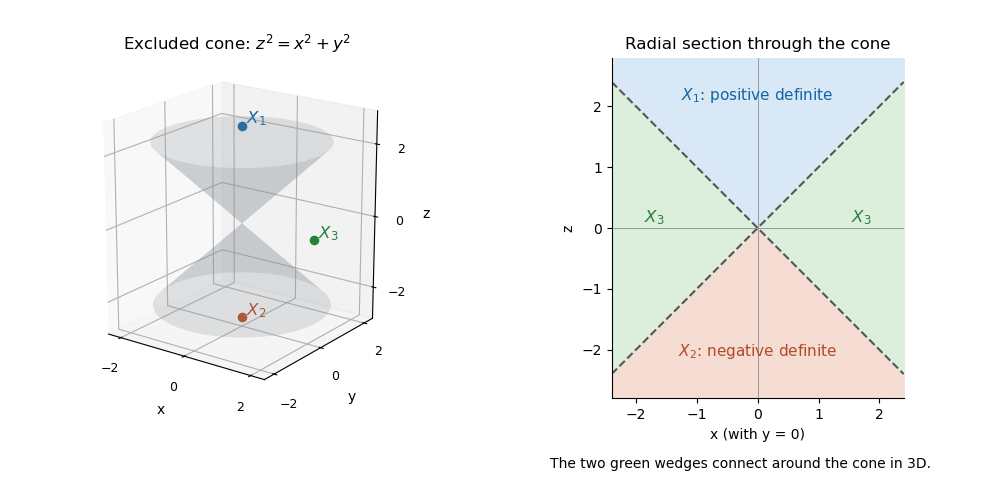
Put . The required three disjoint nonempty open sets areTheir union is precisely , the complement of the double cone . The eigenvalues are , so consists of positive-definite matrices above the upper sheet, of negative-definite matrices below the lower sheet, and of indefinite matrices outside the double cone. Examples are respectively.
The two definite cones are convex sets. The indefinite region is path-connected: shrink continuously to zero while keeping , then change the nonzero vector within the punctured plane. Thus these sets are also exactly the three connected components. This is the determinant cone for real symmetric two-by-two matrices.

For a piecewise continuously differentiable contour , define its contour integral byadding the integrals over the finitely many smooth pieces if necessary. Continuity of along the contour makes each integrand integrable. The derivative supplies both the direction and the complex line element; replacing it by its modulus would give a different integral with respect to arc length.
For , and . The triangle inequality for an integral applied to the parametrized contour integral givesThis is the circular-contour instance of the estimation lemma.
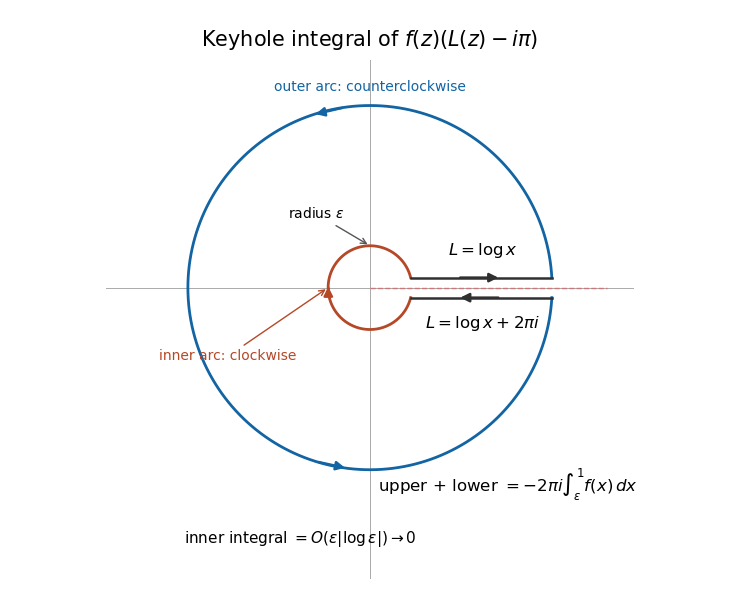
Use the continuous argument on the positive-axis slit plane and defineThis analytic logarithm on the positive-axis slit plane is holomorphic, satisfies and , and has . That value fixes the branch uniquely on the connected domain. For positive real , the two boundary limits areThe jump, rather than a pole of the integrand, is what the keyhole argument exploits.
The Cauchy integral theorem for a star-shaped domain says: if is open and star-shaped and is holomorphic on , then for every closed contour in . Equivalently, has a complex antiderivative on . Star-shaped means that there is one point of from which every straight segment to another point of remains in .
Apply the Cauchy integral theorem to on the slit plane, which is star-shaped about . For fixed , first let . The upper bank is traversed from to one and the lower bank from one to , so their limiting sum isThe outer arc tends to the positively oriented unit-circle integral, interpreting the logarithm by its one-sided boundary values at the cut. On the inner arc, and is bounded near zero. Its integral is therefore and tends to zero. The sum of all four contour pieces is zero. Letting givesThe integral around the full circle is a piecewise integral of the branch's boundary values; is not a single holomorphic function across the cut-crossing point. This is the centred logarithmic keyhole identity.

Along with , the chosen branch has . Use part (iii) and the circular estimate in part (a):The second step uses . The single branch-cut point does not affect the integral. Keeping that weight gives the sharper intermediate bound.
On the real interval, is real and . Expanding and integrating the finite sum yieldsApply part (b)(iv) to the entire function . Since , orthogonality of complex exponentials givesConsequentlyThe quadratic form is actually nonnegative, so its absolute value can be dropped. This shifted Hilbert quadratic-form bound comes from combining the logarithmic contour estimate with a finite Parseval identity.
The identity theorem says that two holomorphic functions on a connected domain which agree on a set with an accumulation point inside that domain agree everywhere there.
No such entire function exists. On the subsequence indexed by even numbers, the proposed function equals . The identity theorem would force throughout . At the points indexed by odd numbers it is instead required to equal , a contradiction since for positive . The accumulation point zero lies inside the assumed domain of holomorphy, which is essential to this argument.
Yes: take the unnormalized sinc function with its removable value at zero,Its power series is , with infinite radius of convergence, so it is an entire function. At it gives as required. The identity theorem also proves this entire solution is unique.
No such entire function exists. If it did, the entire function would vanish at the distinct points , whose accumulation point is one. The identity theorem would give on all of .
At zero this forces . Differentiating the identity gives , impossible at zero. Equivalently, a squared holomorphic function has an even-order zero, whereas has a simple zero. This is the obstruction expressed by no entire square root of the identity function; a square-root branch near one cannot extend holomorphically through zero.
Morera's theorem states that a continuous function on a domain is holomorphic if its contour integral around every triangle whose filled-in interior lies in the domain is zero.
The uniform limit is a continuous function, by the uniform limit theorem. For any such triangle , the estimation lemma givesEach integral of vanishes by the Cauchy integral theorem. Hence the integral of vanishes too, and Morera's theorem proves is holomorphic on . This is the basic locally uniform convergence of holomorphic functions argument; the given uniform convergence on all of is more than needed.
For and , the Cauchy integral formula for derivatives isThe formula applies because the closed unit disc lies inside the domain of holomorphy. For this is the ordinary value formula, with .
Fix and . On and , the reverse triangle inequality gives . Subtract the two Cauchy integral formula expressions and apply the estimation lemma, using circle length :Thus every fixed-order derivative converges uniformly on each smaller disc. The right-hand factor tends to zero by the assumed uniform convergence on . Keeping a positive gap from the integration contour is the essential feature of this Cauchy derivative convergence bound. If , the specified open disc is empty and the claim is vacuous.
Take and , for . These functions are entire andso convergence is uniform on the closed unit disc. But , givingfor every . In particular never approaches zero. On every strictly smaller disc the derivative does converge uniformly, consistent with part (iii). This is uniform holomorphic convergence without boundary derivative convergence.
Laurent's theorem states that a function holomorphic on has a unique expansionconverging uniformly on every compact subannulus. Its coefficients arewith counterclockwise orientation. The value is independent of the chosen intermediate radius. The nonnegative powers form a power series convergent inside the outer radius, and the negative powers form the principal part of a Laurent series.
The residue is the coefficient of in the Laurent series at the isolated singularity. Equivalently it is times the integral around a sufficiently small counterclockwise circle enclosing .
The residue theorem states that if is holomorphic on a neighborhood of a positively oriented simple closed contour and its interior except for finitely many isolated singularities inside, thenNo singularity may lie on the integration contour. A more general contour weights each residue by its winding number.
The Taylor expansions giveand hence . Since , zero is a simple pole with residue . It is not a removable singularity, despite the vanishing numerator, because the denominator has a zero of order two.
Use the upper half-disc of radius , with a clockwise semicircular indentation of radius above zero. The integrand is holomorphic inside that indented contour, so its total integral is zero. On the large arc,because , and . Its integral has modulus at most and vanishes as .
On the small clockwise arc, , so the integral tends to . Therefore the remaining real-axis integral satisfiesThe imaginary part is even and is an ordinary absolutely convergent integral: near zero its integrand tends to , and at infinity it is . Taking imaginary parts givesThe complex integral needs the Cauchy principal value because its real part has a singularity; the requested sine-product integral does not. This sine-product integral with inverse-square weight is an application of the upper-half-plane indentation rule.
For a holomorphic map, conformality means preservation of oriented angles locally; it holds at every point of exactly when there. A Möbius transformation is with , extended to the Riemann sphere at its pole and at infinity.
For three distinct finite points definewhich sends to . If one point is infinite, take the corresponding limit: for use ; for use ; for use . Construct similarly. Then has the required three images.
For uniqueness, normalize any two proposed maps by these same transformations. Composing one normalized map with the inverse of the other fixes . A Möbius map fixing infinity has , one fixing zero then has , and fixing one forces up to the irrelevant common nonzero scalar. It is the identity. This proves sharp three-transitivity of Möbius transformations.
Treat a straight line together with infinity as a generalized circle on the Riemann sphere. Its finite points have a real equationTranslations and nonzero complex scalings preserve circles and lines. Under , multiplying the equation by givesagain the equation of a circle or line. Nondegeneracy is preserved because the reciprocal map is a bijection of the sphere. The zero and infinite points are interpreted there, rather than discarded when multiplying denominators.
Every Möbius map with factors asif it is already affine. Thus Möbius translation-scaling-inversion factorization and the reciprocal transformation of a generalized circle prove every generalized circle maps to another generalized circle. A circle becomes a line exactly when its image contains infinity, that is, when the original circle contains the map's pole.
The first region is the lens around zero bounded by the two circular arcs through and . Writing , its inequalities combine to . The second region is the open first quadrant, and the third is the open horizontal strip between imaginary parts zero and .
Set . The inverse is , andHence the lens condition is exactly . Multiplying by gives real part and imaginary part , both positive exactly under that condition. Thereforeis a Möbius transformation mapping the lens bijectively to the first quadrant. Its pole at one lies on the boundary, and its inverse is , well-defined throughout the quadrant. The derivative never vanishes in the lens. This is a lens-to-quadrant Möbius map.
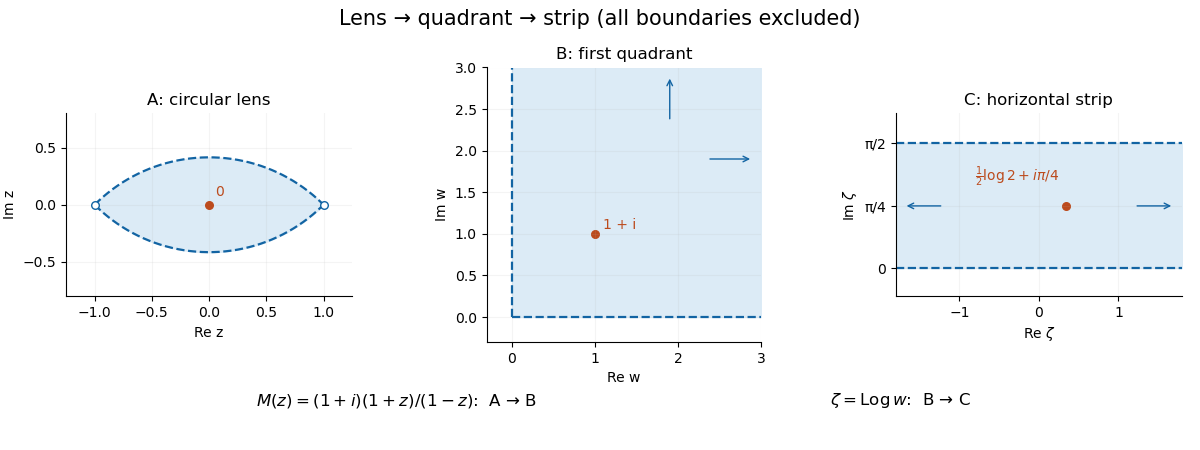

On the first quadrant choose the holomorphic logarithm with . It maps to , so its image is precisely the strip . Its inverse there is the exponential function; both derivatives are nonzero. Composing with part (i) givesThis is a bijective conformal map from the lens onto the strip, with inverseThe logarithm's branch is fixed by its argument range on the quadrant. Using a different branch would shift the strip vertically by an integer multiple of . This is the lens-to-strip logarithmic conformal map.
Articles by others on the same topic
There are currently no matching articles.