The first region is the lens around zero bounded by the two circular arcs through and . Writing , its inequalities combine to . The second region is the open first quadrant, and the third is the open horizontal strip between imaginary parts zero and .
Set . The inverse is , andHence the lens condition is exactly . Multiplying by gives real part and imaginary part , both positive exactly under that condition. Thereforeis a Möbius transformation mapping the lens bijectively to the first quadrant. Its pole at one lies on the boundary, and its inverse is , well-defined throughout the quadrant. The derivative never vanishes in the lens. This is a lens-to-quadrant Möbius map.
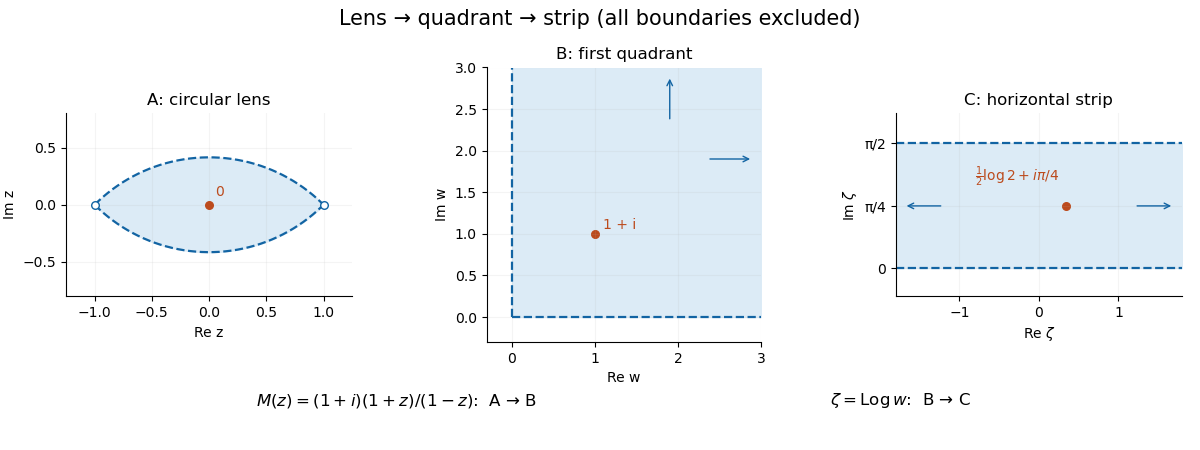

On the first quadrant choose the holomorphic logarithm with . It maps to , so its image is precisely the strip . Its inverse there is the exponential function; both derivatives are nonzero. Composing with part (i) givesThis is a bijective conformal map from the lens onto the strip, with inverseThe logarithm's branch is fixed by its argument range on the quadrant. Using a different branch would shift the strip vertically by an integer multiple of . This is the lens-to-strip logarithmic conformal map.
Articles by others on the same topic
There are currently no matching articles.