For a holomorphic map, conformality means preservation of oriented angles locally; it holds at every point of exactly when there. A Möbius transformation is with , extended to the Riemann sphere at its pole and at infinity.
For three distinct finite points definewhich sends to . If one point is infinite, take the corresponding limit: for use ; for use ; for use . Construct similarly. Then has the required three images.
For uniqueness, normalize any two proposed maps by these same transformations. Composing one normalized map with the inverse of the other fixes . A Möbius map fixing infinity has , one fixing zero then has , and fixing one forces up to the irrelevant common nonzero scalar. It is the identity. This proves sharp three-transitivity of Möbius transformations.
Treat a straight line together with infinity as a generalized circle on the Riemann sphere. Its finite points have a real equationTranslations and nonzero complex scalings preserve circles and lines. Under , multiplying the equation by givesagain the equation of a circle or line. Nondegeneracy is preserved because the reciprocal map is a bijection of the sphere. The zero and infinite points are interpreted there, rather than discarded when multiplying denominators.
Every Möbius map with factors asif it is already affine. Thus Möbius translation-scaling-inversion factorization and the reciprocal transformation of a generalized circle prove every generalized circle maps to another generalized circle. A circle becomes a line exactly when its image contains infinity, that is, when the original circle contains the map's pole.
The first region is the lens around zero bounded by the two circular arcs through and . Writing , its inequalities combine to . The second region is the open first quadrant, and the third is the open horizontal strip between imaginary parts zero and .
Set . The inverse is , andHence the lens condition is exactly . Multiplying by gives real part and imaginary part , both positive exactly under that condition. Thereforeis a Möbius transformation mapping the lens bijectively to the first quadrant. Its pole at one lies on the boundary, and its inverse is , well-defined throughout the quadrant. The derivative never vanishes in the lens. This is a lens-to-quadrant Möbius map.
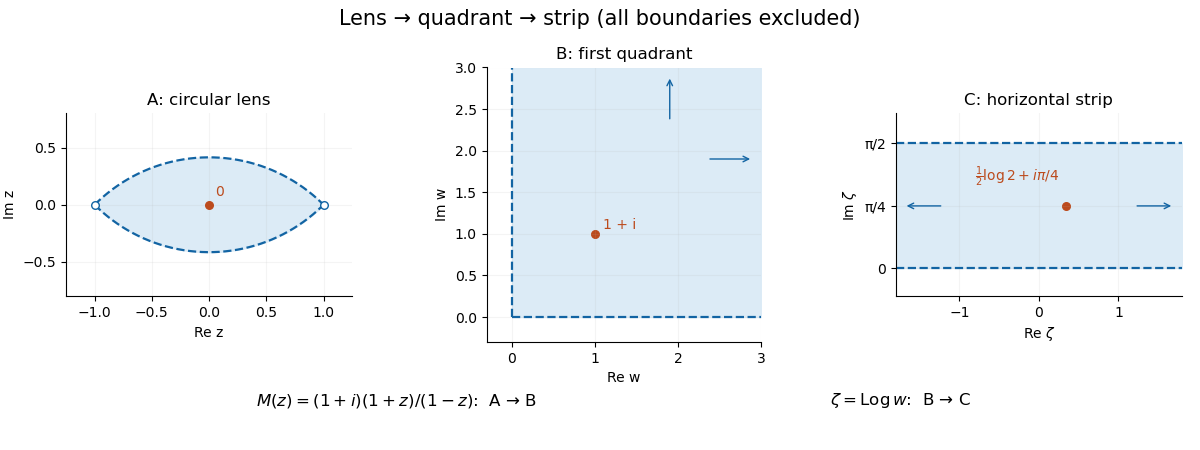

On the first quadrant choose the holomorphic logarithm with . It maps to , so its image is precisely the strip . Its inverse there is the exponential function; both derivatives are nonzero. Composing with part (i) givesThis is a bijective conformal map from the lens onto the strip, with inverseThe logarithm's branch is fixed by its argument range on the quadrant. Using a different branch would shift the strip vertically by an integer multiple of . This is the lens-to-strip logarithmic conformal map.
Articles by others on the same topic
There are currently no matching articles.