Start with the partial fraction decompositionFor , expand the first fraction in negative powers and the second in nonnegative powers using the geometric series:Thus the Laurent expansion on this annulus isFor , both fractions expand in negative powers:Combining the two geometric series givesThe coefficient is zero, consistently with the original rational function being at infinity. Each displayed series converges absolutely on its stated annulus and uniformly on every compact subset of that annulus.
The Liouville theorem states that every bounded entire function is constant.
By the Laurent theorem, has a unique Laurent series on . Split it intoHere is holomorphic on and is holomorphic on . To check their extended regions of convergence explicitly, fix and put . The Laurent coefficient formula givesThe first bound ensures convergence uniformly on every closed disk ; letting range up to covers . The second gives convergence uniformly on ; letting range down to covers . Locally uniform convergence of these power series, in and respectively, proves the claimed holomorphy. On the original annulus their sum is .
For uniqueness under this condition, suppose . Define on and on . The two definitions agree on the overlap, and their domains cover , so they define an entire function. Moreover, at infinity. It is bounded outside a large disk by this limit, and inside by continuity and the extreme value theorem. The Liouville theorem makes constant, and its limit makes that constant zero. Hence and . Without the limiting condition, adding a constant to and subtracting it from would preserve the decomposition.
Suppose were omitted by . Thenwould be an entire function. The reverse triangle inequality gives as , so there. On a sufficiently large closed disk, is bounded by continuity and the extreme value theorem; outside it, the limit gives a bound. The Liouville theorem therefore makes constant, and the limit forces .
Use the principal logarithm with , whose branch cut is the negative real axis. For this choice,has three simple poles away from the cut: , , and . The pole at , caused by , must be included.
Choose and , and use a positively oriented keyhole contour around the negative real axis: the large circle is traversed counterclockwise, the upper bank from to , the small circle clockwise, and the lower bank from to . Formally, use radial segments at arguments , then let with fixed. The function has continuous limiting values on each compact bank, which justifies this limit.
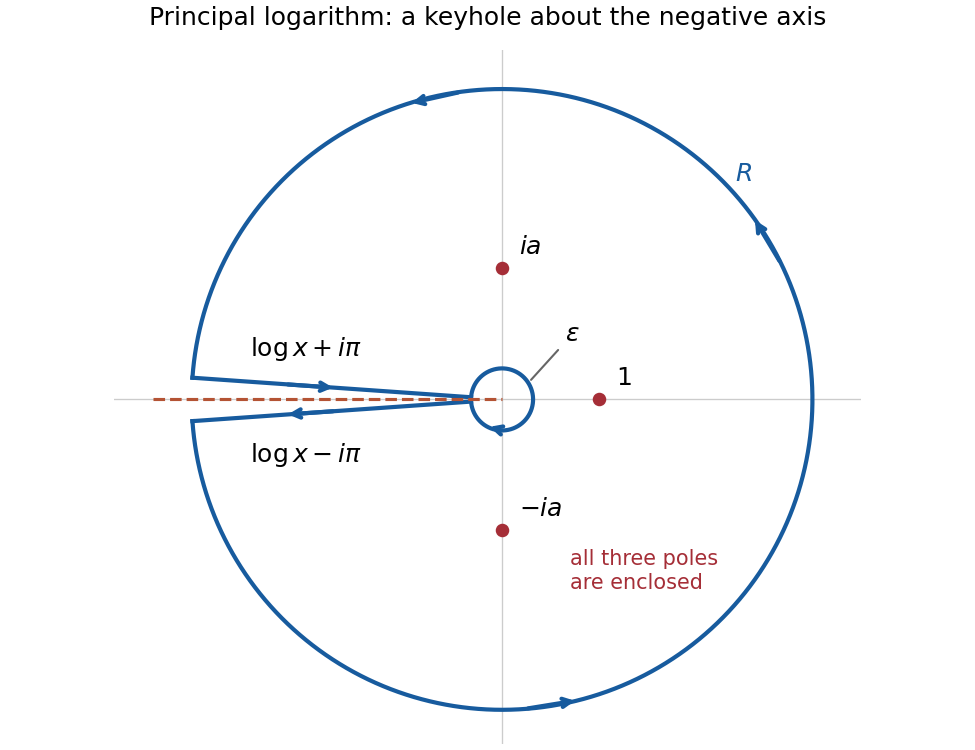

Put . The residues areThe first follows from ; the other two follow from the simple zeros of . Their sum isThese expressions are valid also for , since never vanish for real .
On the outer circle, for and . On the inner circle, and . Thus the estimation lemma bounds the two arc integrals byrespectively, as and .
On the upper bank, gives ; on the lower bank it gives . Accounting for the opposite orientations, their combined integral isThe real improper integral converges: its integrand is bounded near zero by and at infinity by . Taking the arc limits in the residue theorem gives , henceThe final subtraction is exactly the contribution of the pole at .
Articles by others on the same topic
There are currently no matching articles.