Solutions to all six questions of the University of Oxford Part A metric space and complex analysis paper, sat on 14 June 2021. Source: released examination PDF, compilation pages 54–58; paper pages 1–5. The examination counted the best four answers; all six are covered here. The printed request in 6(c)(i) is impossible for the stated planar domain: its solution proves this and gives the precise map obtained when the missing point at infinity is accounted for.
A metric space is a complete metric space if every Cauchy sequence in converges to a point of . Explicitly, the hypothesis isand the conclusion is that some satisfies .
It is a sequentially compact space if every sequence in has a convergent subsequence whose limit of a sequence belongs to .
It is a connected space if there are no disjoint nonempty open subsets of with . Here openness refers to the metric topology of .
It is a path-connected space if, for every , there is a continuous map with and . Such a map is a path. Every path-connected space is a connected space: a separation would pull back along a path joining its two sides to a separation of the interval .
The answers, in the order completeness, sequential compactness, connectedness, and path connectedness, areDefine and for . The estimate proves continuity at zero by the squeeze theorem; elsewhere it follows from the usual continuous functions. Thus is the graph of a function on the closed set .
To check closedness directly, if in the Euclidean plane, then and continuity gives . Therefore is a closed subset of the complete metric space , hence is a complete metric space. The sequence has no convergent subsequence, since its first Cartesian coordinates tends to infinity, so sequential compactness fails.
For any two points , the mapis a continuous path in joining them. Thus is path-connected, and consequently connected. The factor is crucial: the oscillations shrink to the single point .
The answers areDistinct natural numbers have . Taking in the Cauchy sequence condition forces every sufficiently late pair of terms to be equal. Every Cauchy sequence is therefore eventually constant and converges in , proving completeness.
The sequence has no convergent subsequence, since convergence would force its sufficiently late terms to lie within distance of its limit of a sequence, hence to equal that limit. Thus sequential compactness fails.
Every singleton is an open ball of radius , so the metric topology is the discrete topology. For example, and form a separation into two nonempty open sets, so is not connected. It is consequently not path-connected either.
The answers areWrite . The given metric describes locally uniform convergence: if and only if for every fixed . Indeed,so convergence in forces . Conversely, split the defining series at : its tail is at most , and its finitely many initial terms tend to zero.
If is a Cauchy sequence in , the same single-term estimate makes it a Cauchy sequence in the supremum norm on every . The completeness of the continuous-map space in the uniform metric gives a continuous function on with uniformly there. Uniqueness of the limit of a sequence gives , so these functions define a single continuous function on . The preceding finite-head and tail argument proves . Thus the space is complete.
The constant functions have whenever . They have no convergent subsequence, so the space is not sequentially compact.
For fixed , set . On ,as . The equivalence with locally uniform convergence proves that is a continuous path for . Hence the space is path-connected and connected.
The inverse tangent is a homeomorphism from the real line with its Euclidean metric onto with its subspace topology: and its inverse are continuous. It is also an isometry from onto , because . Consequently, for ,For a direct open ball interpretation, is -open by continuity of . Conversely, continuity of at supplies a sufficiently small -ball inside any prescribed -ball about . Thus both metrics generate exactly the same open sets.
The arctangent pullback metric is not complete. Take . Since , its transformed sequence is Cauchy, and hence is a Cauchy sequence for . If it converged in to , thenwould force , which is impossible. The missing endpoint of explains the failure of completeness, even though part (i) shows that the metric topologies agree.
Extend the coefficient lists of each polynomial by zeros. Then is finite because only finitely many terms are nonzero. It is nonnegative and symmetric. Moreover, holds exactly when every coefficient agrees, which by uniqueness of polynomial coefficients is equivalent to .
If , the triangle inequality for the absolute value givesThus satisfies all the metric axioms. It is the metric induced by the polynomial coefficient sum norm.
The space of polynomials is not complete for the supremum norm metric . ConsiderThe geometric series has sum , and for its tail satisfiesThus converges uniformly to and is a Cauchy sequence for .
There is no polynomial agreeing with on : otherwise the polynomial would vanish at infinitely many points and therefore be the zero polynomial. Evaluating this identity at gives . By uniqueness of the uniform limit, has no limit in . This proves the claimed failure of completeness.
For , the triangle inequality givesTaking the supremum proves . Hence convergence for implies convergence for .
The converse is false. For , take and . Its supremum norm is , whereas the binomial theorem givesThe alternating coefficients cancel on ; the polynomial coefficient sum norm measures their absolute values before any cancellation.
A norm on a real vector space is a map such that, for and ,The last property is the triangle inequality; the middle property is absolute homogeneity of a norm. The induced metric isPositivity and separation follow from the norm axioms, symmetry from absolute homogeneity of a norm with , and the triangle inequality from .
First verify that is a vector space. Sums and scalar multiples preserve continuity and the condition at zero. For every partition of an interval , the triangle inequality and absolute homogeneity of a norm of the absolute value implyTaking suprema yieldsFor the second equality follows directly from . In particular, finite variation is preserved, so is closed under these operations.
Nonnegativity is immediate. For any , use the partition of an interval , omitting repeated endpoints if necessary, to getThus forces , and conversely has zero total variation of a function. These observations prove that is a norm on .
Applying the same bound to givesTherefore convergence in the anchored variation norm implies uniform convergence on . The anchoring condition removes the nonzero constant functions which otherwise have zero total variation of a function.
Both properties are preserved by a continuous map.
For sequential compactness, take any sequence in and choose with . If is sequentially compact, some subsequence satisfies . By continuity, . Hence is a sequentially compact space.
For connectedness, suppose instead that is a separation into disjoint nonempty relatively open sets. Then and are disjoint nonempty open sets of whose union is , contradicting connectedness. Therefore is a connected space.
We prove uniform continuity by contradiction. If it fails, there is such that, for every , we can choose withBy sequential compactness, pass to a subsequence with . The triangle inequality givesBy continuity, both and converge to . A second triangle inequality therefore givescontradicting the lower bound. Thus the requested , independent of , exists for every .
We first show that a continuous injection must be surjective. Otherwise its image misses a point . Stereographic projection identifies with , giving a continuous injection . The extreme value theorem supplies distinct points where attains its minimum and maximum , with because is injective.
The two circular arcs from to each contain a point at which , by the intermediate value theorem. Those points are distinct because they lie in the disjoint interiors of the two arcs. This contradicts injectivity, proving the claim about .
Now suppose were a continuous injection. Its restriction to the equatorial circle would be a continuous injection from to itself, hence . The north pole is outside , but must equal for some . This contradicts injectivity. Therefore
Assume condition (1). For fixed , the supremumis nondecreasing as increases. Therefore its limit as exists in the extended real numbers and equals . Because , it is at least . Condition (1) says precisely that this limit is .
It follows that for every there is with . Fix and with . Taking produces an open ball on which . Thus is an open set, and its complementThis proves (1) implies (2). The property being characterized is upper semicontinuity.
Assume condition (2). Fix and . The superlevel setis a closed set and does not contain . Its complement is therefore an open neighbourhood of , so some open ball avoids . Consequently throughout that ball, givingThe same bound holds for every smaller radius. Taking and then yieldsTogether with the previous implication this proves the equivalence. A supremum may equal even when every individual value is strictly smaller; the non-strict estimate here handles that possibility.
If is continuous at , then for every there is such that implies . In particular, for ,The squeeze theorem giveswhich implies condition (1). Thus continuity implies upper semicontinuity.
Apply the local bound from condition (1) separately to and . For any and , there are such thatWith , both inequalities hold when , soThis is exactly continuity at . Since was arbitrary, is continuous on : upper semicontinuity of and of is equivalent to simultaneous upper semicontinuity and lower semicontinuity of .
The hyperbolic sine satisfies . The complex exponential function is entire, and sums and compositions of entire functions are entire. Therefore
The zeros of the hyperbolic sine are exactly , , since is equivalent to . Each zero is simple because . The quotient is therefore holomorphic precisely onAt zero, the Taylor expansion gives , so zero is a simple pole. At , the denominator has a double zero and the numerator is nonzero, giving a pole of order two. Thus none of the omitted points admits a holomorphic extension.
The denominator vanishes exactly when , namely at , . Its derivative there is , so each such zero is simple and the numerator does not cancel it. Henceand every omitted point is a simple pole.
Let . More generally, for a holomorphic function , the increment expansion at givesAlong real increments the first factor is , while along purely imaginary increments it is . Thus complex differentiability of requires . Conversely, if , the displayed expression tends to zero for arbitrary complex increments, so the complex derivative exists and equals zero.
For , this condition is , equivalent to . ConsequentlyThese points form a discrete subset of the complex plane and contain no nonempty open set. Every neighbourhood of each one contains points where is not complex differentiable. Therefore is holomorphic on no nonempty open set, even though it has complex derivatives at the specified points.
The identity theorem states that if two holomorphic functions on a connected open set agree at a sequence of distinct points with an accumulation point inside that set, then they agree everywhere on it. Equivalently, the zeros of a holomorphic function which is not identically zero cannot accumulate inside its domain.
Because never vanish, their logarithmic derivatives are holomorphic. The holomorphic functionvanishes at every . Since the distinct converge to , the identity theorem gives . Applying the quotient rule now givesA holomorphic function with zero derivative on a domain is constant. One can see this locally from its Taylor series, then propagate the constant using connectedness. Hence on , with , andThe conclusion can fail if the accumulation occurs outside . Take the punctured complex plane andBoth functions are nowhere vanishing and holomorphic on , and . The chain rule givesso these logarithmic derivatives agree at every . However, is not constant: for example and . Therefore no constant gives .
On the slit domain , choose the complex argument . The resulting holomorphic logarithm is , with . DefineIt is holomorphic as a composition of holomorphic functions, and . At the chosen argument is , so .
Suppose a holomorphic square root existed on the whole punctured complex plane. It would be nonzero, and differentiating would give . There are several ways to express the resulting obstruction; a direct one uses the unit circle. SetThe chain rule and imply , so is constant. ButThese cannot agree because . Thus no such global holomorphic square root exists. Going once around zero changes the sign of the locally chosen root.
The Cauchy derivative formula says that if is holomorphic on a neighbourhood of a closed disk and is inside its positively oriented boundary circle , then for ,For this is the Cauchy integral formula. The same formula holds for a positively oriented simple closed contour when is holomorphic on a neighbourhood of the contour and its enclosed region.
In the present problem the unit circle and its closed interior lie inside . Parametrize it by , , so . For a positive integer ,The first contour integral is zero by the Cauchy integral theorem, since is holomorphic on the disk; the second is evaluated by the Cauchy derivative formula. ThereforeTaking gives the requested .
The expression is , which is holomorphic for every . At zero,has infinitely many nonzero negative-power terms, so it has an essential singularity. Multiplication by the nonvanishing entire function preserves that classification: if had a removable singularity or a pole, multiplying by would give the same type for , a contradiction. Hence
The only possible finite singularities are , the zeros of . They are simple zeros of the denominator, because its derivative is nonzero. They are also simple zeros of the numerator: and .
The common simple factors cancel, so both points are removable singularities, with extension valuesThere are no other finite singularities; after inserting these two values the function is entire.
For , the denominator vanishes exactly when . Thus setEach denominator zero is simple, sinceEvery is purely imaginary and nonzero. The identity for real shows , so there is no cancellation. Each is consequently a simple pole, with residue .
These poles accumulate at zero. ThereforeIn particular, zero has no punctured neighbourhood on which the function is holomorphic, so it cannot be classified as a removable singularity, a pole, or an isolated essential singularity. There are no other finite singularities.
For , integratealong the contour consisting of and the upper semicircle, with positive orientation of a contour and . Its enclosed simple poles are and , with residuesOn the upper semicircle, . The reverse triangle inequality gives and , so the estimation lemma givesThe integral along the real axis is absolutely convergent: the denominator stays nonzero on bounded real intervals, and the integrand is at infinity. The residue theorem therefore givesTake real parts. The real integrand is an even function, so
To include , fix and let . For , the absolute value of the integrand is bounded byan integrable function on . The dominated convergence theorem justifies passing the limit under the integral. If , then , andHence
Start with the partial fraction decompositionFor , expand the first fraction in negative powers and the second in nonnegative powers using the geometric series:Thus the Laurent expansion on this annulus isFor , both fractions expand in negative powers:Combining the two geometric series givesThe coefficient is zero, consistently with the original rational function being at infinity. Each displayed series converges absolutely on its stated annulus and uniformly on every compact subset of that annulus.
The Liouville theorem states that every bounded entire function is constant.
By the Laurent theorem, has a unique Laurent series on . Split it intoHere is holomorphic on and is holomorphic on . To check their extended regions of convergence explicitly, fix and put . The Laurent coefficient formula givesThe first bound ensures convergence uniformly on every closed disk ; letting range up to covers . The second gives convergence uniformly on ; letting range down to covers . Locally uniform convergence of these power series, in and respectively, proves the claimed holomorphy. On the original annulus their sum is .
For uniqueness under this condition, suppose . Define on and on . The two definitions agree on the overlap, and their domains cover , so they define an entire function. Moreover, at infinity. It is bounded outside a large disk by this limit, and inside by continuity and the extreme value theorem. The Liouville theorem makes constant, and its limit makes that constant zero. Hence and . Without the limiting condition, adding a constant to and subtracting it from would preserve the decomposition.
Suppose were omitted by . Thenwould be an entire function. The reverse triangle inequality gives as , so there. On a sufficiently large closed disk, is bounded by continuity and the extreme value theorem; outside it, the limit gives a bound. The Liouville theorem therefore makes constant, and the limit forces .
Use the principal logarithm with , whose branch cut is the negative real axis. For this choice,has three simple poles away from the cut: , , and . The pole at , caused by , must be included.
Choose and , and use a positively oriented keyhole contour around the negative real axis: the large circle is traversed counterclockwise, the upper bank from to , the small circle clockwise, and the lower bank from to . Formally, use radial segments at arguments , then let with fixed. The function has continuous limiting values on each compact bank, which justifies this limit.
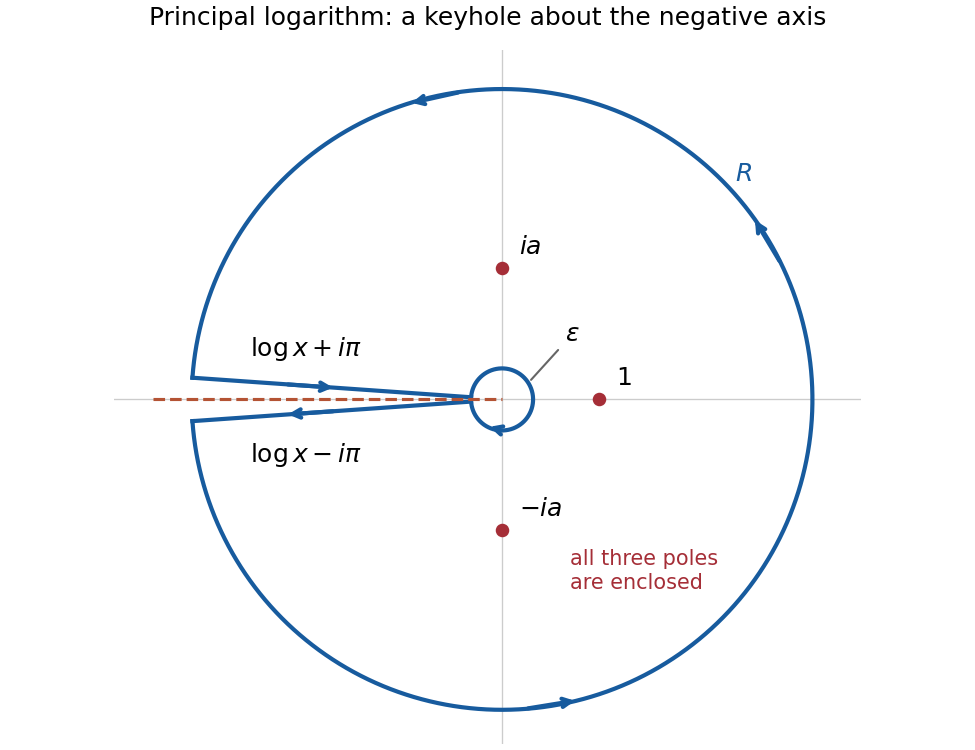
Put . The residues areThe first follows from ; the other two follow from the simple zeros of . Their sum isThese expressions are valid also for , since never vanish for real .
On the outer circle, for and . On the inner circle, and . Thus the estimation lemma bounds the two arc integrals byrespectively, as and .
On the upper bank, gives ; on the lower bank it gives . Accounting for the opposite orientations, their combined integral isThe real improper integral converges: its integrand is bounded near zero by and at infinity by . Taking the arc limits in the residue theorem gives , henceThe final subtraction is exactly the contribution of the pole at .
The Riemann mapping theorem gives a conformal bijection exactly whengiven the hypothesis that is a simply connected domain. A domain is nonempty, open, and connected, so no extra nonemptiness qualification is needed.
For necessity, a conformal bijection would be a bounded nonconstant entire function, contradicting the Liouville theorem. For sufficiency, is a proper simply connected domain, exactly the hypothesis of the Riemann mapping theorem.
Use the univalent functions on , namely the univalent functions . Each has nonzero derivative, so its image is a domain conformally equivalent to , and is therefore simply connected. This image is proper: otherwise would be a bounded nonconstant entire function, contrary to the Liouville theorem.
Conversely, every proper simply connected domain is for some such , by taking the inverse of a Riemann mapping theorem bijection. Thus these functions parameterize all proper simply connected domains by their images. The complex plane itself is the exceptional simply connected domain and must be listed separately.
The parameterization has redundancy: two univalent functions have the same image if and only if for an automorphism of the unit disk . All such automorphisms have the formIf an interior point is prescribed, the normalization and real removes this redundancy. Equivalently one can describe these maps through their convergent Taylor series on , imposing univalence on the resulting holomorphic functions.
Write . For real and , the denominator cannot vanish: if its zero is real, and if then . Taking the imaginary part after multiplying by givesThus . Alsoso it is conformal. Cross-multiplication shows that implies , proving injectivity.
The inverse Möbius transformation isIts coefficients are real and its determinant is again , so the same imaginary part identity shows that it maps into . Therefore every has a preimage in , proving surjectivity. Hence maps one-to-one and onto itself.
The prescribed pole lets us choose and . Write . Fixing and givesso and . ThusIts determinant is , so it is a genuine Möbius transformation. Direct substitution gives , , and a pole at ; the numerator at that pole is .
To identify the image of the unit disc, putThen , , andIn particular, its pole is outside the closed unit disc. The identityshows . For any , solve to getIts denominator is nonzero, and the same modulus identity for this inverse gives . Thus , and global injectivity of a Möbius transformation proves the required one-to-one correspondence.
There is no such map for the domain printed in the paper. The planar domain is not simply connected. For example, a sufficiently large positively oriented circle surrounds and lies in , whileThe integrand is holomorphic on . If were simply connected, the Cauchy integral theorem would force this integral to be zero. A conformal bijection is a homeomorphism and preserves simple connectivity, whereas is simply connected. Thus a conformal bijection is impossible.
The explicit construction also pinpoints the missing point. DefineThis Möbius transformation sends the removed line segment to the nonpositive real axis, together with infinity. More precisely, its image on the stated planar domain issince has no finite solution when . Conversely, its inverse is defined for every in this set and cannot lie on , proving this image description exactly.
Take the principal square root of , characterized by positive real part, and then multiply by . The result is the conformal mapEach stage is injective and onto the indicated image; the square root maps the slit plane to the right half-plane, with the point omitted here. Hence this is a conformal bijection onto the punctured upper half-plane. Its inverse isIf the source is instead on the Riemann sphere, the same map extends with and becomes a conformal bijection onto all of . Indeed, in the local coordinate it has expansion , whose derivative at is nonzero. This gives the sphere version of the requested construction without silently changing the printed planar domain.
Use the same principal square root , which is holomorphic on because its argument avoids the nonpositive real axis. Thenis a holomorphic function satisfyingThus it is a holomorphic branch of the requested square root. This construction does not require a global holomorphic logarithm of or separately. Its sign is fixed by at infinity, so . The negative of this function is the other holomorphic branch; any two branches have a continuous quotient taking values in , which is constant because is connected.
The two boundary circles meet at : subtracting their equations gives , and either equation then gives . Send these points to zero and infinity by the Möbius transformationThe point is on the boundary, so is holomorphic throughout . Write . Substituting the inverse gives the exact equivalencesThusThere is no missing point from the inverse here: lies outside this sector. The image is therefore exactly the stated sector, rather than merely a subset of it.
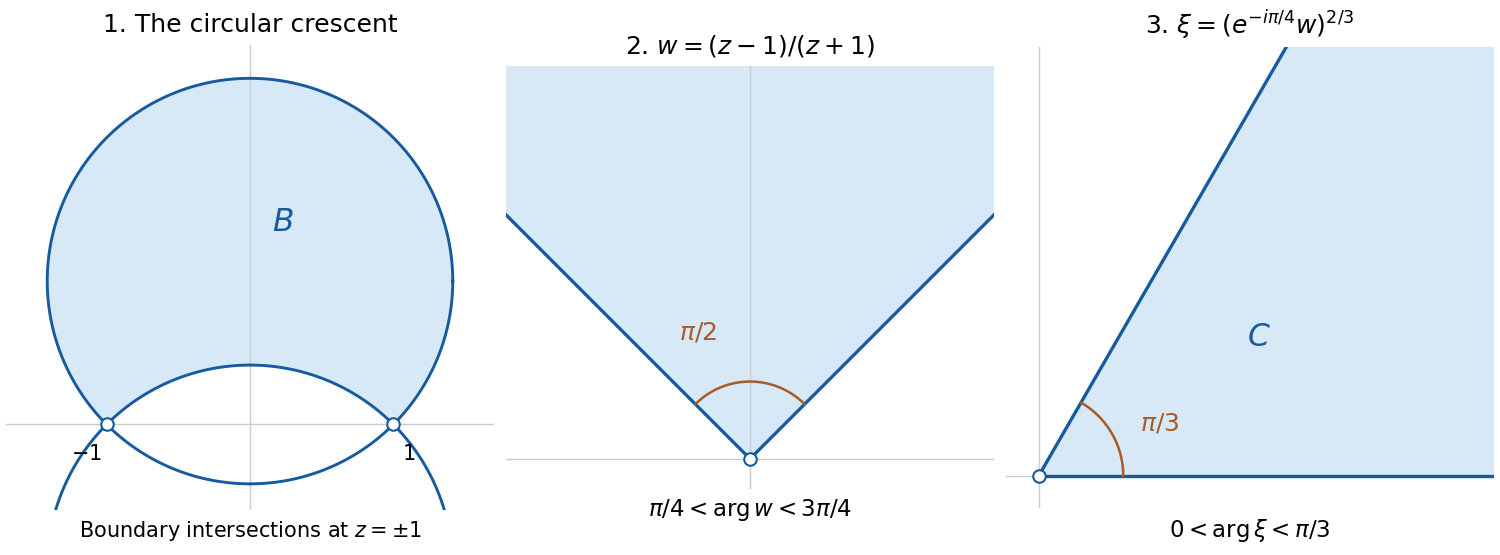


Rotate by to obtain the first quadrant, and take the power using its holomorphic logarithm with . The required map isHere the principal logarithm works because the expression inside it lies in the first quadrant. It multiplies its argument by , giving , and maps its modulus to , which ranges over all positive real numbers.
For explicit surjectivity and injectivity, given with , definewhere uses . Then , so and , and these are inverse operations. Each stage is holomorphic with nonzero derivative, proving that is the requested conformal bijection.
Articles by others on the same topic
There are currently no matching articles.