Self-assembly is organization of interacting building blocks into a larger structure without individually placing every component. Static self-assembly approaches an equilibrium free-energy minimum under fixed conditions; a resulting structure may subsequently become kinetically trapped. Dynamic self-assembly maintains a nonequilibrium organized state through continuing energy or matter throughput and dissipation, and can change or disappear when that drive is removed.
For nanofabrication, parallel assembly of many small components can generate fine periodicity, hierarchical structures and adaptive or self-repairing arrangements with limited direct patterning. Building-block chemistry encodes interactions. However, access to a desired morphology depends on kinetics and competing states; assembly does not automatically eliminate defects or provide arbitrary device geometry.
Relevant interactions include van der Waals attraction, electrostatic attraction or screened repulsion, hydrogen bonding, and hydrophobic/solvophobic association. Coordination bonding, magnetic dipole interactions and capillary forces can also organize suitable building blocks. Entropic effects, including depletion attraction and packing entropy, can drive ordering even without a new chemical bond. Which contribution favours assembly depends on solvent, temperature, concentration and surface chemistry; the complete balance is a free-energy change, not a requirement that every interaction be attractive.
Consider a colloidal photonic crystal assembled from nearly monodisperse dielectric spheres. Spherical geometry and approximately isotropic interactions favour close-packed arrays, although fcc, hcp and stacking-disordered structures can compete. Sphere diameter sets the periodic optical length scale. For an ideal close-packed fcc array,at normal incidence in the simple effective-index picture. Thus changing the building-block size tunes the reflected wavelength; refractive-index contrast affects stop-band strength. Surface charge and screening control colloidal stability and rearrangement during assembly, while polydispersity, roughness and stacking defects broaden the optical response and increase scattering.
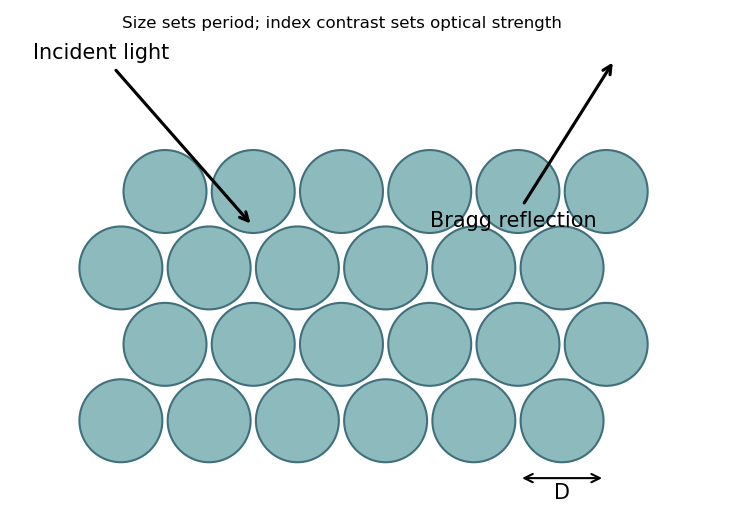

This connects sphere-level geometry and material response to collective periodic optical behaviour. The Bragg reflection estimate does not establish a complete three-dimensional photonic band gap.
Articles by others on the same topic
There are currently no matching articles.