A thermoelectric generator uses the Seebeck effect: a maintained temperature difference across suitable conductors produces an open-circuit electromotive force. For a pair of legs,when the effective Seebeck coefficient is approximately constant. Repeated p- and n-type legs are usually connected electrically in series and thermally in parallel.
Connecting a load lets part of the heat flowing from the hot side to the cold side become electrical power. Both a heat source and a cold-side heat-removal path are necessary: a uniformly warm device with no maintained temperature difference supplies no sustained output. Internal electrical resistance, heat leakage, contact losses and the finite temperature difference reduce the harvested power; the converter is a heat engine rather than a source of energy from temperature alone.
Use a Thévenin equivalent: an ideal voltage source in series with the internal resistance , driving the load .
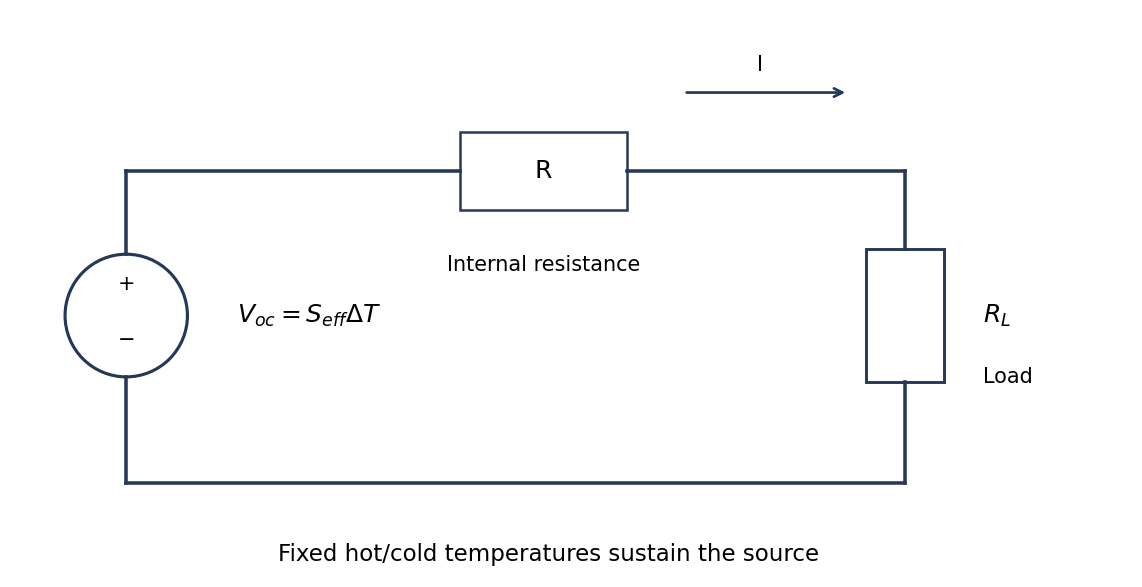
Original fixed-temperature-difference equivalent circuit of a thermoelectric generator, with internal and load resistances distinguished
. Details. 
The same current flows through both resistances, . The load terminal voltage is , smaller than the open-circuit voltage. The electrical battery symbol represents the maintained thermoelectric source under this model; heat input is still required.
At fixed temperature difference and constant internal resistance,Differentiation givesIt is positive below and negative above it, while power vanishes for an open or shorted load. Therefore the maximum power transfer theorem givesAt this point and half the electromotive force drops across the load. Maximum electrical power is not generally maximum thermal-conversion efficiency. If changing current also changes the temperature difference because the thermal source has finite impedance, the fixed- optimization must be reconsidered.
Articles by others on the same topic
There are currently no matching articles.