In contact-mode atomic force microscopy, a sharp tip on a compliant cantilever remains in contact with the surface while a feedback loop controls its normal deflection. A laser reflected from the cantilever onto a position-sensitive detector converts bending into an electrical error signal. With calibrated deflection and stiffness , the normal force is approximately under the stated contact convention.
A piezoelectric scanner raster-scans the sample or tip. The controller adjusts vertical position to maintain the chosen deflection setpoint; that vertical displacement is recorded as topography. The right panel of the microscopy diagram identifies tip, cantilever, optical deflection readout, controller and vertical actuator.
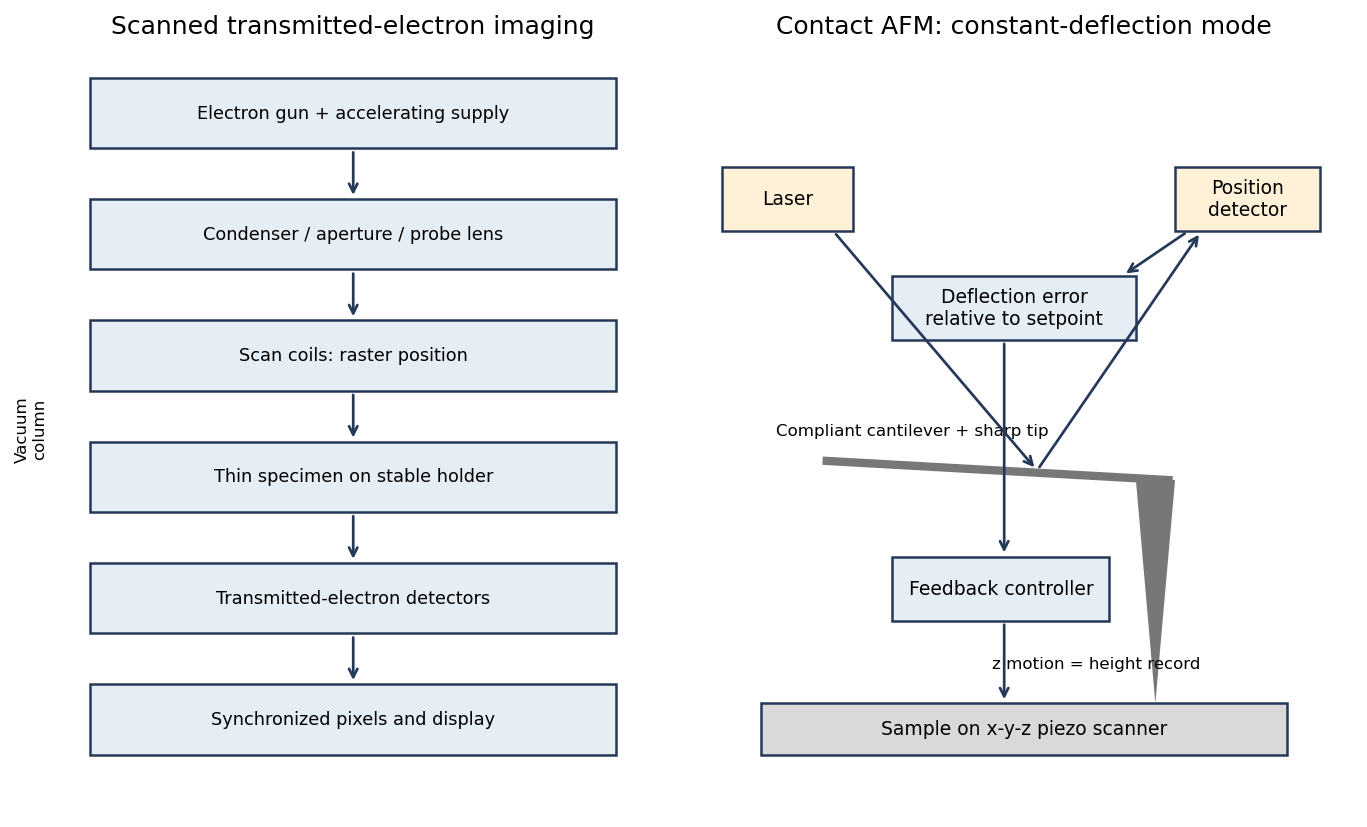
Original instrument diagrams; the right panel shows contact-mode atomic force microscopy and the recorded vertical feedback signal
. Details. 
The result is a probe-accessible surface, affected by finite tip shape, sample deformation, adhesion and feedback bandwidth. Lateral friction can distort or damage a soft surface, so constant deflection is not a guarantee of unchanged specimen structure.
Four useful interactions are dispersion attraction, electrostatic interaction, capillary attraction and short-range repulsion. Their ranges are relative to atomic contact and depend on geometry and environment.
Van der Waals forces provide an attractive contribution extending beyond direct atomic overlap; for an ideal sphere and plane it scales as in a simple nonretarded model. Electrostatic forces can also be long-ranged: biased conducting surfaces are commonly attractive, whereas charged insulating surfaces can attract or repel depending on their charge and screening.
A capillary meniscus in humid air can pull tip and sample together. It acts over the formation and rupture range of the liquid bridge and can greatly exceed atomically localized forces; it is not a universal interaction in a dry vacuum. At the shortest separations, overlap-related Pauli repulsion provides a steep repulsive contact contribution.
Atomic-scale contact contrast relies on strongly localized short-range tip–surface forces, especially the rapidly varying repulsive interaction in the simple contact-mode picture. Long-range attraction mainly adds a background. Real atomic-resolution imaging also depends on apex structure, stability and operating mode; a generic long-range force alone does not resolve individual surface atoms.
For a polymer curve parameterized by contour distance , let be its unit tangent. The persistence length is the characteristic contour distance over which tangent orientations lose correlation. In the usual three-dimensional worm-like chain convention,where is the bending stiffness. Segments much shorter than look approximately straight; a much longer chain can contain many statistically distinct orientations.
A surface image can be traced to estimate tangent correlations as a function of contour separation, after accounting for tracing resolution and substrate effects. A strictly equilibrated two-dimensional chain has a different relation between bending stiffness and correlation decay length from the three-dimensional convention. The definition must therefore state whether the surface preserves a projected conformation or allows in-plane equilibration. This is a statement about statistical filament mechanics; biological interpretation is deferred.
Interpret the stipulated model as a freely jointed chain with independent, isotropically oriented segments of length . With end-to-end vector , cross terms vanish on averaging:Using only the model's supplied segment size and count givesThe mean vector is zero, not the mean magnitude. In the three-dimensional large- Gaussian chain limit,Thus the common root-mean-square interpretation of an average chain size is , while the mean scalar distance is about . The contour length is a different quantity. A count of links between positions changes these estimates by less than .
These are results of the explicitly idealized statistical chain, not a prediction about the conformation or persistence length of an actual biological molecule. TODO (user-deferred biology): material-specific biological interpretation of that model.
A thermoelectric generator uses the Seebeck effect: a maintained temperature difference across suitable conductors produces an open-circuit electromotive force. For a pair of legs,when the effective Seebeck coefficient is approximately constant. Repeated p- and n-type legs are usually connected electrically in series and thermally in parallel.
Connecting a load lets part of the heat flowing from the hot side to the cold side become electrical power. Both a heat source and a cold-side heat-removal path are necessary: a uniformly warm device with no maintained temperature difference supplies no sustained output. Internal electrical resistance, heat leakage, contact losses and the finite temperature difference reduce the harvested power; the converter is a heat engine rather than a source of energy from temperature alone.
Use a Thévenin equivalent: an ideal voltage source in series with the internal resistance , driving the load .
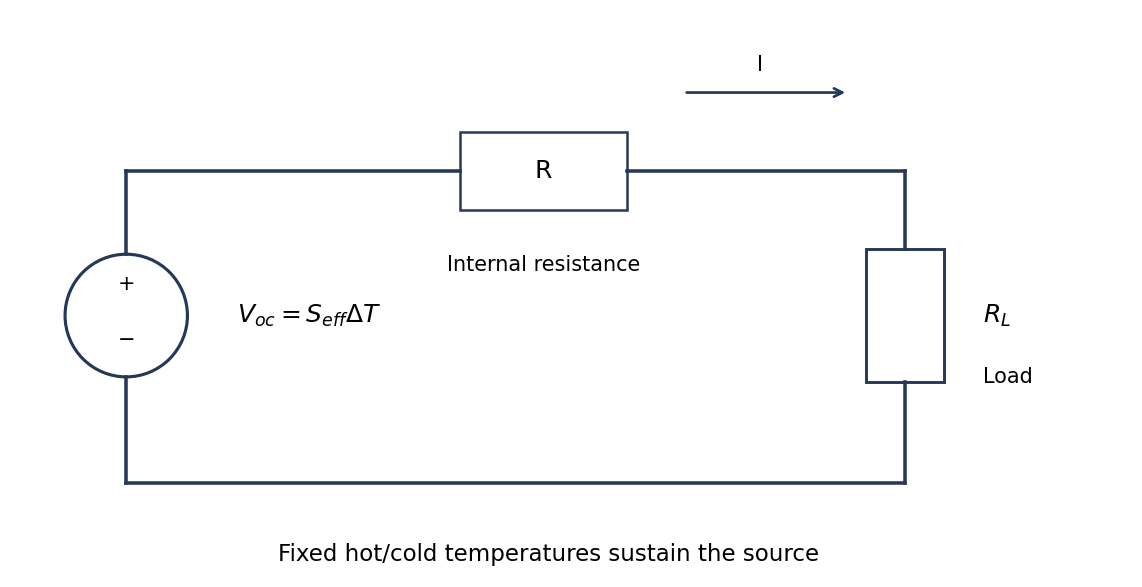
Original fixed-temperature-difference equivalent circuit of a thermoelectric generator, with internal and load resistances distinguished
. Details. 
The same current flows through both resistances, . The load terminal voltage is , smaller than the open-circuit voltage. The electrical battery symbol represents the maintained thermoelectric source under this model; heat input is still required.
At fixed temperature difference and constant internal resistance,Differentiation givesIt is positive below and negative above it, while power vanishes for an open or shorted load. Therefore the maximum power transfer theorem givesAt this point and half the electromotive force drops across the load. Maximum electrical power is not generally maximum thermal-conversion efficiency. If changing current also changes the temperature difference because the thermal source has finite impedance, the fixed- optimization must be reconsidered.
Articles by others on the same topic
There are currently no matching articles.