The Seebeck effect is the generation of a thermoelectric electromotive force by a temperature difference. In a thermocouple, two different homogeneous electrical conductors A and B connect a measuring junction at to two reference connections at a common . With negligible electric current, the measured terminal voltage is determined by the difference of their Seebeck coefficients. A hot junction alone does not specify the reading: the reference temperature, the second material, and the terminal order matter.
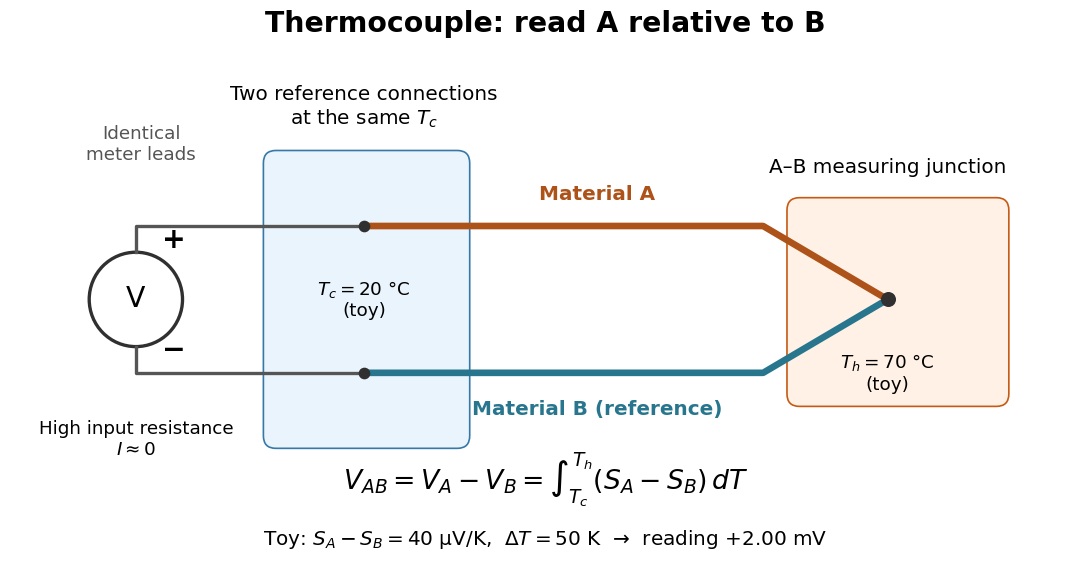

For a motivating experiment, join one end of A to one end of B, insulating the wires elsewhere. Connect their free ends to identical meter leads at reference temperature , for example in an ice-water heat bath. A meter with input electrical resistance much larger than the thermocouple's electrical resistance approximates an open circuit, meaning . Keep the measuring junction in a separately controlled heat bath at and wait for stable junction temperatures. Both reference connections must share ; identical leads with identical endpoint temperatures have cancelling thermoelectric contributions, allowing the meter to be elsewhere. [ref]
https://www.nist.gov/system/files/documents/director/planning/report97-1.pdf. Marx, Link and Scott, Economic Assessment of the NIST Thermocouple Calibration Program (1997), §2.1
.Define the reading as , with the positive input on the A reference terminal and the negative input on B. Use the Seebeck coefficient convention in which the voltage change along a homogeneous wire at zero electric current is . Following the path from A at to the common junction at , then back along B to , givesThis formula assumes homogeneous materials whose Seebeck coefficients depend only on the local temperature, and no additional uncompensated lead contributions. Here voltage is the electrical transport voltage associated with electrochemical potential, rather than a direct measurement of an isolated equilibrium contact electric potential.
Start with , then increase while holding fixed and record at each stable setting. In the ideal model the equal-temperature reading is zero. If throughout the interval, A reads positive when . Exchanging meter inputs reverses the reading; exchanging the two junction temperatures reverses the oriented integral. Repeating the run with identical homogeneous materials gives zero because . These controls test the stated model; a nonzero experimental baseline should be measured rather than silently removed by assuming it is zero.
For an explicitly toy linear example, stipulate constant Seebeck coefficients and . Choose reference temperature and measuring-junction temperature . A temperature difference has the same numerical size in kelvins and on the degree Celsius scale, soSwapping the inputs gives . Bringing both junction regions to the same temperature gives zero. With temperature-dependent Seebeck coefficients, shifting both junction temperatures equally while keeping their difference fixed can change the reading. No actual material pair is claimed to have the stipulated coefficients over this interval.
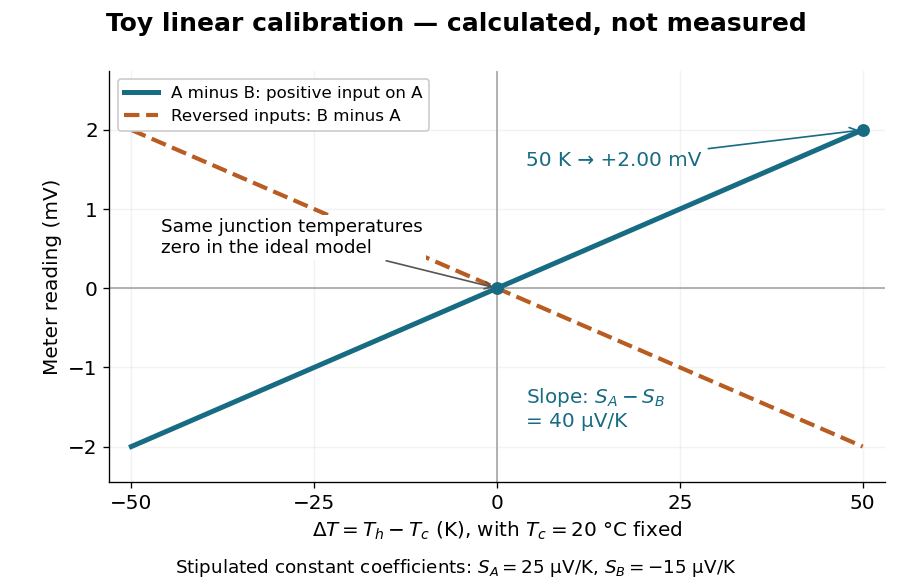

Real thermocouples need a calibrated voltage-versus-temperature relation: the constant-Seebeck coefficient approximation is useful only where the coefficient difference changes little. Wire inhomogeneity can make the result depend on where the temperature gradient lies, and reference connections at unequal or unknown temperatures introduce errors. An electronic reference correction uses a measured reference temperature in place of an ice bath. [ref]
https://www.nist.gov/system/files/documents/director/planning/report97-1.pdf. Marx, Link and Scott (1997), §2.1: reference correction and wire homogeneity
. Burns and colleagues provide the standardized reference functions for common letter-designated thermocouple types; the toy line above is not a replacement for them. [ref]https://www.nist.gov/publications/temperature-electromotive-force-reference-functions-and-tables-letter-designated. Burns et al., Temperature-electromotive force reference functions and tables (1993), NIST Monograph 175
.The historical experiment used a different detector. In his 1821–1823 investigations, Seebeck found that a closed electrical circuit of two dissimilar materials with junctions at different temperatures deflected a compass needle. The modern explanation is that thermoelectric electromotive force drives an electric current, whose magnetic field deflects the needle. The open-circuit experiment above detects voltage while drawing negligible electric current. The striking connection is that a thermal imbalance can become an electrical signal and then a magnetic response. [ref]
https://thermoelectrics.matsci.northwestern.edu/thermoelectrics/history.html. Northwestern thermoelectrics research group: Seebeck's compass experiment
. Articles by others on the same topic
There are currently no matching articles.