Above-gap photon absorption generates electrons and electron holes. A p-n junction's built-in field and carrier diffusion direct them toward selective contacts; their nonequilibrium populations can maintain separated quasi-Fermi levels and deliver electrical power. The equilibrium built-in voltage alone is not a battery supplying continuous power.
Choose diode current positive into the cell. An idealized characteristic isIllumination shifts the curve downward. At short circuit ; at open circuit . Between those points, and , so the delivered power is positive.
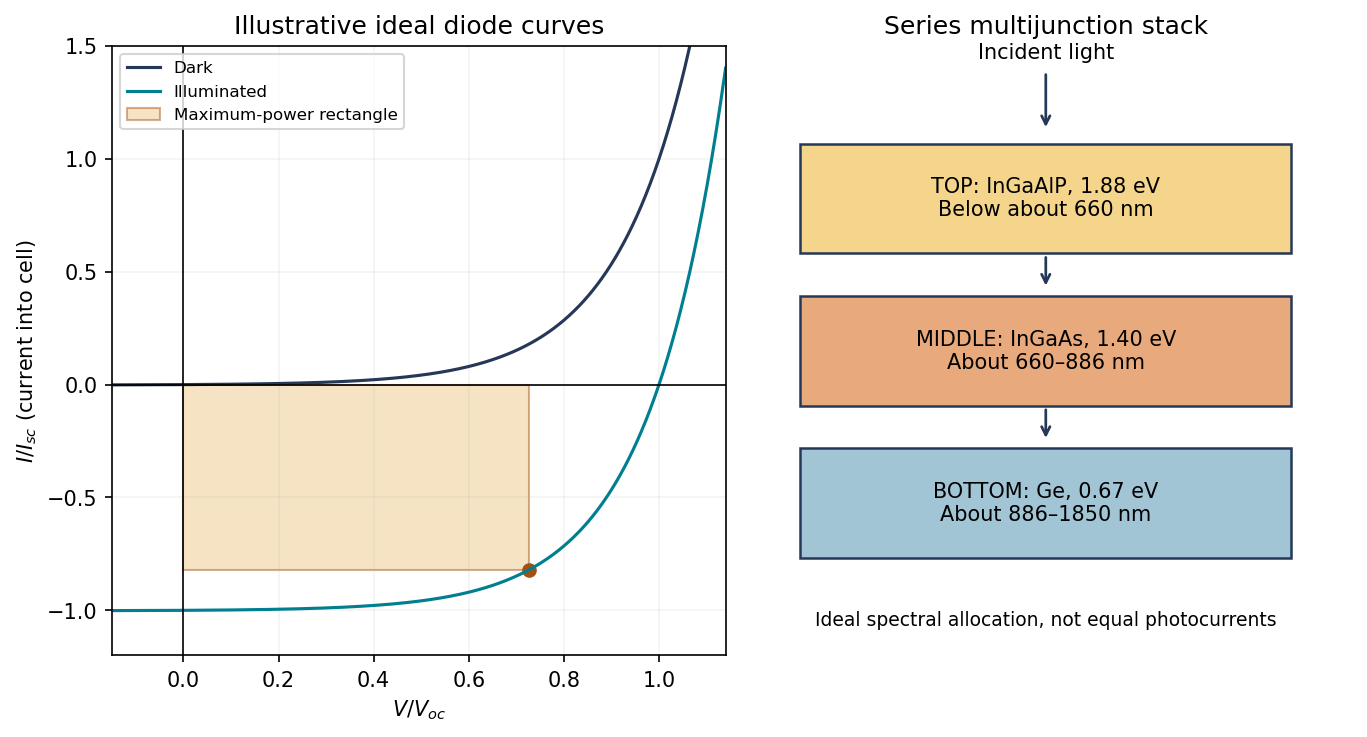
Original idealized photovoltaic current–voltage curves and the descending-bandgap order of the proposed three-junction stack
. Details. 
The solar-cell fill factor compares maximum delivered power with the open/short-circuit rectangle:Series resistance, leakage, recombination and temperature change the shape and hence the fill factor. Neither the short-circuit nor the open-circuit point itself delivers power.
The useful bandgap depends on the illumination spectrum, not only on whether the device is indoors or outdoors. The stipulated gap gives a long-wavelength absorption threshold near ; gives about using in nanometers.
Outdoor sunlight contains substantial visible and near-infrared power, so cadmium telluride can use a broader portion of that spectrum while retaining a useful output voltage. Its direct-gap absorption permits thin absorbers and large-area thin-film manufacture. Challenges include contacts and interfaces, collection and recombination, material supply and managing cadmium-containing material through fabrication and end-of-life handling.
Many indoor lamps concentrate their emission in the visible and provide little near-infrared power. A wider-gap absorber can then trade fewer lost useful photons for a higher attainable voltage and a smaller thermal dark-current penalty. Hydrogenated amorphous silicon has strong visible absorption, permits low-temperature large-area deposition and can suit low-power indoor devices. Disorder and defects restrict transport, and light-induced degradation and passivation stability must be controlled. Its larger gap forfeits more of the outdoor red/near-infrared spectrum.
These are suitability arguments, not guaranteed efficiencies. Indoor lamp spectra differ, and shunt leakage and recombination become particularly important at low light. Bandgap alone does not establish which finished device produces more power in every room.
For a monolithic series-connected multi-junction solar cell, all junctions carry the same terminal current, so a weakly illuminated junction limits the useful series current. Adjust absorber thicknesses, compositions and optical coupling to balance collected photocurrent. Tunnel interconnects provide electrical continuity; low-loss contacts and interfaces also matter. Equal incident energy in each spectral band would not guarantee equal current, because photon counts and collection efficiencies differ.
Put the largest bandgap at the illuminated top and the smallest at the bottom:The top absorber captures high-energy photons while transmitting lower-energy photons to the subsequent layers. Placing germanium first would absorb photons that the higher-gap cells could use at higher voltage.
The absorption edges are approximatelyFor ideal sharp, complete absorption without reflection, the available plotted spectral bands are therefore the visible region below for the top cell, – for the middle cell, and – for germanium. Photons beyond pass all three ideal absorbers. The source plot begins around , so it does not supply an ultraviolet integral below that point.
Using coarse readings of the provided curve, the band integrals are of order , and in plotted-ordinate-units times nanometers, respectively. These are only approximate areas under a low-resolution graph, not calibrated radiances in SI units: the ordinate gives no physical unit or spectral normalization. The robust result is the band allocation; precise photocurrent matching needs a calibrated spectrum and each junction's external quantum efficiency,Thus the diagram and band boundaries establish the intended stack, while the plot cannot justify precise watt-per-area or current values.
Articles by others on the same topic
There are currently no matching articles.