In selective-area epitaxy, precursors supplied by metal-organic vapour-phase epitaxy incorporate on exposed crystalline InP through patterned openings in a silicon-nitride mask. Epitaxial facet-dependent incorporation and surface diffusion select axial and radial growth rates. Advantages include lithographic position and pitch control, an epitaxial orientation relationship and the absence of a foreign metal catalyst. Limitations include mask patterning, selective nucleation requirements, facet-dependent composition, loading and pitch effects, and unwanted radial growth.
In vapour-liquid-solid growth, precursors decompose and supply material to a liquid catalyst droplet; supersaturation drives precipitation at the liquid-solid interface. Droplet size can control wire diameter and enable high aspect ratios. Limitations include possible catalyst contamination, droplet stability and coarsening, composition memory at heterointerfaces, and restrictions from the catalyst phase diagram. Patterned catalyst placement can also control position, so positional ordering is not exclusive to selective-area growth. Conversely, selective-area wires are not automatically free of taper or compositional interfaces.[ref]
Efficient Green Emission from Wurtzite AlInP Nanowires by L. Gagliano and others. Selective-area growth and composition-dependent nanowire structure
The emission energies are approximatelyDraw the Al-rich interface as a wider-gap barrier between these two emitting regions: a raised conduction-band edge impedes electron transfer, and a lowered valence-band edge impedes hole transfer. The following is a consistent straddling-barrier schematic, with the shell having the smaller optical gap.
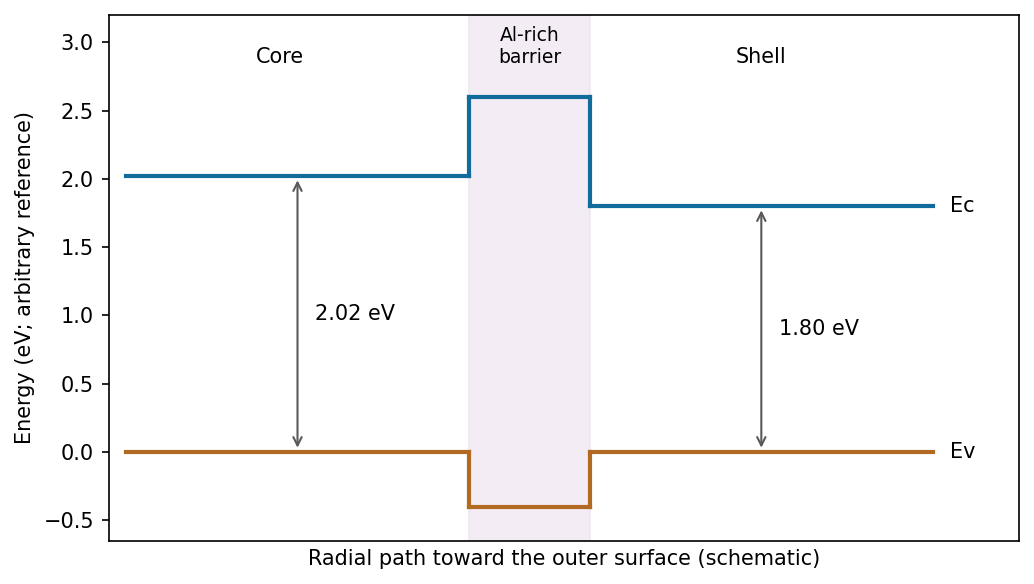
One consistent core–Al-rich-interface–shell alignment; absolute offsets are not fixed by the emission wavelengths
. Source. Details. 
The two emission wavelengths determine optical transition energies, not unique conduction- and valence-band offsets. Exciton binding, confinement and strain can shift emission relative to the bulk band gap. The stated barrier supports inhibited charge exchange; its separate electron and hole barrier heights need additional band-alignment data.
Place the Ag particles near the emitting shell, along the outer sidewalls or accessible shell at the base. Its emission is close to the localized surface plasmon resonance; the core emission is more detuned and farther from an externally placed particle. The plasmon near field decays with distance, so the local emitter-field overlap matters as well as spectral overlap. A thin spacer can reduce direct-contact nonradiative quenching.
Articles by others on the same topic
There are currently no matching articles.