A spin valve contains a magnetically soft free ferromagnet, a thin nonmagnetic metallic spacer and a reference ferromagnet pinned by exchange bias from an antiferromagnet. The recording track's stray field rotates or reverses the free-layer moment while the reference remains approximately fixed. Spin-dependent scattering makes the resistance lower for parallel moments and higher for antiparallel moments. A sense current converts this into a voltage signal, or a fixed voltage into a current signal.
A useful angular approximation is . Biasing the equilibrium moments near gives an approximately linear response to small track fields. Pinning stability, magnetic shielding and the sensor's spatial extent matter for reading adjacent narrow bits.[ref]
For collinear saturated layers, , where . Thus parallel states have and , whereas antiparallel states have and . The free layer switches in the smaller-field interval; the reference layer switches only at larger fields and its loop is shifted by exchange bias.
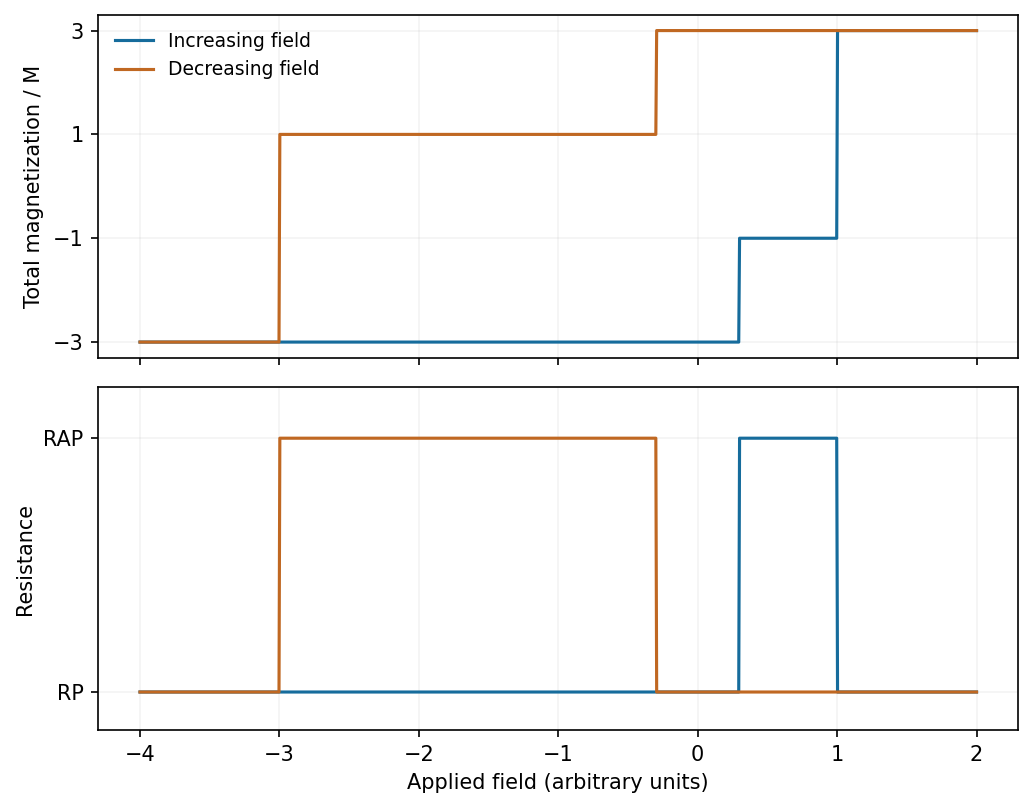
Illustrative major magnetization and resistance loops, with an exchange-shifted reference-layer reversal
. Source. Details. 
The plotted switching fields are illustrative rather than supplied measurements. In the normal read-head minor-loop range, the reference stays positive and only the pair is sampled. Rotational reversal and domain formation can round these ideal abrupt steps.
Spin-valve read-head noise limits the field-to-electrical response: sensitivity is a response relative to noise, not merely a large total resistance. A small free-layer volume gives larger thermally driven angular fluctuations and can lose magnetic stability when its anisotropy barrier is insufficient compared with . Edge damage, stray coupling to the reference layer, nonuniform domains and Barkhausen jumps cause hysteresis and noise. Johnson noise and low-frequency resistance noise compete with a limited GMR signal; raising sense current is restricted by heating and current-induced disturbance.
One useful design combines a single-domain, gently biased free layer with a flux-compensated synthetic-antiferromagnetic reference. This reduces reference stray fields, suppresses unstable domain switching and holds the free layer near a linear operating point. The active sensing width can remain small while magnetic and electrical design preserve adequate stability and signal. An alternative is a magnetic tunnel junction with an optimized barrier, giving a larger magnetoresistance signal; its resistance-area product, shot noise and barrier reliability still require optimization. Shrinking every magnetic dimension indefinitely is not a sensitivity improvement.
[ref]
Giant room-temperature magnetoresistance in Fe-MgO-Fe junctions by Shinji Yuasa and others. Demonstration of large tunnel magnetoresistance with a crystalline MgO barrier
Articles by others on the same topic
There are currently no matching articles.