A physical bound-state wave function must be single-valued, finite, square-integrable and normalizable. Across a finite step in a regular potential, both and its first derivative are continuous when the particle mass is the same on either side; integrate the Schrödinger equation across an infinitesimal interval to obtain the derivative condition. The second derivative need not be continuous.
An infinite hard wall is an exception to derivative matching: the interior wave function vanishes at the boundary, but its derivative need not equal the exterior zero derivative. A delta-function potential also permits a prescribed derivative jump, and an effective-mass interface requires the appropriate mass-weighted matching condition. Thus ordinary finite-step conditions should not be asserted without qualification for every singular potential.
The wave function vanishes in regions I and III. In region II it is sinusoidal and satisfies . The time-independent equation there isA nonzero stationary state therefore has standing-wave nodes at the two walls; it cannot have a nonzero constant ground-state wave function.
For , write with . The condition at zero gives ; the condition at gives , where . The solution is identically zero and is not a state. Normalization gives . HenceChoosing positive fixes an irrelevant overall phase.
Only have . The printed squared coefficients sum to , rather than exactly one. Normalizing those numbers givesTreating the coefficients as rounded values of an already normalized state gives the intended approximately answer. Probabilities are sums of squared amplitudes because the energy eigenstates are orthonormal.
Let and . For the time-independent well,It remains zero outside the well. Each expansion coefficient acquires a phase of unit magnitude, so every energy probability, including the preceding , is time-independent. The position probability density generally changes because cross terms between different energies oscillate.
The measured energy selects . Immediately after an ideal projective measurement, the normalized state is up to an overall phase, with no surviving components. At later times before any further disturbance it is , where is the measurement time. A repeated energy measurement returns with probability one.
A spin valve contains a magnetically soft free ferromagnet, a thin nonmagnetic metallic spacer and a reference ferromagnet pinned by exchange bias from an antiferromagnet. The recording track's stray field rotates or reverses the free-layer moment while the reference remains approximately fixed. Spin-dependent scattering makes the resistance lower for parallel moments and higher for antiparallel moments. A sense current converts this into a voltage signal, or a fixed voltage into a current signal.
A useful angular approximation is . Biasing the equilibrium moments near gives an approximately linear response to small track fields. Pinning stability, magnetic shielding and the sensor's spatial extent matter for reading adjacent narrow bits.[ref]
For collinear saturated layers, , where . Thus parallel states have and , whereas antiparallel states have and . The free layer switches in the smaller-field interval; the reference layer switches only at larger fields and its loop is shifted by exchange bias.
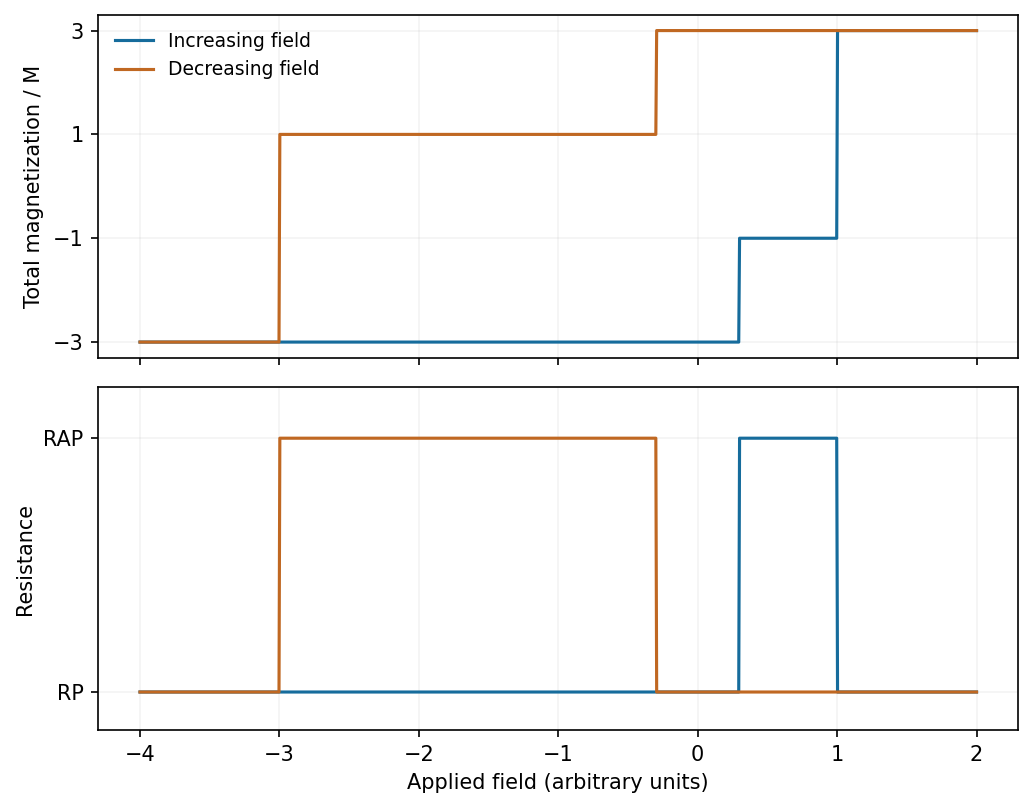
Illustrative major magnetization and resistance loops, with an exchange-shifted reference-layer reversal
. Source. Details. 
The plotted switching fields are illustrative rather than supplied measurements. In the normal read-head minor-loop range, the reference stays positive and only the pair is sampled. Rotational reversal and domain formation can round these ideal abrupt steps.
Spin-valve read-head noise limits the field-to-electrical response: sensitivity is a response relative to noise, not merely a large total resistance. A small free-layer volume gives larger thermally driven angular fluctuations and can lose magnetic stability when its anisotropy barrier is insufficient compared with . Edge damage, stray coupling to the reference layer, nonuniform domains and Barkhausen jumps cause hysteresis and noise. Johnson noise and low-frequency resistance noise compete with a limited GMR signal; raising sense current is restricted by heating and current-induced disturbance.
One useful design combines a single-domain, gently biased free layer with a flux-compensated synthetic-antiferromagnetic reference. This reduces reference stray fields, suppresses unstable domain switching and holds the free layer near a linear operating point. The active sensing width can remain small while magnetic and electrical design preserve adequate stability and signal. An alternative is a magnetic tunnel junction with an optimized barrier, giving a larger magnetoresistance signal; its resistance-area product, shot noise and barrier reliability still require optimization. Shrinking every magnetic dimension indefinitely is not a sensitivity improvement.
[ref]
Giant room-temperature magnetoresistance in Fe-MgO-Fe junctions by Shinji Yuasa and others. Demonstration of large tunnel magnetoresistance with a crystalline MgO barrier
Articles by others on the same topic
There are currently no matching articles.