A carbon-containing feed adsorbs and decomposes on a catalytic metal particle, releasing mobile carbon. Carbon can migrate over the surface and/or through the particle, depending on catalyst, temperature and feedstock. Supersaturation and graphitic nucleation generate a curved cap; nonhexagonal rings provide the curvature needed to close its end. Continued carbon incorporation at the cap rim lifts or extends the cap into a tube while leaving a growth interface at the catalyst.
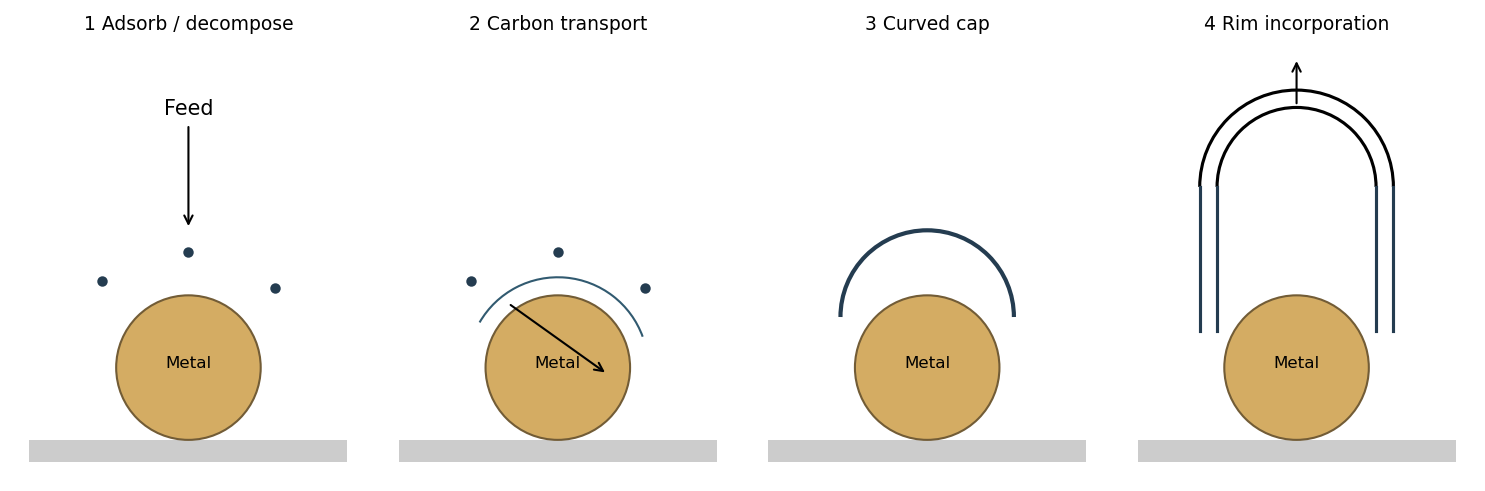

With strong catalyst-support adhesion the particle remains at the base; with weaker adhesion it can lift with the growing tube. Several shells can nucleate and extend to form a multiwall tube. Continued growth requires access to active catalyst sites: encapsulation by an impermeable carbon coating can terminate it. The catalyst need not be liquid in every chemical vapour deposition growth mechanism, and bulk dissolution is not the only possible carbon-transport route.
Articles by others on the same topic
There are currently no matching articles.