This is a multi-walled carbon nanotube with a hollow interior and approximately concentric graphitic shells running along its axis. The walls show many resolved (002) fringes: a relatively straight section supports an approximate count of 16 shells, with some uncertainty from contrast and overlapping/terminated fringes. The tube is not a uniform straight cylinder: the inner channel narrows and changes direction, walls kink and curve, and some inner fringes terminate or join a partly closed internal region. The rough outer boundary contains disordered carbon or incomplete outer layers. The high-contrast material below the tube should not simply be counted as additional concentric shells.
Bending, incomplete walls and changes of atomic bonding scatter charge carriers and can mix shells, reducing the mean free path and causing extra resistance or localization. Covalent intershell links can also increase transfer between shells. Nonhexagonal rings or vacancies are plausible atomic causes, but this image does not resolve a unique ring inventory or prove a specific Stone-Wales defect. Different shell chiralities can intrinsically give different metallic or semiconducting behaviour; a (002) image alone does not assign those chiralities.
For a graphene honeycomb with C-C bond length , a primitive cell has two atoms and area . Its areal atomic density isFor the nanotube atom-count estimate, treat each shell as a graphene cylinder. The atoms per axial length areUsing the fringe spacing as an internal ruler gives representative estimates , and , consistent with radial spacings of . ThenThe meaningful estimate is of order atoms per nm, not an exact count. It assumes nearly complete cylindrical shells, uses projected dimensions in a reasonably straight segment, and neglects defects, corrugation and extra external carbon. Image uncertainty in wall count and diameter changes the estimate by tens of percent; no external scale bar is available in this figure.
A carbon-containing feed adsorbs and decomposes on a catalytic metal particle, releasing mobile carbon. Carbon can migrate over the surface and/or through the particle, depending on catalyst, temperature and feedstock. Supersaturation and graphitic nucleation generate a curved cap; nonhexagonal rings provide the curvature needed to close its end. Continued carbon incorporation at the cap rim lifts or extends the cap into a tube while leaving a growth interface at the catalyst.
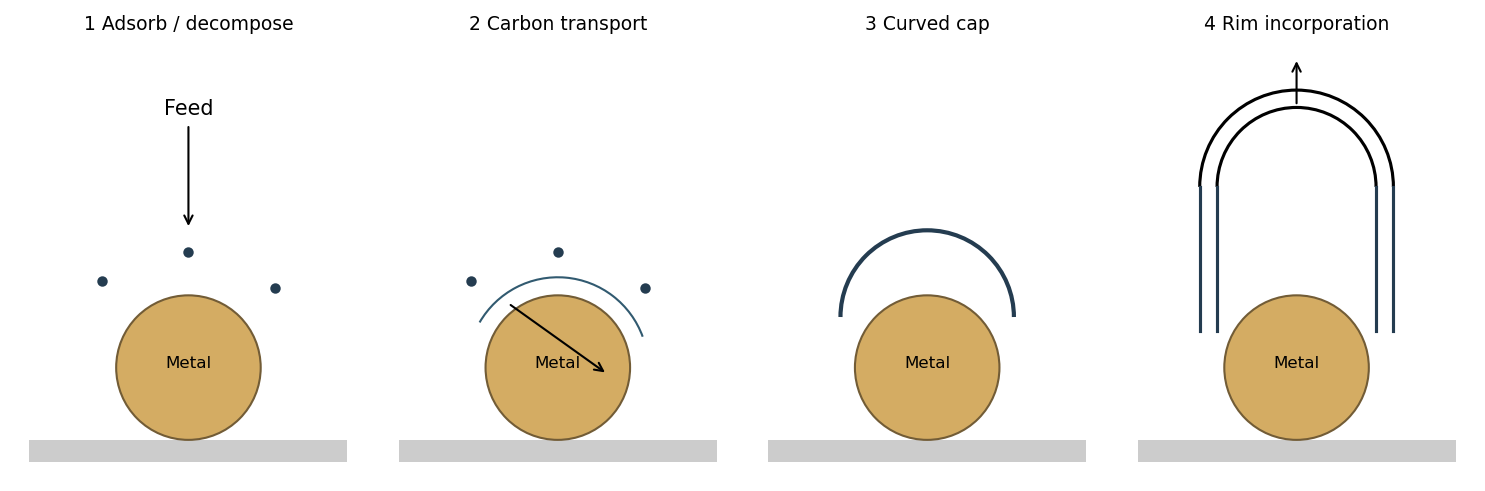

With strong catalyst-support adhesion the particle remains at the base; with weaker adhesion it can lift with the growing tube. Several shells can nucleate and extend to form a multiwall tube. Continued growth requires access to active catalyst sites: encapsulation by an impermeable carbon coating can terminate it. The catalyst need not be liquid in every chemical vapour deposition growth mechanism, and bulk dissolution is not the only possible carbon-transport route.
Let the graphene lattice constant be , and choose direct primitive vectors and . Reciprocal primitive vectors satisfying areThe first Brillouin zone is a hexagon. Its corners K and K' are inequivalent valleys; M denotes an edge midpoint. In the nearest-neighbour model, , where and are the three bond vectors. The band separation is : it vanishes at K/K' and is at M, varying continuously along each edge.
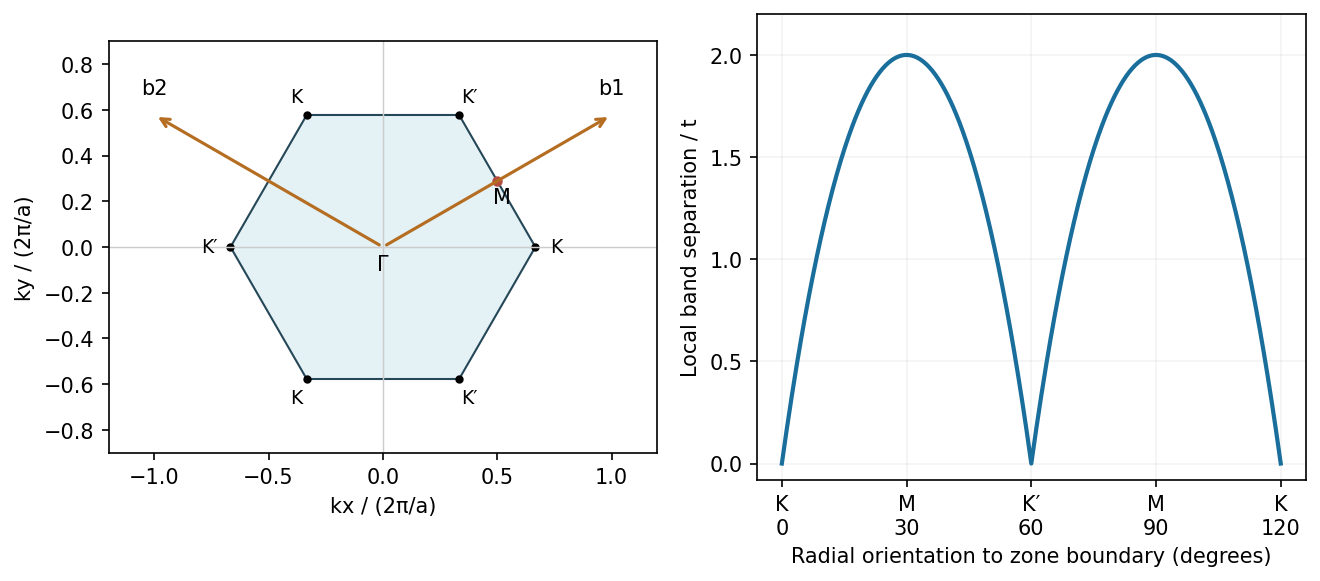
Graphene reciprocal primitive vectors and the orientation-dependent band separation on its zone boundary
. Source. Details. 
This graphene zone-boundary band separation is a local conduction-to-valence separation. Ideal graphene itself remains globally gapless because the bands touch at the corners. Circumferential quantization in a nanotube selects lines through this two-dimensional band structure; whether they pass through a valley determines the ideal metallic versus semiconducting distinction.
Articles by others on the same topic
There are currently no matching articles.