A conventional capacitor stores separated electronic charge across a dielectric, with capacitance set approximately by . An electric double-layer capacitor stores charge at the interface between a porous electronic conductor and an ionic electrolyte. Electrolyte counterions screen charge on the electrode over a very small interfacial separation, and a porous electrode provides a large accessible area. The separator prevents an electronic short while permitting ionic transport; the two electrode interfaces form series capacitances.
Pseudocapacitance is charge storage by fast, reversible Faradaic processes that give a capacitor-like relation between stored charge and potential over a useful range. Examples include surface redox and suitably rapid insertion processes. It is distinct from purely electrostatic double-layer charging. Merely observing a redox peak does not establish pseudocapacitive behaviour: a slow two-phase battery reaction can remain battery-like even when its electrode is nanostructured.
For constant current and nearly constant capacitance,An ideal supercapacitor therefore has approximately linear charge and discharge ramps, making a triangular voltage–time trace. Series resistance adds an immediate voltage step when current starts and a step of magnitude when it reverses directly from to . Leakage and voltage-dependent capacitance introduce curvature.
A secondary battery instead follows electrode chemical potentials as its state of charge changes; many chemistries have broad plateaus or sloping plateaus, with polarization separating the charge and discharge curves. This distinction is typical rather than universal: some batteries have steeply sloping profiles, while strongly potential-dependent pseudocapacitive materials can depart substantially from a triangle.
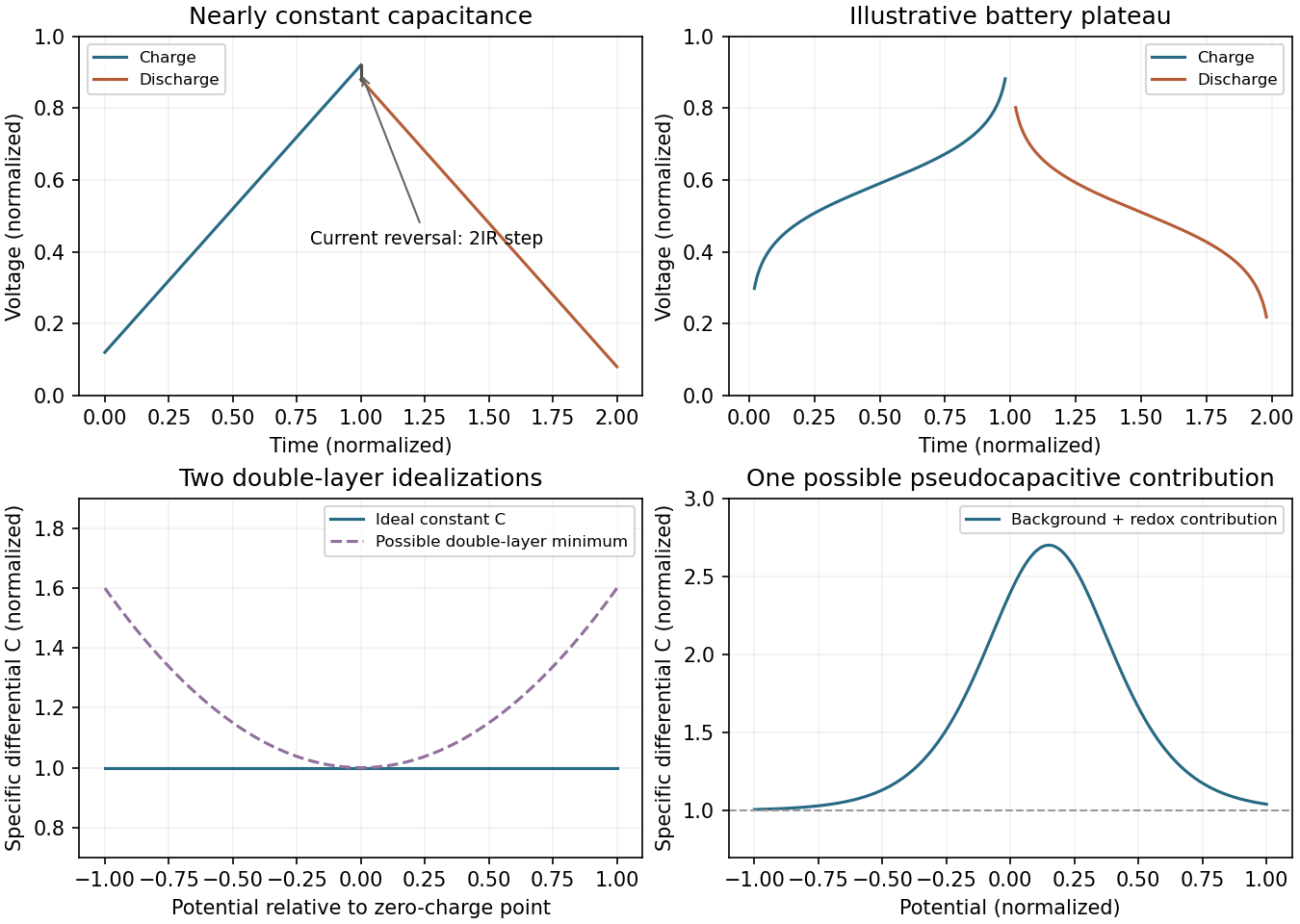
Idealized supercapacitor and battery responses, with capacitance–potential alternatives
. Original schematic curves; the lower panels distinguish a constant differential capacitance, a double-layer minimum and a localized redox contribution. They are alternative models, not a universal measured curve. Details.
Define mass-specific differential capacitance, or specific capacitance, byState whether is one electrode's active mass, both electrodes' active mass or the entire device mass; these conventions are not interchangeable. An average capacitance inferred from a finite voltage interval is and need not equal the local derivative.
A nearly ideal double-layer supercapacitor has an approximately flat capacitance over its stable operating window, so stored charge rises nearly linearly with potential. Real electrodes need not be flat: dilute-electrolyte double-layer models can give a minimum near the potential of zero charge, while concentrated electrolytes, finite ion size and pore confinement can produce bell-shaped or double-peaked curves. Pseudocapacitance can add broad potential-dependent contributions near a redox transition. The sketch above therefore labels several possible behaviours instead of asserting a universal monotonic trend. Constant-potential simulations have directly found transitions between double-peaked and bell-shaped differential-capacitance curves as interfacial interactions change.[ref]
Porous carbon emphasizes power and cycle life. Activated carbon, graphene-derived structures and nanotubes can provide high accessible area, electronic conduction and relatively reversible double-layer charging. Cost and stability can be favourable. However, inaccessible micropores, tortuous ionic paths, poor packing density and surface functional groups can reduce useful rate performance or volumetric energy density. Area measured by gas adsorption is not automatically accessible to electrolyte ions.
Metal oxides can add substantial redox charge storage. A suitable oxide offers high pseudocapacitance, but its electronic conductivity, ion-transport distance and electrochemical stability can limit power. Some high-performing compositions are expensive or contain scarce elements. Structural changes and dissolution can shorten life. Conductive composites and thin active layers help, but adding inactive support dilutes device-level energy storage.
Conducting polymers combine redox activity with electronic conduction and flexible processing. Their oxidation state and counterion population change during charging. Repeated ion and solvent uptake causes swelling and shrinkage, which can crack or delaminate an electrode and shorten cycle life. Conductivity is also state-dependent, and potential windows are constrained by overoxidation or reduction. A practical comparison must include both electrodes, electrolyte, packaging and the usable voltage: makes voltage stability as important as a large gravimetric capacitance.
Articles by others on the same topic
There are currently no matching articles.