Use consistent units for the Gibbs free energy:Then givesThis is a dimensionless thermodynamic equilibrium constant defined through activities. For an ideal dilute association, the numerical concentration association constant is about when concentrations use the standard state. Both favourable enthalpy and positive entropy favour association here; association need not always have a negative entropy change because solvent release can outweigh the loss of translational freedom.
Cyclodextrins are truncated-cone-shaped hosts that form host–guest complexes. Their hydroxyl-rich exterior interacts favourably with water, while the internal cavity is relatively nonpolar and can accommodate a suitably sized organic guest. The six-, seven- and eight-unit rings have different cavity sizes, so shape and size selectivity matter. Binding can involve London dispersion forces, displacement of cavity water and changes in solvation; no covalent modification of the guest is necessary.
An odorous organic guest can be included in the cavity, decreasing its free concentration and hence its tendency to enter the vapour phase. The same inclusion chemistry can increase the apparent aqueous solubility of a poorly soluble compound, and reversible association allows release when conditions or concentrations change. In a separation, guests with different association constants partition differently between free and bound states; a suitably immobilized host can therefore act as a selective stationary phase.
The unifying mechanism is reversible molecular inclusion in a size-selective cavity. These are chemical explanations of binding and partitioning. Biological action, therapeutic efficacy and physiological delivery mechanisms are outside the present nonbiology scope.
The gas-phase attraction is a cation–π interaction. The positively charged ion interacts with benzene's electron distribution and polarizes the aromatic molecule. An orientation above the ring face allows stabilization without a conventional covalent bond. A modest association constant reflects the balance of that attraction against the entropy cost of joining two independent species, at the stated gas-phase standard state.
In water, a small ion such as is strongly solvated. Forming a direct benzene complex requires rearranging or losing favourable ion–water contacts; benzene is also solvated, and the solvent screens electrostatic interactions. The relevant solution free energy therefore includes desolvation and solvent reorganization, not just the attractive energy of the isolated pair. The gas-phase association constant cannot be transferred to water without changing this thermodynamic cycle and the standard states. The interaction is not forbidden in solution, but it need not give appreciable direct complexation under the specified conditions.
The receptor is a triazolophane with a relatively rigid central cavity. Its inward-facing triazole and phenylene C–H groups act cooperatively as hydrogen bond donors to an anion. The supplied preference is , so it is not a simple ranking by charge density or basicity.
Chloride has the best fit for several favourable C–H···anion contacts simultaneously; bromide is close enough in size to retain strong binding. Fluoride is too small to engage the whole donor array optimally, and its desolvation penalty can further oppose binding in solution. Iodide is too large for the cavity and cannot sit in the same favourable geometry. Molecular preorganization reduces the conformational penalty for binding a matched guest, but makes the cavity less adaptable to mismatched ones.
The exact solvent is not specified in this question, so a quantitative hydration argument would be unwarranted. The structure and observed nonmonotonic order support size complementarity plus cooperative C–H hydrogen bonding, with solvation modifying the measured constants. The original receptor study experimentally demonstrated halide size selectivity and tunability through the phenylene substituents.[ref]
Size-selective halide binding by Yongjun Li and Amar H. Flood. 2008, halide-binding investigations and cavity-size comparison
Take unit activity of each dissolved metal ion, unit activity of each metal, and . The hydrogen-electrode Nernst equation givesThus at pH 1 and at pH 14. For corrosion coupled to hydrogen evolution,For alkaline solution the same electron balance can be written , before allowing for metal-ion hydrolysis or complexation. Using for zinc and lead, and for lithium, the results per mole of metal areLithium is strongly unstable against hydrogen evolution in both media in this model. The positive alkaline values for zinc and lead apply to the stipulated unit-activity free-ion products; they are not complete predictions of alkaline corrosion once hydroxide precipitation and complexation change the product chemical potentials.
A useful aqueous anode must deliver the desired oxidation current while limiting parasitic corrosion and hydrogen evolution. Thermodynamics sets the driving force, while activation overpotential, surface films and mass transport control the rate.
For zinc, the acid calculation favours dissolution with hydrogen evolution, but a substantial kinetic barrier to hydrogen evolution on a clean zinc surface can slow this loss. Impurities and catalytic inclusions can increase it. In alkaline electrolyte, zinc can be useful in batteries, but the unit-activity calculation is incomplete: soluble zincate and zinc oxide or hydroxide alter the relevant equilibrium. A surface film can protect against corrosion or obstruct useful discharge, depending on its conductivity and transport properties.
For lead, acid corrosion has a much smaller driving force in the stipulated model, and slow hydrogen kinetics can permit practical use. The electrolyte anion matters: a lead sulfate layer in a lead–acid system has a different role from arbitrary soluble lead salts. In alkaline media, hydroxide formation, soluble complexes and passivation again need consideration before drawing a practical conclusion from the free-ion potential.
Metallic lithium is unsuitable as an exposed anode in an ordinary aqueous electrolyte. Its strongly favourable reaction with water overwhelms the argument for simply relying on a hydrogen overpotential. A lithium-ion host electrode is a different material and must be judged by its own operating potential and interfacial chemistry.
A conventional capacitor stores separated electronic charge across a dielectric, with capacitance set approximately by . An electric double-layer capacitor stores charge at the interface between a porous electronic conductor and an ionic electrolyte. Electrolyte counterions screen charge on the electrode over a very small interfacial separation, and a porous electrode provides a large accessible area. The separator prevents an electronic short while permitting ionic transport; the two electrode interfaces form series capacitances.
Pseudocapacitance is charge storage by fast, reversible Faradaic processes that give a capacitor-like relation between stored charge and potential over a useful range. Examples include surface redox and suitably rapid insertion processes. It is distinct from purely electrostatic double-layer charging. Merely observing a redox peak does not establish pseudocapacitive behaviour: a slow two-phase battery reaction can remain battery-like even when its electrode is nanostructured.
For constant current and nearly constant capacitance,An ideal supercapacitor therefore has approximately linear charge and discharge ramps, making a triangular voltage–time trace. Series resistance adds an immediate voltage step when current starts and a step of magnitude when it reverses directly from to . Leakage and voltage-dependent capacitance introduce curvature.
A secondary battery instead follows electrode chemical potentials as its state of charge changes; many chemistries have broad plateaus or sloping plateaus, with polarization separating the charge and discharge curves. This distinction is typical rather than universal: some batteries have steeply sloping profiles, while strongly potential-dependent pseudocapacitive materials can depart substantially from a triangle.
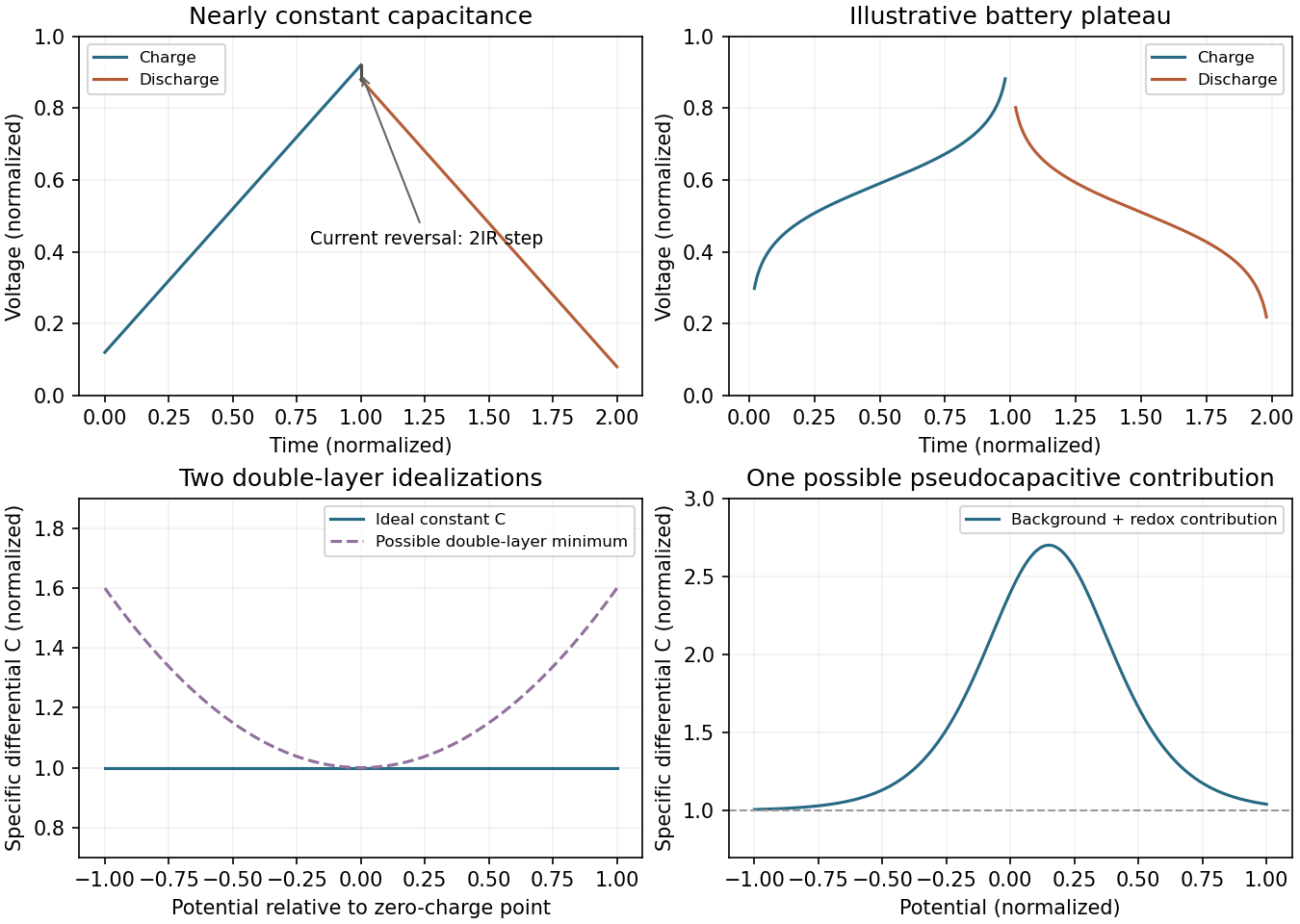
Idealized supercapacitor and battery responses, with capacitance–potential alternatives
. Original schematic curves; the lower panels distinguish a constant differential capacitance, a double-layer minimum and a localized redox contribution. They are alternative models, not a universal measured curve. Details.
Define mass-specific differential capacitance, or specific capacitance, byState whether is one electrode's active mass, both electrodes' active mass or the entire device mass; these conventions are not interchangeable. An average capacitance inferred from a finite voltage interval is and need not equal the local derivative.
A nearly ideal double-layer supercapacitor has an approximately flat capacitance over its stable operating window, so stored charge rises nearly linearly with potential. Real electrodes need not be flat: dilute-electrolyte double-layer models can give a minimum near the potential of zero charge, while concentrated electrolytes, finite ion size and pore confinement can produce bell-shaped or double-peaked curves. Pseudocapacitance can add broad potential-dependent contributions near a redox transition. The sketch above therefore labels several possible behaviours instead of asserting a universal monotonic trend. Constant-potential simulations have directly found transitions between double-peaked and bell-shaped differential-capacitance curves as interfacial interactions change.[ref]
Porous carbon emphasizes power and cycle life. Activated carbon, graphene-derived structures and nanotubes can provide high accessible area, electronic conduction and relatively reversible double-layer charging. Cost and stability can be favourable. However, inaccessible micropores, tortuous ionic paths, poor packing density and surface functional groups can reduce useful rate performance or volumetric energy density. Area measured by gas adsorption is not automatically accessible to electrolyte ions.
Metal oxides can add substantial redox charge storage. A suitable oxide offers high pseudocapacitance, but its electronic conductivity, ion-transport distance and electrochemical stability can limit power. Some high-performing compositions are expensive or contain scarce elements. Structural changes and dissolution can shorten life. Conductive composites and thin active layers help, but adding inactive support dilutes device-level energy storage.
Conducting polymers combine redox activity with electronic conduction and flexible processing. Their oxidation state and counterion population change during charging. Repeated ion and solvent uptake causes swelling and shrinkage, which can crack or delaminate an electrode and shorten cycle life. Conductivity is also state-dependent, and potential windows are constrained by overoxidation or reduction. A practical comparison must include both electrodes, electrolyte, packaging and the usable voltage: makes voltage stability as important as a large gravimetric capacitance.
Articles by others on the same topic
There are currently no matching articles.