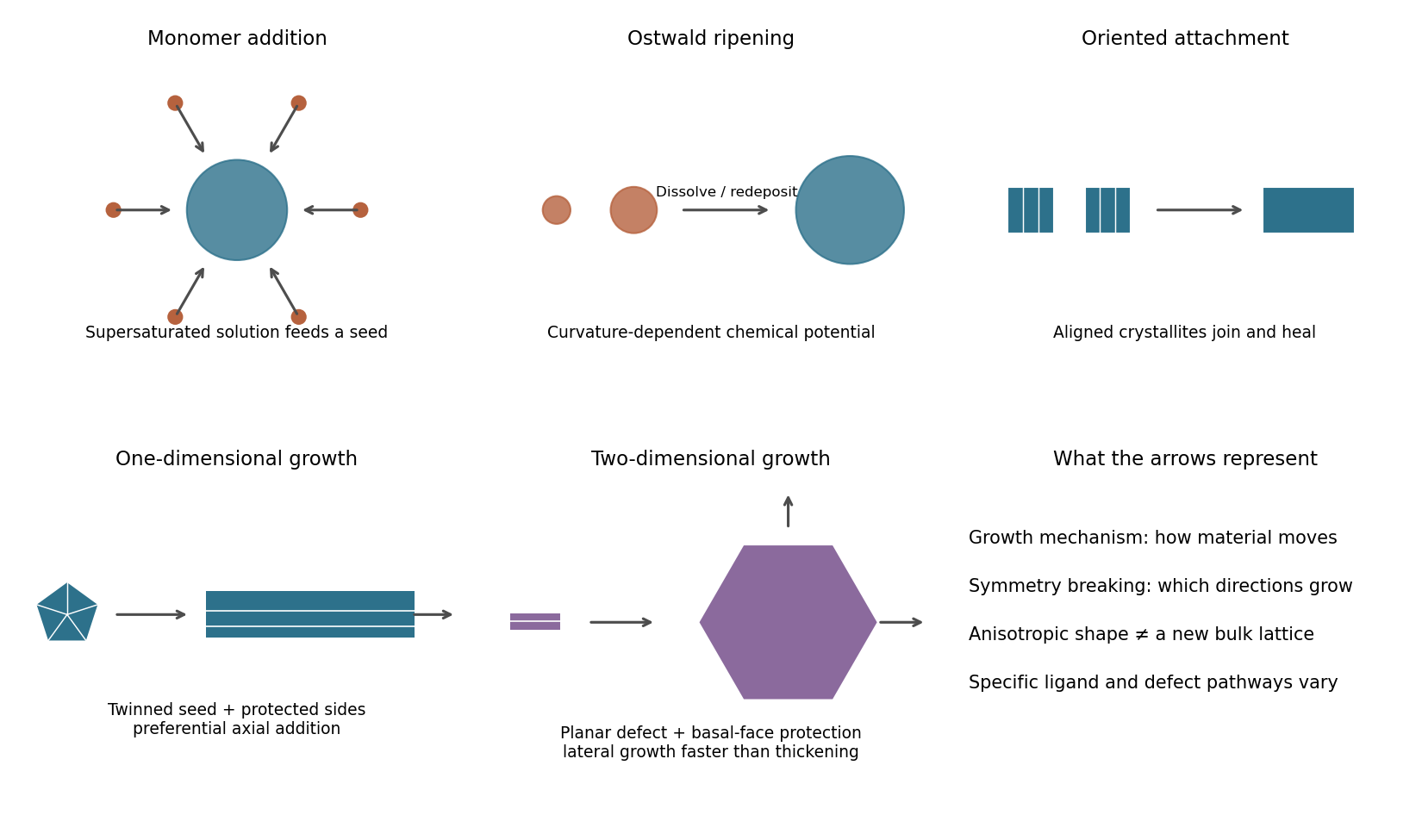
Three useful growth mechanisms are monomer addition, Ostwald ripening and oriented attachment. They can occur sequentially or compete; they are not necessarily three distinct experimental recipes.
In monomer-addition crystal growth, dissolved atoms, ions or molecular growth units attach to an existing nanocrystal. Supersaturation provides a chemical-potential driving force, approximately for an ideal solution. Transport through solution and incorporation at steps or facets determine the rate. Growth consumes the excess solute without requiring collisions between whole crystals.
In Ostwald ripening, smaller crystals dissolve while larger ones grow through solution. Curvature raises the surface contribution to chemical potential, approximately for a sphere with surface free energy and atomic volume . Dissolved material therefore moves from high-curvature particles to lower-curvature ones, reducing total interfacial free energy.
In oriented attachment, whole crystallites align compatible lattice planes and join. Removing exposed surface and forming a coherent interface lowers free energy; rotation, ligand removal and interface healing can be rate limiting. Misalignment can leave twins or other defects. Simple aggregation without crystallographic registration is related particle attachment, but is not necessarily oriented attachment.

Symmetry breaking in nanocrystal growth makes growth rates along initially equivalent crystallographic directions unequal, so the final shape has lower symmetry than an unperturbed seed. It need not change the underlying face-centered cubic lattice. A cubic lattice does not require a cubic external shape.
Anisotropy can originate in a twin or stacking fault, unequal ligand coverage of nominally equivalent sites, selective adsorption or etching, a substrate or external field, or a local fluctuation amplified because newly deposited material changes subsequent growth. Facet-selective binding suppresses some normal growth rates; concentration and reduction kinetics determine whether atoms can redistribute towards a near-equilibrium shape or remain in a kinetically selected one. A facet with slow normal growth tends to remain exposed, while a fast-growing facet can disappear.
For a one-dimensional silver example, begin with a small seed with multiple regions related by crystal twinning containing five sectors around a common axis. Ligand-protected lateral faces and more active ends favour axial addition, producing an elongated pentagonal rod and then a wire. The defect geometry and surface kinetics jointly distinguish the axial direction. Fivefold twinning is a composite structure with strain accommodation, not a perfect single fcc crystal with forbidden fivefold lattice symmetry.
For a two-dimensional example, begin with a seed containing a planar twin or stacking fault. Basal-face protection and enhanced incorporation at suitable edges favour lateral extension over thickening, producing a thin triangular or hexagonal plate. The accompanying schematic emphasizes seed, symmetry-breaking event and anisotropic growth stages. These are representative routes, not universal requirements for every rod or plate. Experimentally, silver-seed growth can also be redirected into lower-symmetry forms by controlling reduction kinetics.[ref]
Symmetry Breaking during Seeded Growth of Nanocrystals by Xiaohu Xia and Younan Xia. 2012, seeded-silver growth and kinetic symmetry breaking
In surface-enhanced Raman spectroscopy, electromagnetic SERS enhancement comes from the strong local optical field near a plasmonic metal nanostructure. A localized surface plasmon resonance in gold or silver can increase both the field driving a molecular Raman transition and the coupling of its emitted light to the far field. A common estimate isoften summarized as an enhancement when pump and Stokes frequencies see similar responses. Sharp tips and narrow interparticle gaps can produce intense hot spots.
Chemical SERS enhancement changes the molecule's Raman polarizability through adsorption, electronic hybridization or a metal–molecule charge-transfer resonance. It is more sensitive to molecular identity and binding geometry than a purely electromagnetic field enhancement, and generally requires close contact.
Tune particle size, shape and gap geometry so that a plasmon resonance overlaps the excitation and Raman frequencies, and bring the target into the enhanced-field region. Reproducible adsorption sites, low fluorescence background and clean reference spectra are as important as a large local enhancement. A hot spot does not guarantee that a dilute sample occupies it; a detection limit cannot be computed from concentration alone. Au or Ag improve the signal per suitably located molecule, while sampling and background determine the practical limit.
Articles by others on the same topic
There are currently no matching articles.