Each equation is stored thermal energy changing at the rate “input minus output”. Define the three heat capacities , and introduce the internal heat-transfer ratesIn the fuel balance, is accumulation, is thermal power generation and is transfer to the neutron moderator. In the moderator balance, enters, leaves and is accumulation. In the coolant balance, enters, is accumulation and is net energy carried away by flowing coolant.
The factor two follows the model's arithmetic-mean approximation , since the advective energy removal is . The parameters and are effective thermal resistances, in , for fuel-to-moderator and moderator-to-coolant transfer. They summarize the relevant geometry and heat-transfer mechanisms; they are not heat capacities.
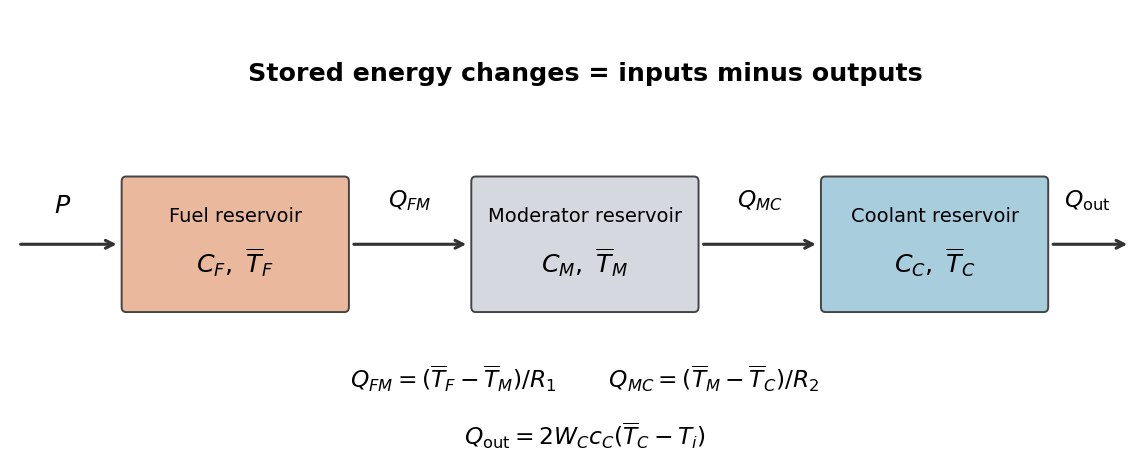
Original three-reservoir energy-balance diagram
. Details. 
At a steady state, all three accumulation terms vanish. The fuel balance gives , the moderator balance then gives , and the coolant balance equates that input to its advective output. ThereforeEach successive region adds the temperature drop needed to carry the same thermal power through its thermal resistance. Summing the original balances cancels both internal transfers, providing the independent total energy balance .
The coolant mass flow rate is approximately . All thermal power leaves in the steady coolant energy rise:With the stated constant specific heat capacity,The difference equals a difference. Thermal power is used directly; no electrical conversion efficiency enters.
The average moderator temperature is . First the mean coolant temperature in the lumped thermal model isAt a steady state, the same thermal power crosses both thermal resistances. If , thenThusIn particular at the specified state.
Differentiate the family of steady states, keeping , , , and fixed. A quasistatic process uses the temperature responses from part (b):Apply the chain rule to reactor reactivity along that family, weighting each response by its temperature coefficient of reactivity. Collecting terms gives the power coefficient of reactivityIts unit is inverse power. If the thermal resistances, coolant flow or inlet condition varied appreciably with power, their derivatives would contribute additional terms; those changes are excluded by the stipulated constant-parameter model.
The power coefficient is approximately , or . From part (c),Substituting in the power coefficient of reactivity givesThe negative sign means that a slow increase in thermal power produces a decrease in reactor reactivity along this family. This is a restoring thermal feedback control effect despite the positive moderator coefficient. A negative quasistatic slope alone does not prove stability of every transient: the separate heat capacities, transport delays and neutron-population dynamics matter for a time-dependent stability analysis.
Articles by others on the same topic
There are currently no matching articles.