A quasistatic process is an ideal limit in which a changing thermodynamic system passes through a sequence of states arbitrarily close to thermodynamic equilibrium. Its intermediate pressure, temperature and volume are therefore well defined and obey its equation of state. Driving must be slow compared with the system's own equilibration, rather than merely taking a long time on a clock. A reversible thermodynamic process additionally allows both system and surroundings to be restored without net change; friction can produce entropy even in a quasistatic process.[ref]
For a computed example, take a fixed amount of substance of ideal gas in a sealed cylinder with a frictionless piston, in contact with a heat bath at absolute temperature . Reduce the external load in infinitesimal steps so that the piston expands from to . In the reversible limit, the gas pressure exceeds the external pressure by an infinitesimal amount during expansion, and the heat transfer occurs across an infinitesimal temperature difference. Exact mechanical equilibrium would give no driving force; the limiting imbalance supplies motion while preserving equilibrium intermediate states.[ref]
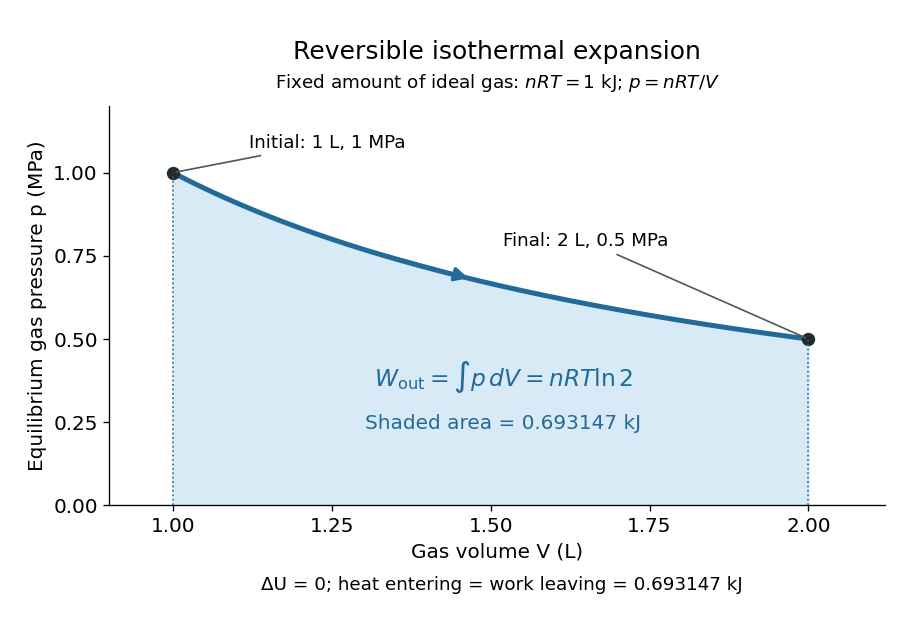
Along this reversible isothermal expansion, the ideal gas law givesHere is the molar gas constant; specifying fixes an energy scale, without choosing and separately. The initial and final equilibrium states are and . Count work delivered to the surroundings as positive. The reversible work is the shaded area beneath the pressure-volume curve:The integral of supplies the natural logarithm. Since internal energy of an ideal gas depends only on temperature, ; the first law of thermodynamics, , gives to the displayed precision. The heat bath replaces the energy delivered as work.[ref]
Now start from the same initial state, but abruptly lower the external pressure to the constant value . There is a finite initial pressure imbalance, so this is an irreversible expansion rather than a quasistatic process. Assume the piston begins and ends at rest, has no net change in stored energy, and has no external friction; relaxation occurs within the gas and its heat bath. After motion has settled and the heat bath has restored temperature , mechanical equilibrium and the ideal gas law give . The work delivered to the constant load isThis work follows directly from load force times piston displacement, using for piston area . Intermediate gas states need not have a single equilibrium pressure or temperature. In particular, neither at the bath temperature nor describes the actual gas during this irreversible motion. The rectangle below plots the known external load; its upper edge is not an equilibrium gas path.
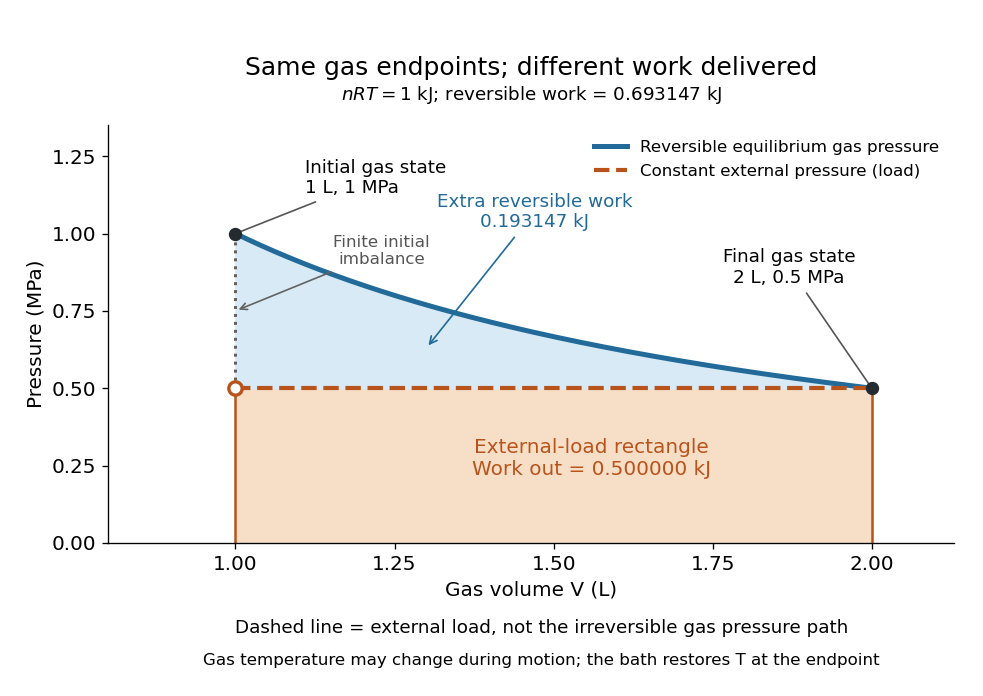
The same equilibrium endpoints give different work for reversible and constant-load expansion
. The blue curve is the reversible ideal gas path. The dashed orange line is constant external pressure, whose rectangle gives of load work. The additional blue shading is available in the reversible case. Black points mark the common gas endpoints; the open orange point marks the initial external load, and the dotted gap indicates the initial imbalance. No irreversible internal gas path is drawn. Details.The entropy accounting makes the difference precise. Because entropy is a state function, both expansions have the same gas entropy change, computed along the reversible isothermal expansion:The thermal reservoir stays at and loses heat , so . Assume the ideal load stores work without an entropy change. The combined entropy production is thereforeNo numerical entropy unit is implied by alone: or must also be specified. The lost work opportunity is for this comparison. This calculation uses equilibrium endpoints and the reservoir's temperature, without assigning equilibrium intermediate states to the irreversible gas. [ref]
https://openstax.org/books/university-physics-volume-2/pages/4-6-entropy. OpenStax, §4.6: entropy as a state function and reversible reference paths
For another boundary choice, let the same ideal gas expand into an initially evacuated compartment of volume inside a rigid, insulated vessel of total volume . Removing the partition causes free expansion: no load is moved and no heat crosses the outer boundary, so and . After equilibration the temperature is again , the pressure is , and the gas entropy has increased by . The outer vessel has fixed volume; the gas's accessible volume doubles. Restoring the initial gas state requires compression and removal of heat, changing the surroundings. Equal endpoints do not make free expansion reversible. [ref]
https://openstax.org/books/university-physics-volume-2/pages/4-1-reversible-and-irreversible-processes. OpenStax, §4.1: insulated free expansion and restoration
A slowly moving piston with dry friction supplies a different caution: its gas can remain arbitrarily close to thermodynamic equilibrium, yet rubbing still converts work into heat and produces entropy. If the frictional force has a nonzero slow-motion limit, its dissipated energy over a fixed travel does not vanish with speed. Reversing the motion reverses friction, so infinitesimally changing the external load cannot retrace the same operation and restore the surroundings. The heat capacity calculations additionally exclude friction and other dissipative work.[ref]
The usefulness of a quasistatic process is that it replaces detailed motion by a readable sequence of equilibrium states. An equation of state and an integral then turn a pressure-volume drawing into an energy budget. The beautiful distinction is that internal energy and entropy depend on the endpoints, while heat and work record how the change was performed. Reversible benchmarks expose how much work an irreversible device sacrifices, while entropy production explains why simply making it slower need not recover that opportunity.
Articles by others on the same topic



A quasistatic process is a thermodynamic process that occurs so slowly that the system remains in near-equilibrium throughout the process. In other words, at each stage of the process, the system is close to a state of equilibrium, allowing for a clear definition of properties like temperature and pressure.