Synroc immobilises waste ions in selected durable crystalline hosts, rather than trying to put the whole inventory into one universal site. The underlying philosophy is that minerals retaining analogous elements over geological times suggest useful crystal structures for engineered containment. These natural analogues motivate the choice; their survival does not prove that every synthetic composition, damaged microstructure or groundwater environment will behave identically. This was the rationale of the original mineral-analogue proposal.[ref]
Immobilisation of high level nuclear reactor wastes in SYNROC by A. E. Ringwood and others. Nature 278, 219–223, abstract and mineral-analogue argument
A representative Synroc-C assemblage includes zirconolite, , as an actinide host; a hollandite waste-form phase, represented by , whose tunnels accommodate large cations such as caesium; and a perovskite waste-form phase, , which can accept strontium on calcium sites and other constituents with suitable charge compensation in a crystal. Titanium-oxide phases provide additional accommodation and composition flexibility. The actual phases are solid solutions, not simply pure end-member minerals mixed with an inert waste powder.[ref]
Crystal chemistry and phase manipulation in Synroc by E. R. Vance and others. Key Engineering Materials 48–50, 717–721; ANSTO abstract identifying the multiphase titanate assemblage
Manufacture combines a characterised waste feed with selected oxide-forming precursors, converts the mixture to a suitable powder or calcination product, and consolidates it while forming the host phases. hot pressing and hot isostatic pressing are consolidation approaches; the latter uses pressure acting approximately equally in all directions. The objective is a dense ceramic with the intended phase assemblage and low connected porosity, contained in an appropriate radioactive waste package. Verify density and phase composition, use microscopy to find segregated constituents or pores, and test leaching of the actual product. Successful densification alone does not establish radionuclide retention.[ref]
ANSTO Synroc Radioactive Waste Treatment Technology by the Australian Nuclear Science and Technology Organisation. Institutional technology overview, waste-form design, characterisation and hot isostatic pressing
The host is zirconolite, with ideal end-member composition . In the proposed formula, the substitution is formallyIt is an isovalent substitution: the mean charge of the mixed zirconium/plutonium site remains , soNo compensating oxygen vacancy or aliovalent co-substituent is required by this particular charge account. Suitable oxidation state is essential; the same formula interpreted with only trivalent plutonium would not be charge balanced.
In zirconolite-2M the zirconium site has an oxygen coordination number of seven. The ionic radius of plutonium(IV) is larger than that of zirconium(IV), so increasing its occupancy changes local strain and the preferred arrangement of the cation layers. The observed progression in the investigated substitution series was zirconolite-2M → zirconolite-4M → pyrochlore structure, rather than unlimited substitution in one unchanged monoclinic lattice. The primary study found a 2M solid-solution limit near , a narrow 4M range near , and a pyrochlore composition at in . These are experimental observations for that series, not universal boundaries independent of preparation and oxidation state.[ref]
Structural Effect of Pu Substitutions on the Zr-Site in Zirconolite by B. D. Begg and others. MRS Proceedings 663, 259; abstract, seven-coordinate site and reported polytype transitions
Consequently the nominal composition identifies a zirconolite-based waste-form design, but does not by itself prove a pure 2M product. Diffraction and phase-composition measurements are needed. At larger substitution, the fluorite-related pyrochlore arrangement accommodates a different cation distribution and coordination environment.
gadolinium is primarily a strong neutron absorber. The supplied thermal cross section for gadolinium-157 is very large, so capture removes neutrons that could otherwise sustain nuclear fission. This is a criticality-control role rather than a requirement to complete the host formula. The isotope-specific number must not be assigned unchanged to natural gadolinium.
hafnium supplies an additional neutron poison with favourable retention chemistry. Its supplied natural-abundance thermal cross section is much smaller than that of gadolinium-157 but still appreciable. Chemically, tetravalent hafnium resembles zirconium and can remain associated with a durable titanate host. Keeping the absorber with the fissile inventory during alteration is as important as its initial neutron capture strength: a highly absorbing constituent offers poor long-term protection if it is preferentially lost. These considerations explain using complementary absorbers rather than ranking them solely by their initial thermal cross sections.
uranium addition chiefly addresses isotopic dilution, including the long-term daughter inventory. plutonium-239 alpha decay produces uranium-235. Added uranium-238 lowers the uranium-235 fraction of that future uranium inventory; depleted uranium adds less uranium-235 initially than natural uranium. uranium-238 also absorbs some neutrons, but its small listed cross section does not make it a substitute for the strong absorbers. The long-term daughter issue and the retention of gadolinium and hafnium are explicit concerns in ceramic waste-form development.[ref]
Immobilisation of Higher Activity Wastes from Nuclear Reactor Production of 99Mo by M. W. A. Stewart and others. Section 2, plutonium-immobilisation ceramic development, uranium-235 ingrowth and neutron-absorber retention
These are complementary physical purposes, not proof of criticality control in radioactive waste from three cross-section values. neutron energy, isotopic composition, geometry, moderation, absorber distribution and their coupled evolution matter. Incorporation in the same durable waste form helps maintain association, but neither uranium addition nor chemical immobilisation makes deliberate element separation physically impossible.
Let be the fraction still crystalline. Under the direct-impact amorphization model, damage events occur randomly and independently; an event striking already amorphous material does not create that much additional amorphous volume. Only the crystalline fraction can be newly converted, soThe product of the given event rate density and damage volume has units of inverse time:For radiation-induced amorphization, , givingUsing days per year, the corresponding calendar date is approximately 3555 CE, measured from disposal preparation in 2050.
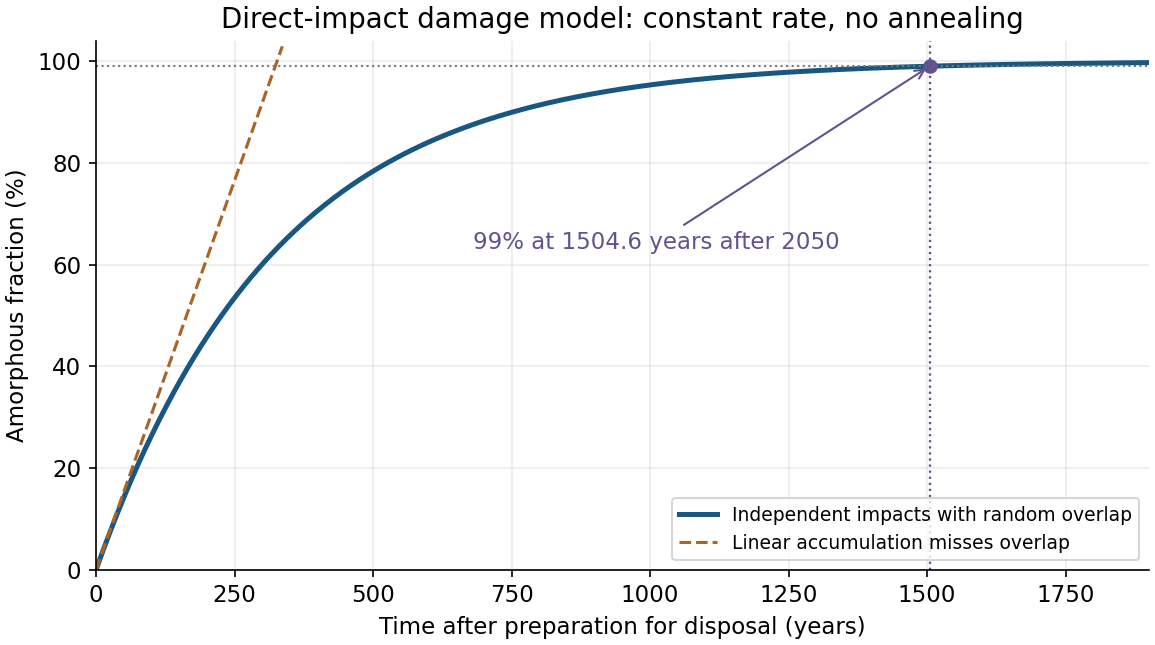

A linear estimate misses repeated hits to already damaged regions and therefore predicts too rapid an approach to . The exponential function model never reaches exactly in finite time. Its assumptions include constant dose rate, fixed effective damage volume, no annealing and no spatial correlation of damage. Actual alpha decay generates recoil damage as well as the alpha particle's track; the stated damage volume must be understood as the effective volume per radioactive decay for the chosen model.
Amorphous is not synonymous with dissolved or failed containment. Radiation damage can change swelling, connected porosity and leach behaviour, so testing must compare structural evolution with element release. Accelerated self-irradiation and parallel dissolution measurements are useful precisely because crystallinity alone is not the performance endpoint.[ref]
JAERI/ANSTO co-operative research on radiation damage and actinide behaviour in Synroc by S. Muraoka and others. 1994 primary conference abstract, accelerated self-irradiation and parallel aqueous-dissolution investigations
Articles by others on the same topic
There are currently no matching articles.