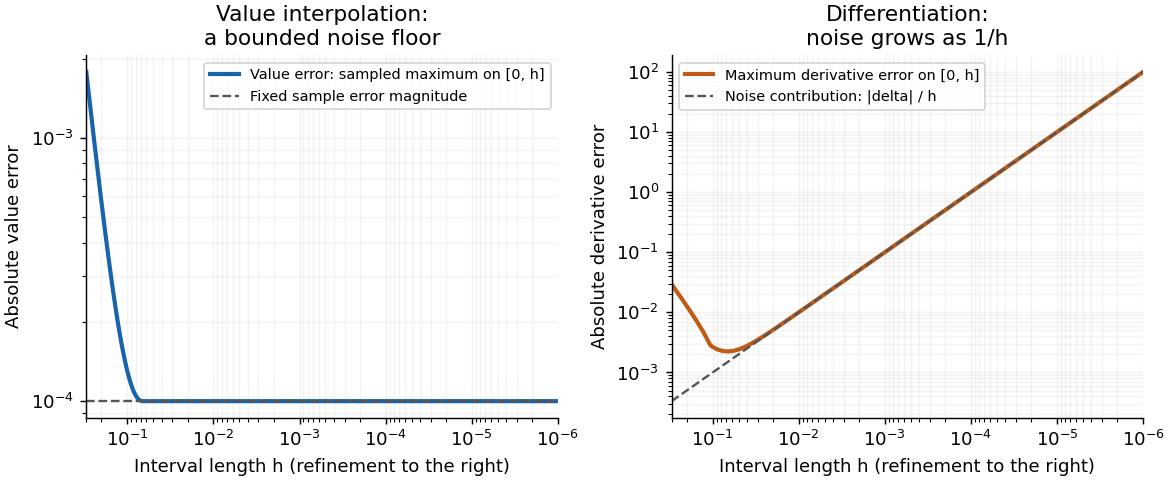
Write and for the quantities computed from the perturbed second sample. The endpoint linear interpolation and its derivative areCompare them on their interpolation interval , with fixed . Put , . The Taylor series of the sine gives, uniformly in ,Here the second equality compares with . More generally, the exact derivative is andThe input perturbation itself changes the value interpolant by exactly , and changes its derivative by exactly . ThusFor fixed nonzero , the value approximation has a bounded noise floor: its maximum error approaches , and at that error is exactly . It does not converge uniformly to the exact values as . However, it does not amplify the absolute sample perturbation on . The derivative error instead grows without bound like .
With exact samples, , both approximations do converge on the shrinking interval: the value error is for this particular sine, and the derivative error is . With step-dependent noise, value convergence requires , whereas derivative convergence requires the stronger , where denotes little o notation.
This is noise amplification by differentiation of a linear interpolant. Value interpolation has an absolute perturbation bound independent of on the sampled interval. Numerical differentiation has a perturbation factor , expressing the ill-posedness of numerical differentiation from values with fixed absolute uncertainty. The amplification follows from the mathematical data map even in exact arithmetic; it is distinct from additional roundoff error in a particular implementation. For fixed outside , the operation becomes extrapolation, and the value perturbation can also diverge.

Articles by others on the same topic
There are currently no matching articles.