An orthogonal projector sends to the foot of its perpendicular onto the image of a linear map . The residual is orthogonal to the entire range, not just to the single vector . Indeed, for any range vector ,In particular . The orthogonal projection diagram illustrates the resulting right triangle.
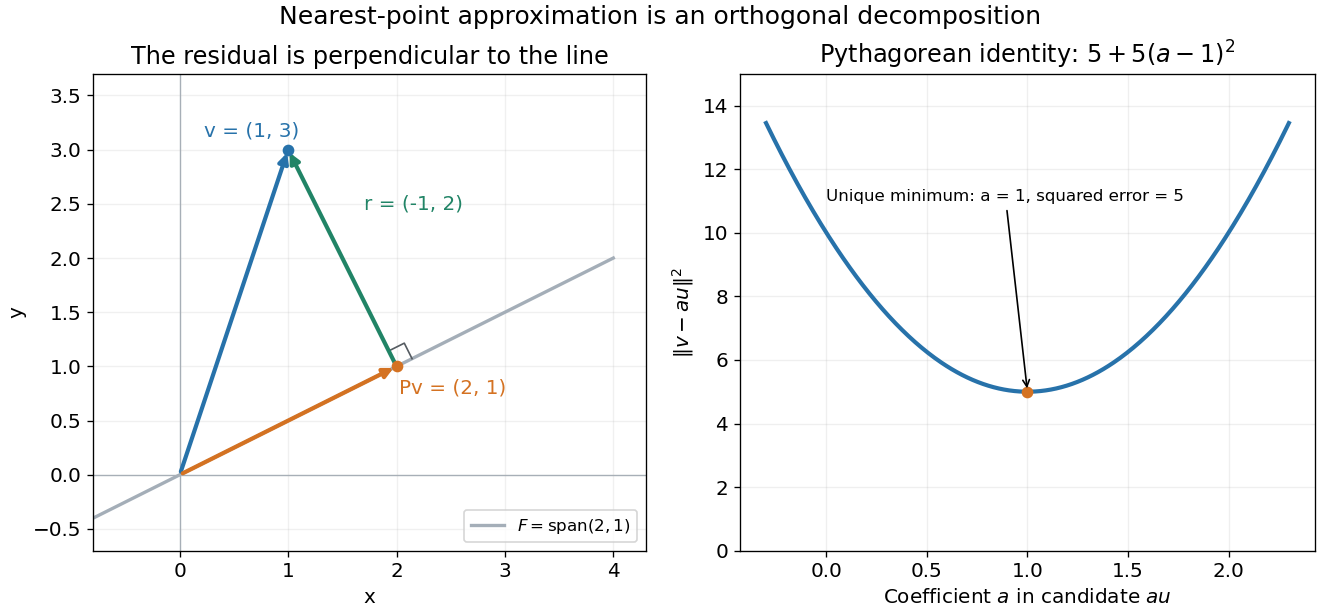
An orthogonal projector maps a vector to its perpendicular foot on the range; the residual is orthogonal to that range
. Details. 
The vector Euclidean norm is , the ordinary length from the origin. The induced matrix norm isGeometrically this is the largest stretch of a unit vector. A linear map sends the unit sphere to an ellipsoid, possibly degenerate; its largest semiaxis has length . Equivalently the matrix 2-norm is the largest singular value.
The perpendicular decomposition in part (a) gives, by the Pythagorean theorem,Thus an orthogonal projection cannot lengthen a vector and . Algebraically the cross term vanishes because , giving the same identity directly from the hypotheses. If , take a nonzero in its range; then and . For the norm is zero.
The nullspace is the vector subspace . A full real singular value decomposition iswhere are orthogonal matrices and for , with for . We may order . The columns of form an orthonormal basis of the input space , and the columns of form one of the output space . The positive singular values number exactly the matrix rank.
Let be the matrix rank, and partition the right singular vectors as , with consisting of the columns associated with zero singular values. From , these columns form an orthonormal basis of the nullspace. Therefore its orthogonal projector isIt acts on the input space . Symmetry and idempotence follow from . At full column rank it is zero, and at rank zero it is the identity.
Articles by others on the same topic
There are currently no matching articles.