Temporal coherence measures correlation between an optical field and a delayed copy. For a stationary scalar complex field with carrier convention ,The power spectrum and the field autocorrelation form a Fourier transform pair, the Wiener-Khinchin theorem:A Michelson interferometer supplies delay . With equal arm intensities and matched polarization, its interferometric visibility is ; unequal intensities or mode mismatch lower visibility independently of temporal coherence. The relevant spectrum is the optical field spectrum, not the low-frequency spectrum of detector intensity fluctuations.
For a single Lorentzian optical line of angular-frequency full width at half maximum , use the narrow-line detuning modelSuch a model describes a phase-diffusing monochromatic source. An correlation time is , and its coherence length is . The Lorentzian extension over all detunings approximates a narrow optical line with .
For two equal, mutually incoherent ideal monochromatic spectral lines,Here and . Visibility has zeros and revivals, so the overall spectral span alone does not determine a unique decay time. Giving each line a common finite Lorentzian linewidth multiplies this beating correlation by the corresponding exponential envelope.
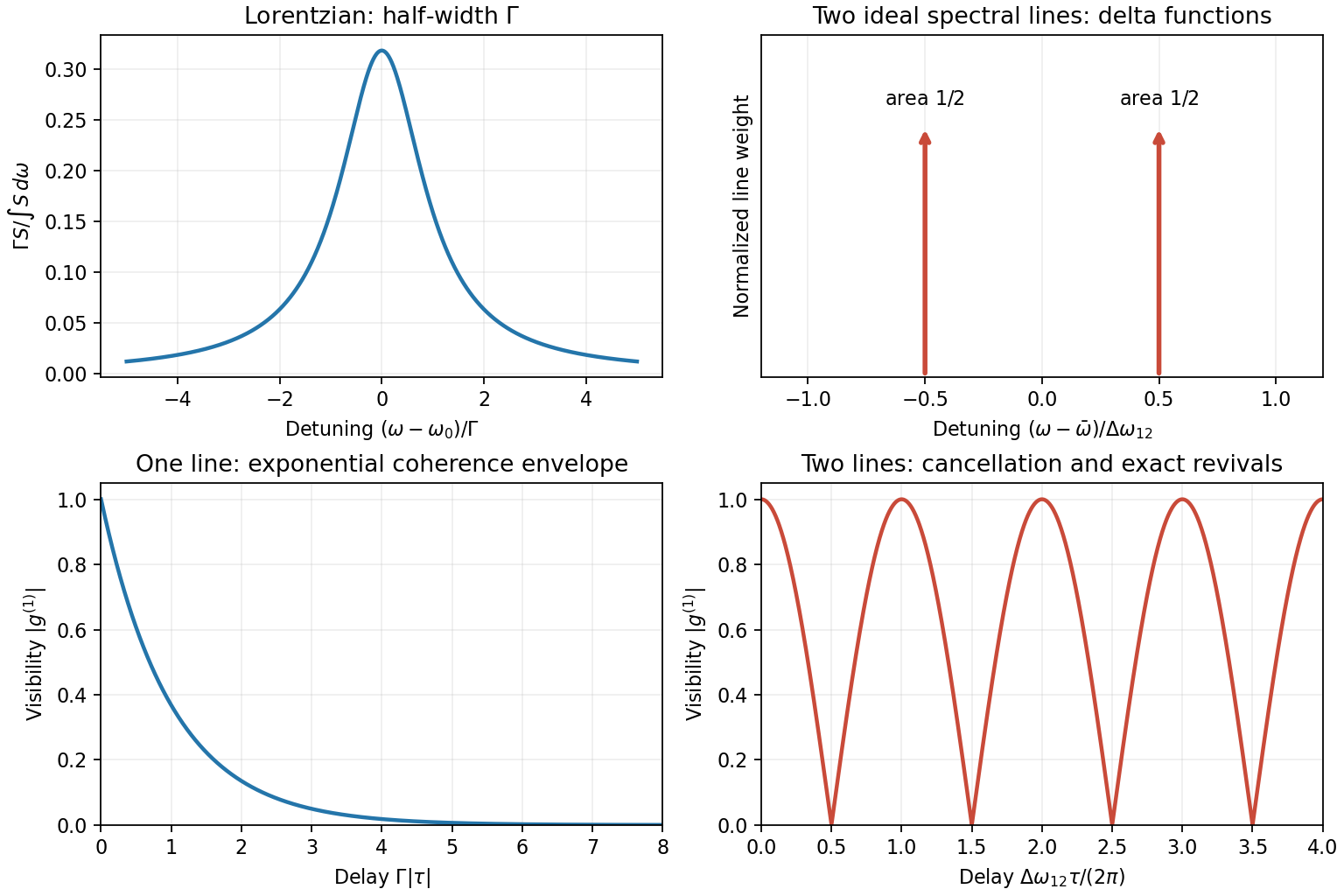

These two examples distinguish irreversible envelope decay from cancellation and revival of discrete spectral components. The line profiles are explicit models, not claimed measurements of a particular source.
Articles by others on the same topic
There are currently no matching articles.