Original paper: Public original PDF, physical pages 211–214; cover on page 211 and questions on pages 212–214.
The electric field of the reflected beam is perpendicular to the vertical plane of incidence, hence parallel to the water surface. At Brewster's angle the reflected p-polarization amplitude vanishes; only the s-polarization component remains. For incidence from air, approximated by refractive index one,Incidence is measured from the surface normal, whereas solar elevation is measured from the horizontal. The Brewster solar elevation is thereforeThis assumes an ideally flat, transparent, nonmagnetic interface; ripples, absorption and diffuse light would spoil complete polarization.
For a Hertzian dipole of length driven at peak electric current , the electric dipole moment amplitude is . ConsequentlyThe Hertzian dipole fixed-current power scaling is thus , givingThe inverse-fourth-power wavelength scaling would hold at fixed electric dipole moment, not at the fixed electric current specified here.
During the time light crosses a telescope of length , Earth moves sideways by approximately . The telescope must tilt towards Earth's motion so that both ends intercept the ray. Thus the annual stellar aberration amplitude at a transverse sightline is .
Taking one orbital year as days and treating the orbit as circular,This is the instantaneous shift relative to a stationary heliocentric observer, not the doubled peak-to-peak annual excursion. The exact Lorentz transformation for a ray transverse in that frame gives , with the same first-order result.
An accelerating point charge has a transverse radiation field in addition to its near field. At nonrelativistic speed and large distance ,The acceleration is evaluated at retarded time. Radiation fields decay as , so their outward energy flux integrated over a sphere is independent of radius; the near electric field instead decays as . The radiation vanishes along the acceleration and is strongest perpendicular to it.[ref]
The Feynman Lectures on Physics, Volume I by Richard Feynman and others. §28–2, Eqs. (28.5)–(28.6): transverse acceleration field and inverse-distance radiation
Using the Poynting vector givesThe integral uses . This is the Larmor formula. A harmonically accelerated charge with peak acceleration has mean power ; external work supplies this radiated energy in steady operation. Uniform inertial motion does not radiate.
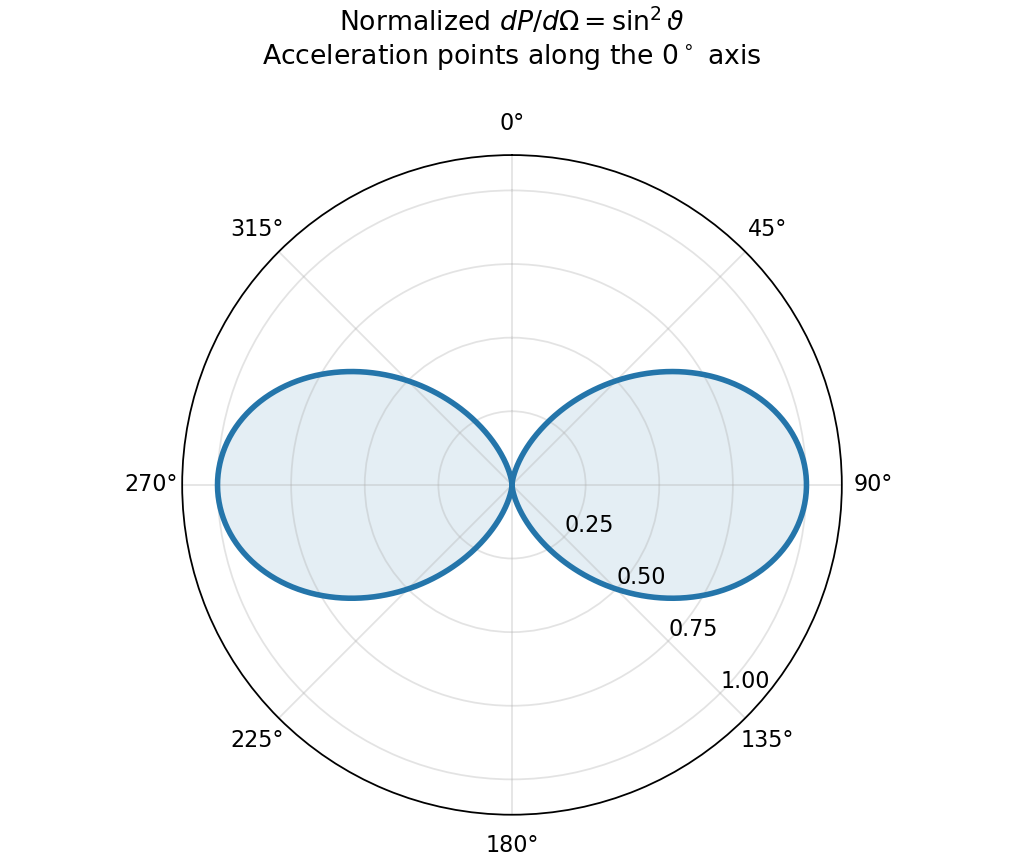
Original nonrelativistic radiation pattern, with zero power along the acceleration and maximum power transverse to it
. Details. At relativistic speed the angular pattern becomes directionally concentrated and retarded-source factors matter. The total instantaneous radiated power generalizes to , with . The displayed simple pattern is restricted to the nonrelativistic limit.
Temporal coherence measures correlation between an optical field and a delayed copy. For a stationary scalar complex field with carrier convention ,The power spectrum and the field autocorrelation form a Fourier transform pair, the Wiener-Khinchin theorem:A Michelson interferometer supplies delay . With equal arm intensities and matched polarization, its interferometric visibility is ; unequal intensities or mode mismatch lower visibility independently of temporal coherence. The relevant spectrum is the optical field spectrum, not the low-frequency spectrum of detector intensity fluctuations.
For a single Lorentzian optical line of angular-frequency full width at half maximum , use the narrow-line detuning modelSuch a model describes a phase-diffusing monochromatic source. An correlation time is , and its coherence length is . The Lorentzian extension over all detunings approximates a narrow optical line with .
For two equal, mutually incoherent ideal monochromatic spectral lines,Here and . Visibility has zeros and revivals, so the overall spectral span alone does not determine a unique decay time. Giving each line a common finite Lorentzian linewidth multiplies this beating correlation by the corresponding exponential envelope.
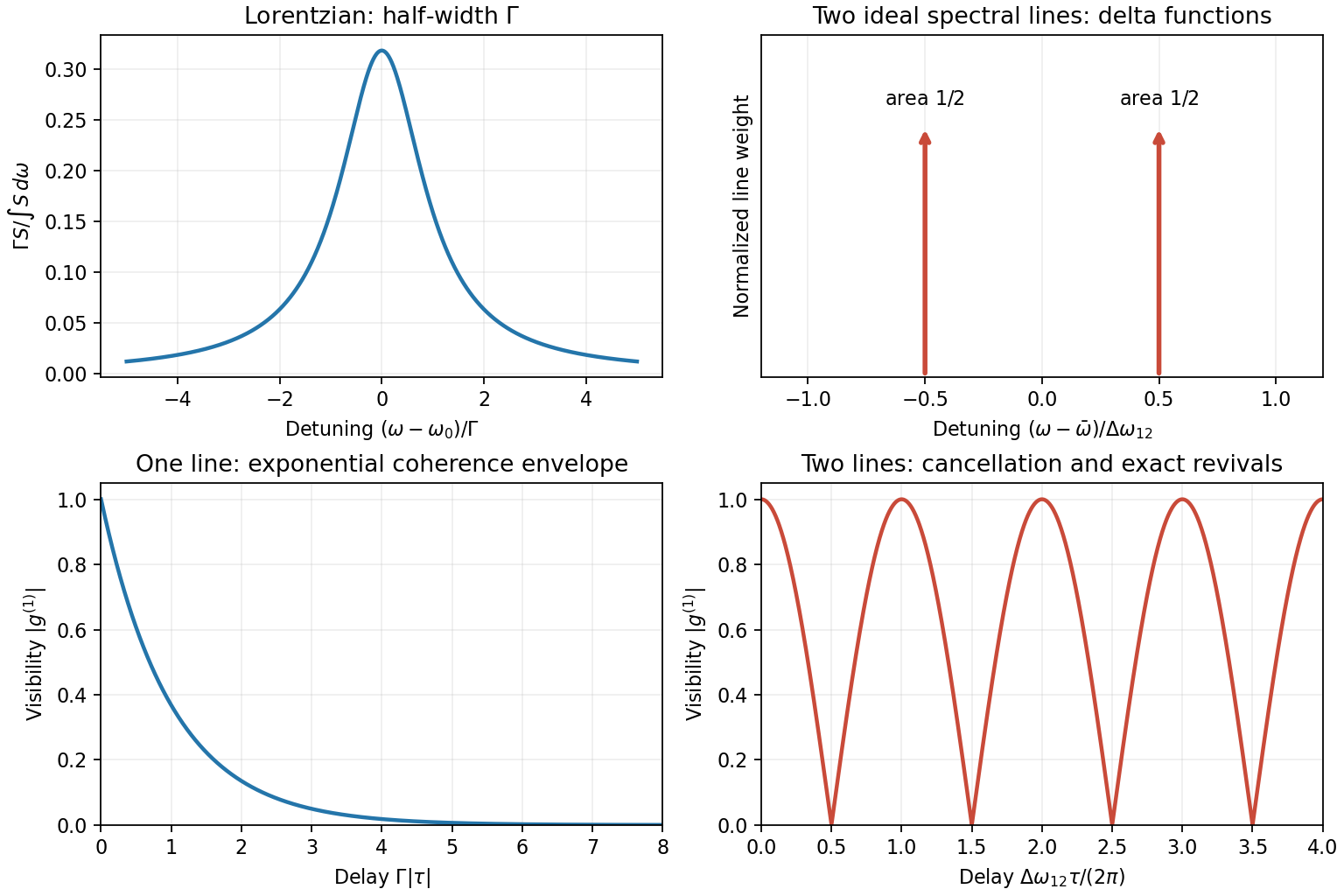


These two examples distinguish irreversible envelope decay from cancellation and revival of discrete spectral components. The line profiles are explicit models, not claimed measurements of a particular source.
The electric potential and magnetic vector potential represent the fields through and . They are not unique: a differentiable function giveswithout changing either field. Gauge fixing restricts this freedom to suit the sources, boundaries or symmetry; it does not alter observables.
The Lorenz gauge is Lorentz covariant. Maxwell's equations then reduce to sourced wave equations,Retarded solutions implement causal radiation conditions. This gauge is useful for radiation and relativistic calculations; residual transformations obey the homogeneous wave equation.[ref]
The Feynman Lectures on Physics, Volume II by Richard Feynman and others. §18–6, Eqs. (18.23)–(18.25): gauge choice and potential wave equations
The Coulomb gauge instead gives . Its electric potential is an instantaneous Poisson solution, but the accompanying magnetic vector potential makes the full physical electric field causal. It is useful in separating longitudinal electric fields from transverse radiation. In a source-free vacuum region, suitable radiation boundary conditions permit radiation gauge , , leaving two transverse plane-wave polarizations. These extra conditions are not a gauge choice applicable unchanged to arbitrary nonzero charge distributions.
Different gauges redistribute information between potentials; the same boundary-value problem gives the same electric fields and magnetic fields.
Use . A Jones vector records the two transverse complex amplitudes. The amplitude ratio and relative phase determine the polarization ellipse; a common nonzero scalar does not change the polarization. A fixed Jones vector describes fully polarized monochromatic light, not an unpolarized statistical mixture.
Linear birefringence gives orthogonal principal polarizations different refractive indices. Put , so is the fast axis. A plate of thickness gives slow-minus-fast phase retardationThe thinnest quarter-wave plate hasHere is the vacuum wavelength. For linear input at angle to the fast axis, the output at design frequency is up to common phase. Axis-aligned input remains linear; equal nonzero components at modulo give circular polarization; other input angles give elliptical polarization. There is no need to spatially separate the two components.[ref]
The Feynman Lectures on Physics, Volume I by Richard Feynman and others. §33–3: phase accumulation between orthogonal principal polarizations and quarter-wave conversion
For waveplate retardance detuning, defineNeglecting material dispersion reduces this to . Remove the common fast-axis phase. Then . A similar half-wave plate of twice the thickness has twice the retardation, giving . The shared error parameter presumes the same material and matched thickness ratio.
For the half-wave and quarter-wave achromatic circularizer, the first fast-axis angle is and the second is . With the stated passive rotation convention,An explicit expression valid for the given shared error is obtained by putting and definingAt , the half-wave plate rotates the linear input to , which is relative to the second fast axis. ThusThis is circular polarization. With our time convention its fixed-point electric vector is proportional, after a time-origin shift, to ; this specifies the rotation without relying on conflicting handedness conventions.
Expanding the exact product to first order givesThese coefficients are rounded to three significant figures. Before rounding, the derivative is exactly , with . The Jones-component ratio sensitivity therefore vanishes:Only common phase changes at first order. This proves compensation for the prescribed input near the design frequency, not exact achromatic performance throughout the visible spectrum for arbitrary input polarization.
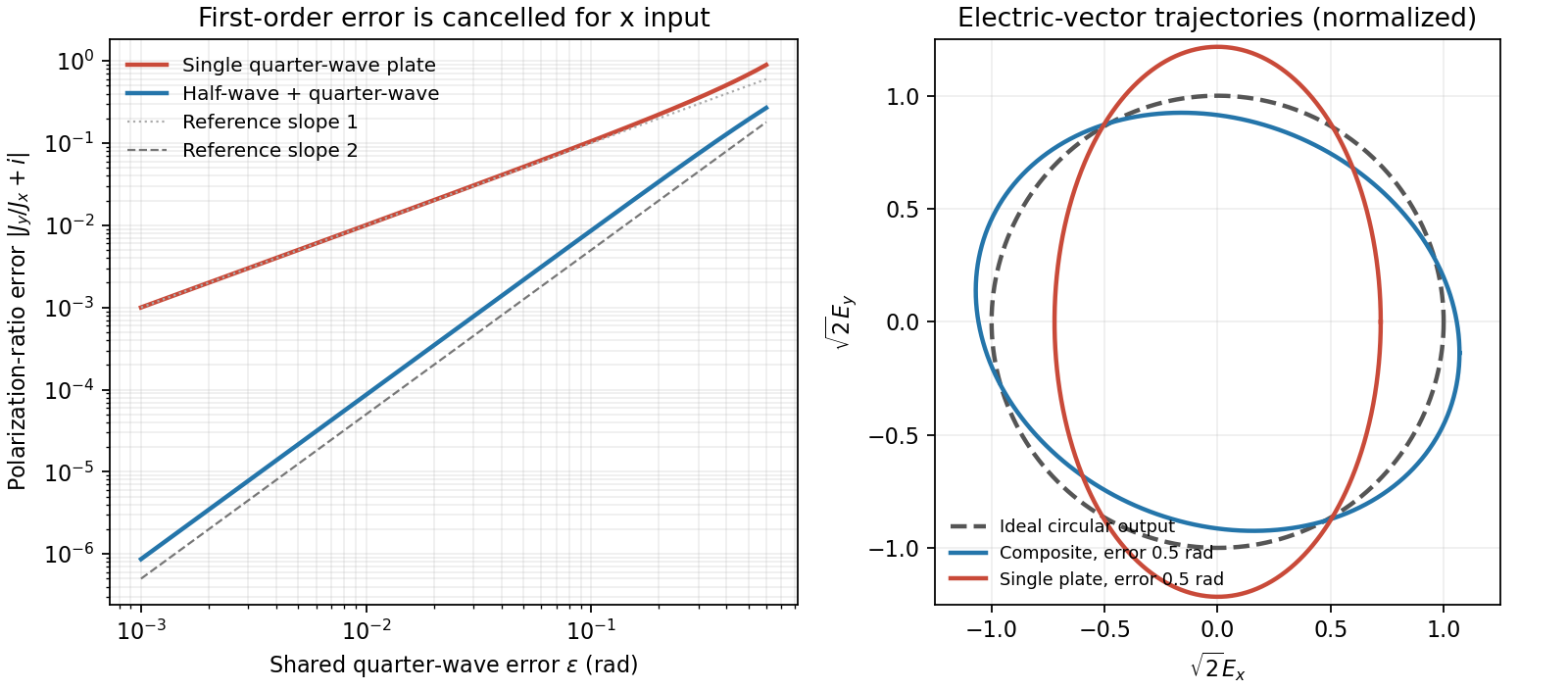
Original comparison of single-plate and composite polarization errors and the composite electric-vector trajectory
. Details. 
A transverse static electric field can induce linear birefringence through the electro-optic Kerr effect. Define its coefficient by , with the principal axes parallel and perpendicular to the applied field. A length then gives .
For input polarized at to those axes, switching from zero retardation to switches linear to circular polarization. Other input angles generally become elliptical, and axis-aligned input stays linear. The required field magnitude for the lowest-order setting isA Kerr cell is suitable as a switchable quarter-wave plate. The field can be changed electronically without mechanically rotating the axes; actual switching time depends on the material response and driving circuit. This is induced linear birefringence, not polarization-selective absorption.[ref]
The Feynman Lectures on Physics, Volume I by Richard Feynman and others. §33–3, final paragraphs: an applied electric field produces birefringence and electrical light switching in a Kerr cell
The longitudinal Faraday effect produces circular birefringence: right- and left-circular components have different phase velocities. Linear input contains equal amplitudes of both circular eigenpolarizations. A relative phase rotates its linear polarization through , preserving linearity in an ideal transparent sample. Conventionally the signed rotation is , with Verdet constant .
A pure Faraday rotator cannot serve as the required switchable quarter-wave plate. It rotates a line into another line rather than producing the required relative phase between fixed orthogonal linear components. Applying a field that gives a nominal quarter-cycle circular-eigenmode retardation simply rotates linear polarization by . Circular dichroism or a separate linear retarder would change the device, and is not the stated pure Faraday mechanism.
Take and metric signature . The four-current, four-potential and four-gradient areThe first two transform as contravariant four-vectors under an inertial-frame Lorentz transformation, within a consistently transformed electromagnetic gauge. The lowered-index gradient is a covector. Their contraction is a Lorentz scalar:Indeed, and , so the two matrices cancel in the contraction. Local charge conservation in one inertial frame implies local charge conservation in every inertial frame. Integrating over a region gives the charge change equal to minus its outward current flux; global conserved charge requires no flux through the system boundary.
Let point transversely away from the line and define . Cylindrical Gauss's law in the line's rest frame givesThe transverse distance is unchanged by the axial boost: . Applying the inverse of the given field transformation to a boosted uniform line charge,Here and all longitudinal field components vanish. Substituting back verifies and . The sign of determines the radial and circulation directions.
A material segment of the line with rest length has laboratory length , while its charge is unchanged. ThusEquivalently the line-integrated four-current transforms from to . Gauss's and Ampère's laws in now give and , exactly the fields found in part (a). Charge density is frame-dependent even though the charge of the same set of particles is invariant.
In , adding the stationary opposite line cancels charge density and electric field but contributes no current. HenceThe neutral current filament in a boosted frame is not neutral. Transform its line-integrated four-current:The same result follows by adding the original resting line to the new negative line, whose primed density and current are . In particular because .
Transforming the total fields givesFor positive , points inward, explaining the electric-field sign. The primed Gauss and Ampère fields calculated from and reproduce these expressions. Both a moving charge distribution and a moving current must be transformed; boosting just one constituent would give an inconsistent total.
An ideal current-carrying wire consists of opposite charge populations, one associated with the stationary lattice and one with drifting carriers. They may cancel in the lattice frame while carrying a net current, as in part (c), up to exchanging the charge signs and current direction. In a carrier-rest description their densities no longer cancel because the two populations undergo different length contractions. The wire then has both electric fields and magnetic fields.
A neutral steady current in one frame generally becomes a charged steady current in another. This illustrates how electric fields and magnetic fields are parts of one relativistic field rather than separately invariant forces. Real resistive wires also have a driving longitudinal electric field and geometry-dependent surface charges; the infinite uniform filament model isolates the transverse fields of a neutral current and does not describe every field of a complete circuit.
Articles by others on the same topic
There are currently no matching articles.