An accelerating point charge has a transverse radiation field in addition to its near field. At nonrelativistic speed and large distance ,The acceleration is evaluated at retarded time. Radiation fields decay as , so their outward energy flux integrated over a sphere is independent of radius; the near electric field instead decays as . The radiation vanishes along the acceleration and is strongest perpendicular to it.[ref]
The Feynman Lectures on Physics, Volume I by Richard Feynman and others. §28–2, Eqs. (28.5)–(28.6): transverse acceleration field and inverse-distance radiation
Using the Poynting vector givesThe integral uses . This is the Larmor formula. A harmonically accelerated charge with peak acceleration has mean power ; external work supplies this radiated energy in steady operation. Uniform inertial motion does not radiate.
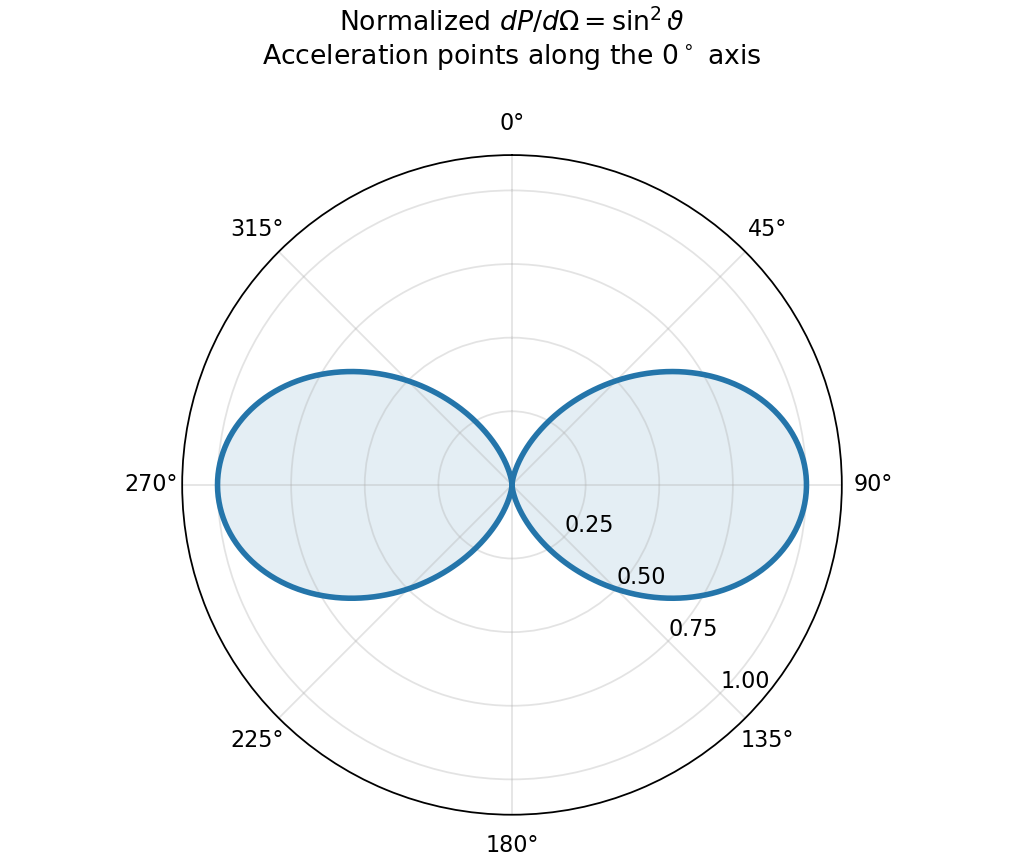
Original nonrelativistic radiation pattern, with zero power along the acceleration and maximum power transverse to it
. Details. At relativistic speed the angular pattern becomes directionally concentrated and retarded-source factors matter. The total instantaneous radiated power generalizes to , with . The displayed simple pattern is restricted to the nonrelativistic limit.
Temporal coherence measures correlation between an optical field and a delayed copy. For a stationary scalar complex field with carrier convention ,The power spectrum and the field autocorrelation form a Fourier transform pair, the Wiener-Khinchin theorem:A Michelson interferometer supplies delay . With equal arm intensities and matched polarization, its interferometric visibility is ; unequal intensities or mode mismatch lower visibility independently of temporal coherence. The relevant spectrum is the optical field spectrum, not the low-frequency spectrum of detector intensity fluctuations.
For a single Lorentzian optical line of angular-frequency full width at half maximum , use the narrow-line detuning modelSuch a model describes a phase-diffusing monochromatic source. An correlation time is , and its coherence length is . The Lorentzian extension over all detunings approximates a narrow optical line with .
For two equal, mutually incoherent ideal monochromatic spectral lines,Here and . Visibility has zeros and revivals, so the overall spectral span alone does not determine a unique decay time. Giving each line a common finite Lorentzian linewidth multiplies this beating correlation by the corresponding exponential envelope.
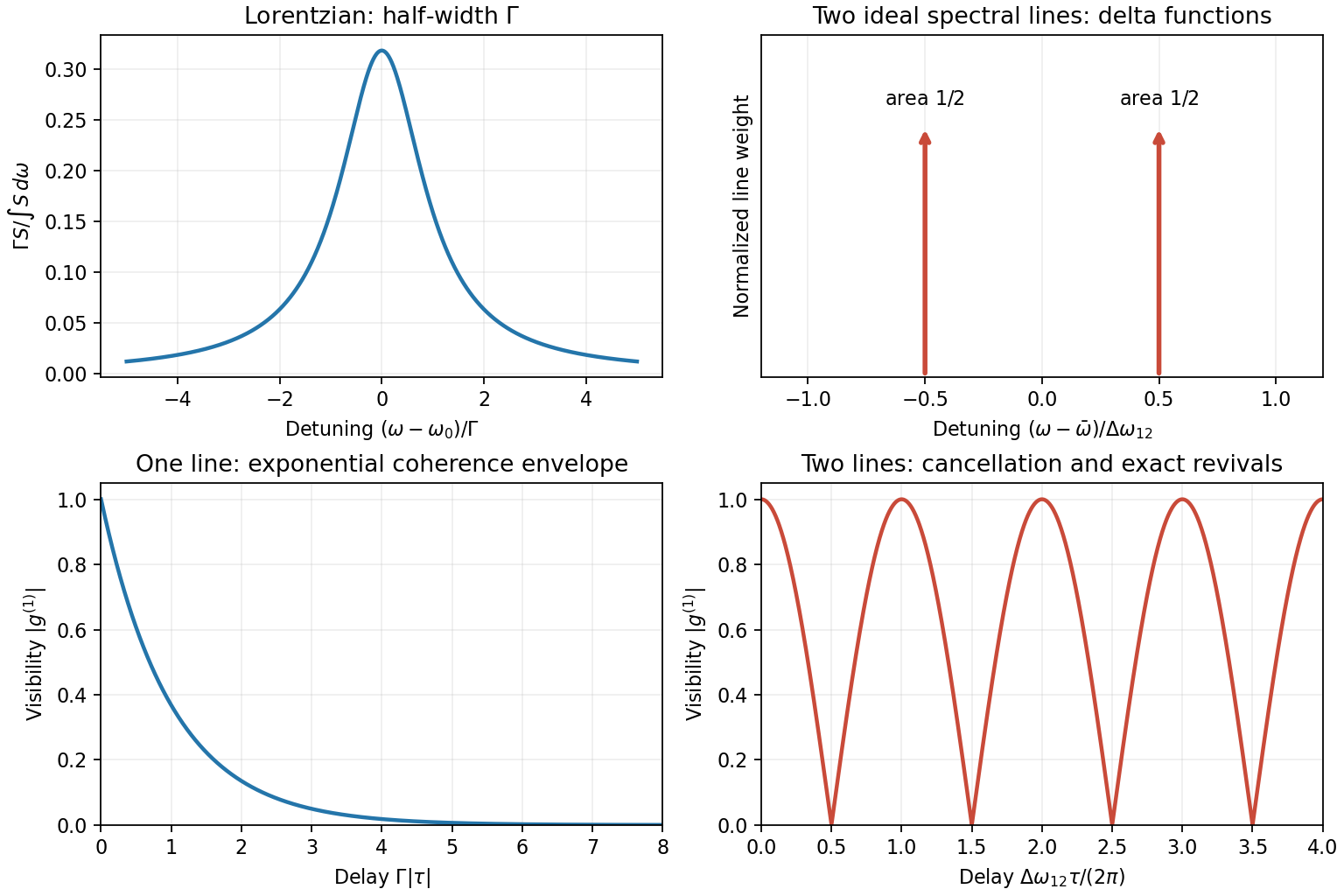


These two examples distinguish irreversible envelope decay from cancellation and revival of discrete spectral components. The line profiles are explicit models, not claimed measurements of a particular source.
The electric potential and magnetic vector potential represent the fields through and . They are not unique: a differentiable function giveswithout changing either field. Gauge fixing restricts this freedom to suit the sources, boundaries or symmetry; it does not alter observables.
The Lorenz gauge is Lorentz covariant. Maxwell's equations then reduce to sourced wave equations,Retarded solutions implement causal radiation conditions. This gauge is useful for radiation and relativistic calculations; residual transformations obey the homogeneous wave equation.[ref]
The Feynman Lectures on Physics, Volume II by Richard Feynman and others. §18–6, Eqs. (18.23)–(18.25): gauge choice and potential wave equations
The Coulomb gauge instead gives . Its electric potential is an instantaneous Poisson solution, but the accompanying magnetic vector potential makes the full physical electric field causal. It is useful in separating longitudinal electric fields from transverse radiation. In a source-free vacuum region, suitable radiation boundary conditions permit radiation gauge , , leaving two transverse plane-wave polarizations. These extra conditions are not a gauge choice applicable unchanged to arbitrary nonzero charge distributions.
Different gauges redistribute information between potentials; the same boundary-value problem gives the same electric fields and magnetic fields.
Articles by others on the same topic
There are currently no matching articles.