Use . A Jones vector records the two transverse complex amplitudes. The amplitude ratio and relative phase determine the polarization ellipse; a common nonzero scalar does not change the polarization. A fixed Jones vector describes fully polarized monochromatic light, not an unpolarized statistical mixture.
Linear birefringence gives orthogonal principal polarizations different refractive indices. Put , so is the fast axis. A plate of thickness gives slow-minus-fast phase retardationThe thinnest quarter-wave plate hasHere is the vacuum wavelength. For linear input at angle to the fast axis, the output at design frequency is up to common phase. Axis-aligned input remains linear; equal nonzero components at modulo give circular polarization; other input angles give elliptical polarization. There is no need to spatially separate the two components.[ref]
The Feynman Lectures on Physics, Volume I by Richard Feynman and others. §33–3: phase accumulation between orthogonal principal polarizations and quarter-wave conversion
For waveplate retardance detuning, defineNeglecting material dispersion reduces this to . Remove the common fast-axis phase. Then . A similar half-wave plate of twice the thickness has twice the retardation, giving . The shared error parameter presumes the same material and matched thickness ratio.
For the half-wave and quarter-wave achromatic circularizer, the first fast-axis angle is and the second is . With the stated passive rotation convention,An explicit expression valid for the given shared error is obtained by putting and definingAt , the half-wave plate rotates the linear input to , which is relative to the second fast axis. ThusThis is circular polarization. With our time convention its fixed-point electric vector is proportional, after a time-origin shift, to ; this specifies the rotation without relying on conflicting handedness conventions.
Expanding the exact product to first order givesThese coefficients are rounded to three significant figures. Before rounding, the derivative is exactly , with . The Jones-component ratio sensitivity therefore vanishes:Only common phase changes at first order. This proves compensation for the prescribed input near the design frequency, not exact achromatic performance throughout the visible spectrum for arbitrary input polarization.
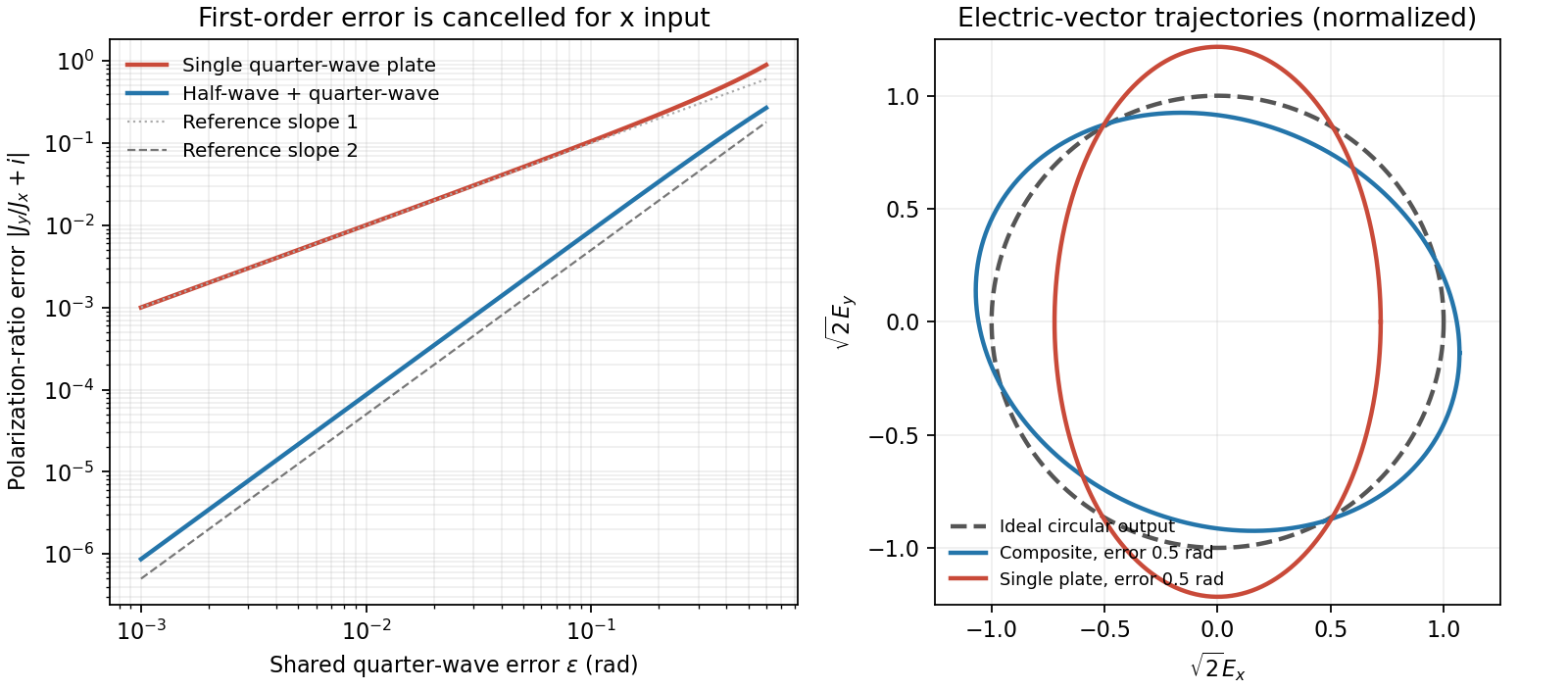
Original comparison of single-plate and composite polarization errors and the composite electric-vector trajectory
. Details. 
Articles by others on the same topic
There are currently no matching articles.