For a twice continuously differentiable stream function, equality of mixed derivatives givesThis is the incompressible flow condition in two dimensions. A streamline is a curve whose tangent at each regular point is parallel to the instantaneous velocity field. Parameterize it by . The chain rule yieldsTherefore the stream function is constant on each streamline. This proof includes arbitrary regular parametrizations; at a stagnation point the velocity vanishes and the usual tangent direction is not determined.
The complex potential of a two-dimensional potential flow is , soFor , a nonzero level isThus the streamlines are circles tangent to the horizontal axis at the excluded singular origin, with centers on the vertical axis. Each circle has the origin removed. The zero level is the horizontal axis without the origin, whose positive and negative rays are separate streamlines. Since is nonzero away from the origin, no other stagnation points intervene. For the flow vanishes everywhere off the origin, so the circle description is replaced by the degenerate zero-velocity field.
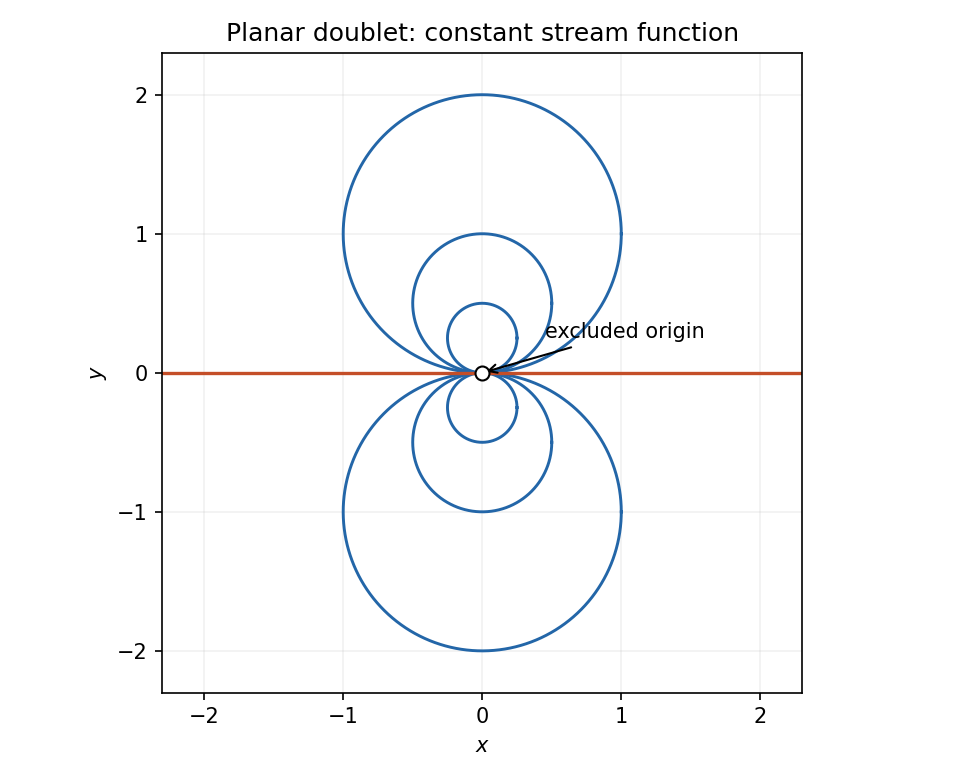
Streamlines of a planar doublet
. Circles tangent at the excluded origin and the two zero-level horizontal rays; the drawing uses positive doublet strength. Details.
The stream function gives and . Its scalar vorticity isFor this does not vanish on any nonempty open region of the plane. A holomorphic complex potential of a two-dimensional potential flow would produce an irrotational flow there. Equivalently, its imaginary part would be a harmonic function, whereas . Thus no complex potential exists on any nonempty open region for this flow; vanishing vorticity only along the vertical line does not provide a two-dimensional domain.
Start from the uniform-flow complex potential of a two-dimensional potential flow . Milne-Thomson's circle theorem adds the image doublet , yielding constant stream function on . Add a line vortex with positive counterclockwise circulation :Indeed, on the uniform-flow and doublet terms sum to the real number , while the vortex has imaginary part , also constant. Thus the cylinder is a streamline and satisfies the impermeability condition. The vortex velocity is in the counterclockwise direction. Although the potential is multivalued when , its velocity is single-valued.
Differentiate and locate the coefficient of in the square:For the counterclockwise contour in the printed Blasius force theorem, the residue theorem gives . ConsequentlyThese are force components per unit cylinder length; with the stated circulation convention the lift is downward for positive .
Articles by others on the same topic
There are currently no matching articles.