For a planar incompressible flow, a stream function satisfies , . A velocity potential satisfies , where the flow is irrotational; such a potential exists locally, and globally on a simply connected nonsingular region. The irrotational flow condition is . Where both exist, the Cauchy-Riemann equations make the complex potential analytic with .
For the logarithmic potential, write . ThenThe outward volume flux per unit span across a circle is . Hence it is a line source of strength . The potential may use local logarithm branches; its velocity is single-valued away from the source.
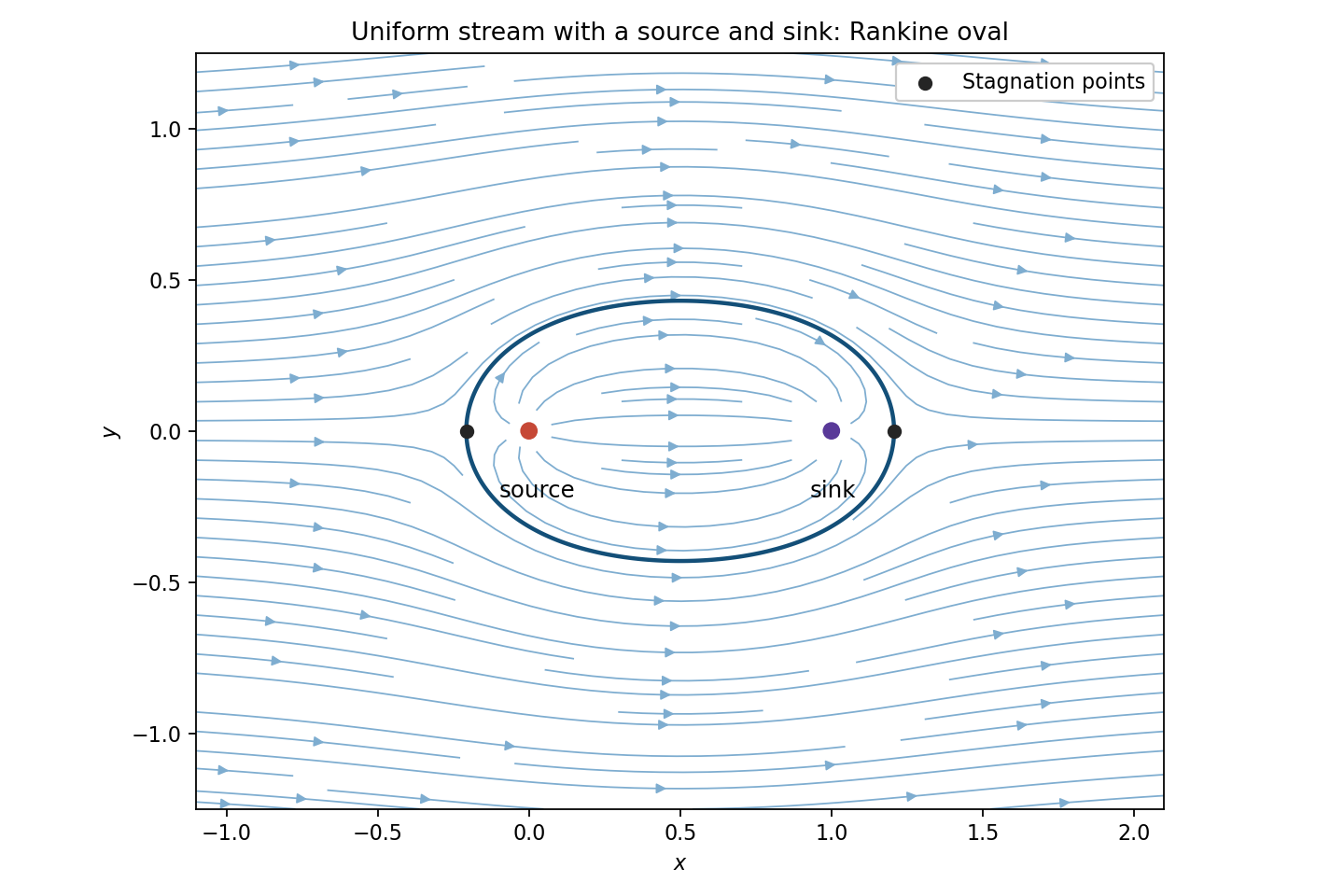
By superposition, the full flow hasFor positive and , the stagnation points areThey are real, one upstream of the source and one downstream of the sink. Away from the singularities, streamlines are level curves ofThe zero level through the two stagnation points contains an upper and a lower separating curve, symmetric about the real axis and about . Together they bound a Rankine oval. Flow inside goes from source to sink; the external stream divides around this oval and tends to horizontal flow far away. This also specifies the sketch for every positive parameter ratio; the figure illustrates one ratio.

For the isolated line vortex, use polar coordinates to obtainThus for nonzero the streamlines are circles and their counterclockwise circulation is . If the fluid is stationary and the streamline description degenerates.
Place an opposite image vortex at . The method of images givesOn , the distances to the two vortex positions agree, so . Hence the wall is a streamline. Directly the wall velocity has andFor the stipulated steady flow, Bernoulli's equation in the irrotational fluid outside the vortex core givesThe force exerted by the fluid on this wall points in the direction for positive pressure. Relative to uniform pressure , however, its change is in the direction. Using the supplied integral, the force change per unit span isThus the wall is attracted towards the vortex, with this magnitude if the other side remains at . Subtracting the uniform pressure is essential for an infinite wall. A freely moving vortex would translate parallel to the wall under its image-induced velocity; the calculation here is for the stated steady vortex configuration, with its position held fixed.
Articles by others on the same topic
There are currently no matching articles.