For a fixed centre , the triangle inequality gives , so the distance-to-centre function is continuous. Its preimage of is the closed ball, hence is closed. Since that closed set contains the corresponding open ball, it contains its closure:Here the bar on the right denotes a closed ball, while the bar on the left denotes closure.
The condition gives the closed squareIts four edges and corners are included, as shown in the left panel of the figure below.
Intersect the ambient balls with . All points on the vertical arm have distance at least from the centre, so the open ball isThe closed ball also contains the endpoints of that segment and the lower half of the vertical arm:The closure of the open ball in is just . Both endpoints are limits of points in the open segment, whereas a vertical point of positive height has a small enough neighbourhood disjoint from it. Thus every point with witnesses strict containment.
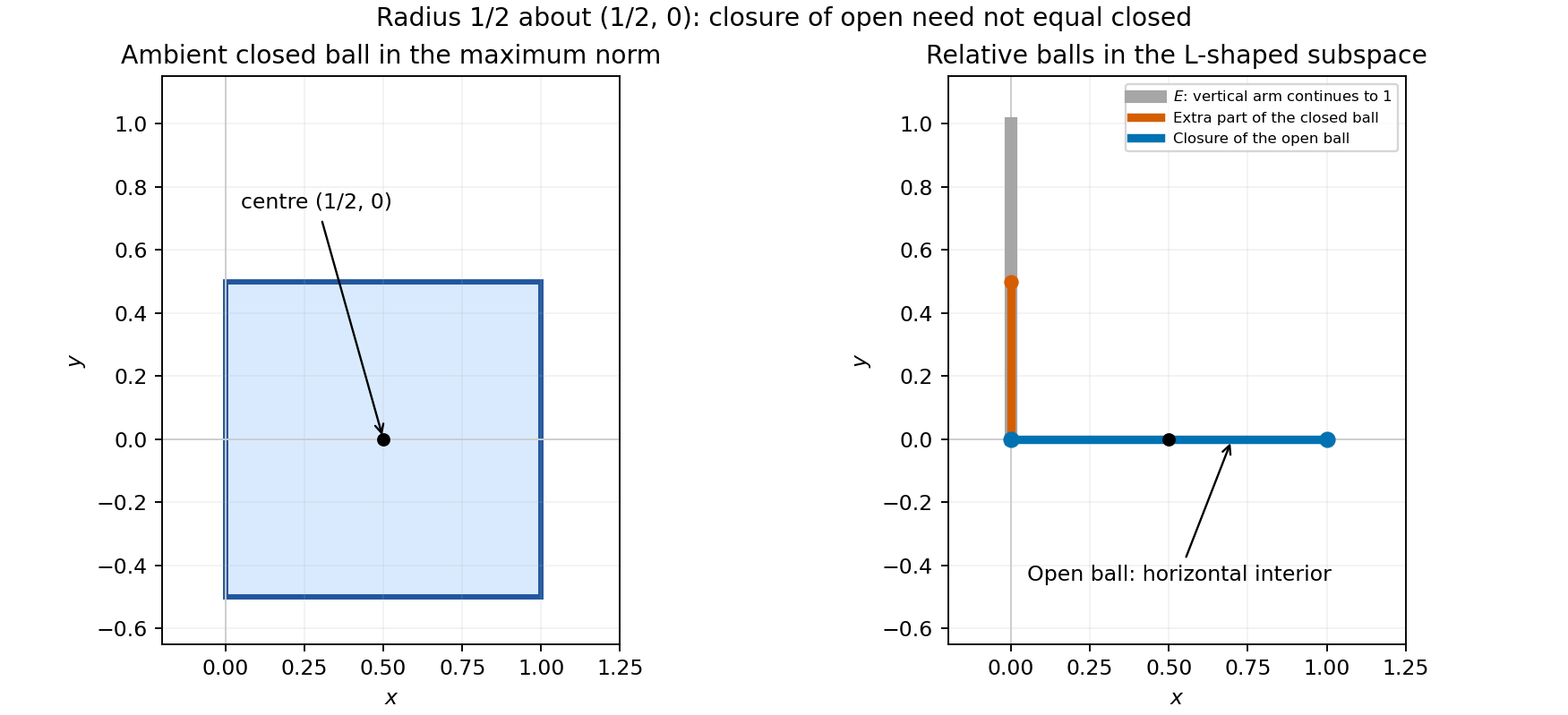
Ambient and relative maximum-norm balls
. The square on the left is the ambient closed ball. On the right, the open ball is the horizontal segment without its endpoints; its closure omits the additional vertical part of the relative closed ball. Details.
Articles by others on the same topic
There are currently no matching articles.