Assume the quoted intensities represent relative emitted photon numbers, with efficiency corrections implicit, as required for population-flow bookkeeping. The prominent branch obeys , and identifies a serial two-photon branch. The energies obey and within their uncertainties. The weak fifth line directly spans D to A. Reversing which end contains the line-1 step and interchanging the serial line-2/line-3 order produces the four possibilities.
Take A as zero. A gamma-ray energy-network fit to the five energy differences gives the following approximate excitation energies in keV:The line connections, in the order , are respectively: I: ; II: ; III: ; IV: .
For I and II, the B population entering through lines 2 or 3 and line 4 exits through line 1. For III and IV, line 1 feeds C and its intensity splits into the direct line 4 and serial lines 2/3. The small direct D-to-A branch bypasses these intermediate balances. The central measured energies do not obey every sum exactly; all four fitted arrangements have for two energy constraints. Assigning the weakest line's central energy as an exact excitation energy would discard the more precise cascade measurements.
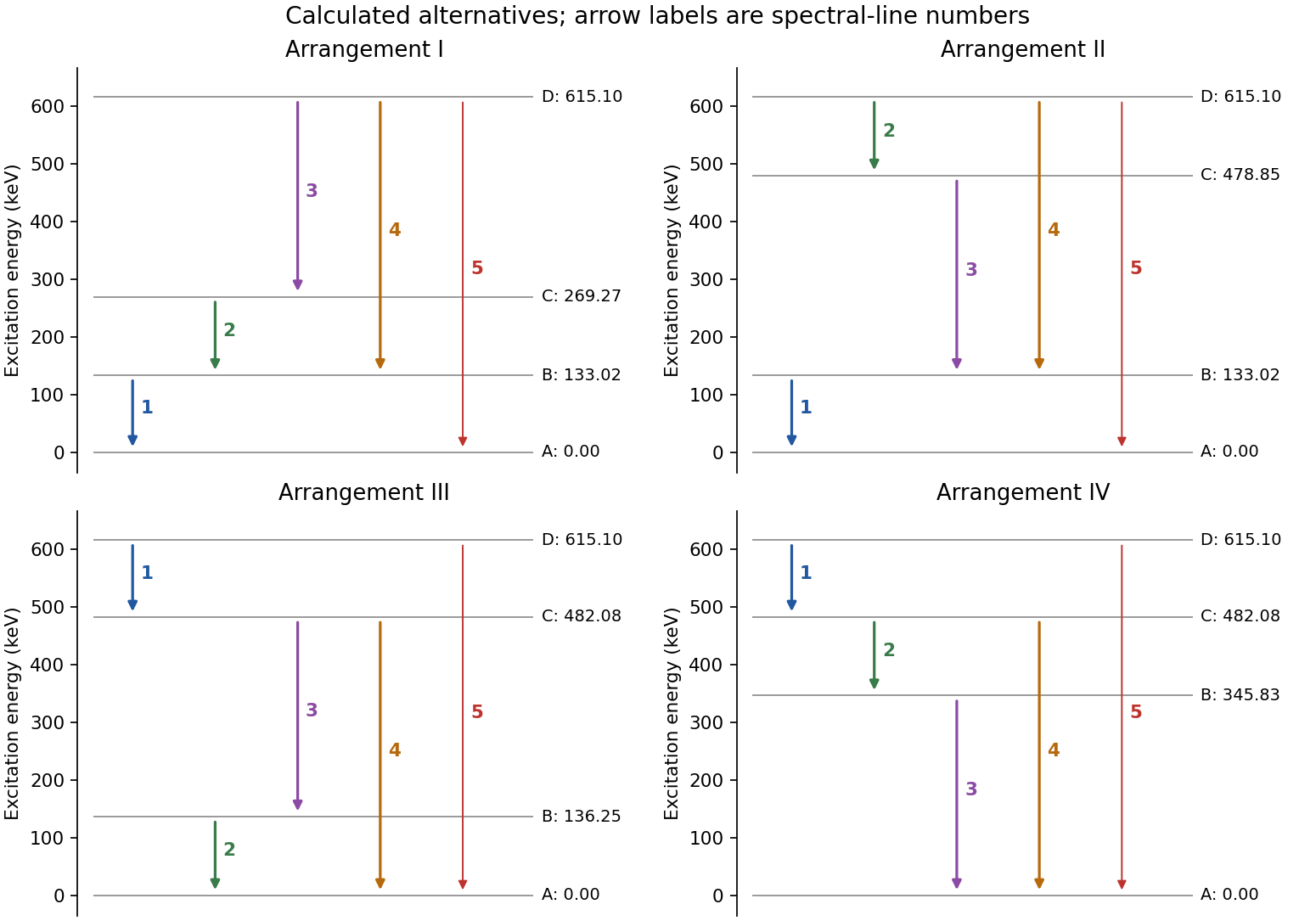
Original reconstructed solutions I–IV, with all five observed line numbers attached to calculated transitions; excitation energies are fitted, not a copy of the source diagram
. Details. 
The symbols and mean electric and magnetic radiation multipoles of order . The orders are called dipole, quadrupole and octupole. They describe the angular structure of charge/current radiation and the total angular momentum carried by the radiation; they do not change the photon's intrinsic spin from one. A real single photon has no monopole radiation mode.
An electric multipole has radiation parity and a magnetic multipole parity . The radiation quantum numbers are thereforeEquivalently, an transition requires , while an transition requires .
For comparable transition energies and ordinary single-particle nuclear strengths in the long-wavelength regime, the usual qualitative ordering is , , , , , from faster to slower. Each increase of multipole order is strongly suppressed, and magnetic radiation is usually weaker than electric radiation of the same order. More precisely,The nuclear reduced transition strength is essential: collective enhancement, cancellation and selection rules can overturn this benchmark. It is not a universal ranking between arbitrary transitions of different energies. The weak measured M3 branch is consistent with high-multipole suppression, but its absolute lifetime cannot be obtained from its arbitrary-unit intensity alone.[ref]
Guidelines for Nuclear Structure Evaluators by Murray J. Martin. Appendix C, printed pp.60–67, transition rates and Weisskopf single-particle estimates
For a single-photon transition, angular momentum addition requires , , together with the electric/magnetic parity rules above. Thus a known final state and a measured multipole restrict both the spin difference and parity of the emitting level. For example, an E1 line reverses parity and allows except ; a mixed M1+E2 line preserves parity and must satisfy both angular triangles. An E2 line preserves parity and allows spin differences up to two.
Line energies identify connected levels, while calibrated intensities and coincidences test cascade flow and branching. If a proposed assignment permits a fast low-order transition to a lower state, an experimentally stringent absence of that line argues against the assignment. Nevertheless, an allowed transition can have a small or vanishing nuclear matrix element. Pure E2 radiation alone does not prove that M1 is forbidden by angular momentum. Detection sensitivity, efficiency and overlap must be considered, and in real nuclei internal conversion can remove photons; this question explicitly excludes that competing channel. Lifetimes or reduced-strength estimates make a missing-line argument substantially stronger than a bare selection-rule statement.
Use arrangement III. Lines 2 and 4 connect B and C to A, line 3 connects C to B, line 1 connects D to C, and line 5 connects D to A. Every measured multipole preserves parity, so B, C and D all have positive parity. The two mixed M1+E2 transitions to strictly implyThe measured E2 C-to-B and D-to-C transitions require and , with their angular sums at least two. The M3 D-to-A line gives and . These inequalities, with half-integer spins, are the strict observed-line constraints. They do not alone fix unique spins.
The customary low-multipole-dominance inference goes further. If lower-order allowed radiation would not be accidentally hindered, a pure M3 D-to-A decay indicates , giving or . Its E2 connection to C then forces or , respectively. Treating the pure E2 C-to-B transition similarly as a spin change of two selectsIn either assignment the missing D-to-B line changes spin by four. Its lowest parity-preserving multipole is E4, so it is naturally much weaker than the observed E2 D-to-C branch. This spin-reflection ambiguity around the reference spin is not resolved by the spectra under this approximation.
The boxed alternatives are conditional on ordinary, unhindered lower-multipole strengths. If accidental or structural hindrance is allowed, other spins satisfying the preceding inequalities remain possible: an upper limit on an unobserved lower multipole does not mathematically prove its selection-rule prohibition. The supplied intensities and absence of other comparable lines support the usual assignments but do not supply measured reduced strengths sufficient to eliminate that qualification.
Articles by others on the same topic
There are currently no matching articles.