There are three free-particle rest-energy terms and five nuclear corrections. In the paper's natural units, their meanings are:
- : the rest energy of free protons.
- : the rest energy of the atomic Electrons; including this term makes the result an atomic, rather than bare nuclear, mass. Small atomic binding energies are neglected.
- : the rest energy of the free neutrons.
- , with : the attractive volume term. The short-range nuclear force mainly binds each nucleon to nearby neighbours, so the leading attraction is extensive.
- : the surface correction. Surface nucleons have fewer neighbours and are less bound; surface area grows as at approximately constant nuclear density.
- : the nuclear Coulomb energy cost of repelling protons, scaling as with nuclear radius .
- : the nuclear symmetry energy, penalizing unequal neutron and proton populations. The Pauli exclusion principle forces an excess species into higher single-particle states; strong-interaction effects also contribute.
- : nuclear pairing. It lowers the mass for even-even nuclei, raises it for odd-odd nuclei, and vanishes for odd in the stated model.
The sign convention is significant: the quantity labeled in the supplied mass formula is added to the free-particle masses and is normally negative for a bound nucleus. It is the negative of the conventional positive nuclear binding energy :The coefficients must therefore retain their printed signs; using positive while still adding it to the masses would be inconsistent.
In the supplied signed convention, and omitting pairing, the four contributions per nucleon areThe volume contribution is the constant . The positive surface correction decreases with . At fixed proton fraction , the positive Coulomb correction grows as , while the asymmetry correction is constant. Along the beta-stable valley the fraction itself falls, and the asymmetry correction consequently grows.
Because the formula depends on both and , no unique plot against exists until a path is chosen. The original sketch below uses the continuous minimum of the nuclear Coulomb-plus-asymmetry terms,ignoring the small neutron-proton-electron rest-mass difference in locating that path. This is a stated smooth approximation to the valley of stability, not an assertion that nuclei have noninteger .
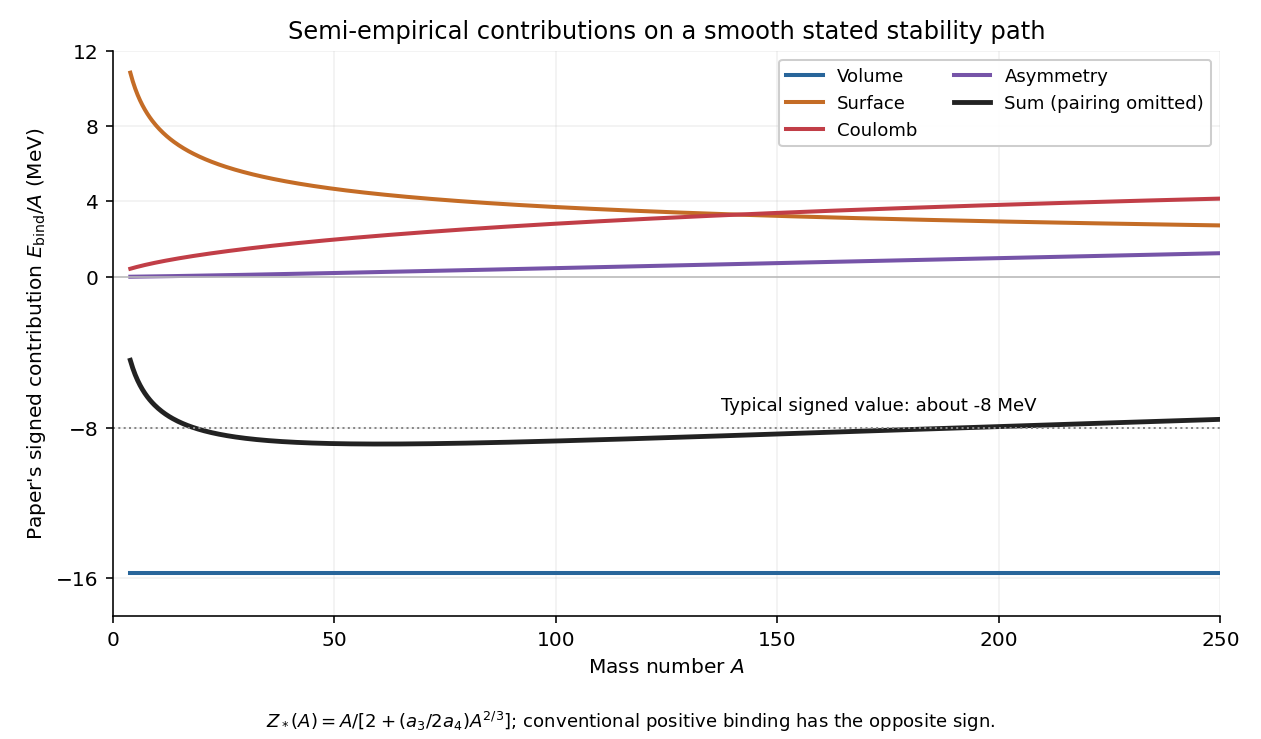
Signed semi-empirical binding-energy contributions along a stated smooth stability path
. Details. 
The four individual terms and their sum appear in one plot. A typical well-bound nucleus has in the paper's convention, equivalently conventional positive binding energy per nucleon . If a positive-binding-energy plot is preferred, every plotted contribution must have its sign reversed. The competition between the surface and Coulomb penalties gives the familiar maximum of positive binding per nucleon near the iron-group nuclei.
The qualitative explanation is nuclear pairing: is odd-odd (), while both and are even-even. At , moving from the odd-odd to either even-even branch lowers the pairing contribution to the atomic mass byTwo neighboring even-even nuclear isobars can therefore both be lower in mass than the intervening odd-odd member. The two possible directions areHowever, the particular coefficients printed in this paper do not quantitatively reproduce both allowed directions. Let . Using every supplied term, rather than pairing alone, givesThus this parametrization would forbid the calcium beta-minus branch. The physical atomic mass differences are instead approximately to argon and to calcium, so both physical directions are allowed.[ref]
The valid interpretation is therefore pairing explains how both directions can be possible, but the supplied smooth mass formula is insufficient to establish both for this isotope. The semi-empirical mass formula has MeV-scale residual errors and omits nuclear shell closure corrections; has the especially stable shell closures. One must use measured masses or a model with those corrections for a quantitative proof, rather than changing the printed numbers silently.
The two processes are electron capture and beta-plus decay:For neutral atomic masses, their available total energies obeyHence electron capture has approximately more available energy. Electron-hole energies and nuclear recoil give smaller corrections for capture from a particular shell. With the physical mass difference, and the positron kinetic-energy budget is only about .
Electron capture dominates the argon-producing decays. Energetic advantage alone is not a universal theorem about branching fractions: electron density at the nucleus and nuclear transition matrix elements and selection rules also matter. In this case capture can populate the approximately excited argon level, whereas positron emission cannot; this is an additional reason the physical capture branch is much larger.[ref]
The KDK experiment by KDK collaboration (2021). Dominant capture branch to the 1460.8-keV argon level and rare positron branch
The number of radioactive atoms is determined by the supplied isotope mass, rather than by the total body mass:The radioactive activity is , with nuclear decay constant . Using ,ThereforeA becquerel is one decay per second; this is total activity over all decay branches. Multiplying by the argon-producing branching fraction would give that branch's activity, not the total asked for. Activity alone is also distinct from an absorbed radiation dose.
Let be the surviving potassium-40 population and the accumulated radiogenic argon-40. The total nuclear decay constant sets . Only fraction of lost potassium atoms produces argon, so under the stated retention and zero-initial-argon assumptions,Dividing by the present potassium abundance eliminates the unknown initial population:With ,Thus the inferred potassium-argon dating age is about billion years, consistent with the proposed -year age to the accuracy of the supplied inputs. Omitting the branching fraction would seriously underestimate the age. At exactly billion years, the model predicts , consistent with the rounded measured .
This dates closure of the mineral to argon loss and potassium exchange under the assumptions, not necessarily its original crystallization or the first formation of the Earth's crust. The depth alone is not an age measurement. No uncertainty or argon-retention history is supplied, so the agreement is a consistency check rather than proof of a particular geological event.
Articles by others on the same topic
There are currently no matching articles.