Parity is full spatial reflection, , represented by a parity operator . A polar vector, such as momentum, reverses, whereas an axial vector, such as spin, does not. A state of definite parity has , with in the usual convention. A multiparticle state's parity includes both the product of its intrinsic parities and its orbital spatial factor, for example for relative orbital angular momentum .
An interaction conserves parity when its dynamics are invariant under this transformation, equivalently for a time-independent Hamiltonian. Parity violation means that a process and its fully reflected counterpart need not have the same probability. It is more than a left-right asymmetry in an unreflected laboratory apparatus.
The electromagnetic and strong sectors of the Standard Model conserve parity to the accuracy relevant here, taking the strong-sector Yang-Mills theta term to vanish. The weak charged current selects left-chiral fermions and right-chiral antifermions, as defined by fermion chirality; the reflected right-chiral charged current is not equally present. The neutral weak current also generally has different left- and right-chiral couplings. Consequently the weak sector violates parity; this does not mean that every individual weak decay must have opposite initial and final parity. For a massive particle, helicity and fermion chirality should be distinguished.
In the Wu experiment, Chien-Shiung Wu and collaborators studied beta-minus decay of polarized cobalt-60,A thin cobalt-60 layer on a cerium magnesium nitrate crystal was cooled by adiabatic demagnetization to a few millikelvin. A polarizing magnetic field produced nuclear polarization. An anthracene scintillation counter and photomultiplier detected the emitted Electrons; angular gamma ray observations from the daughter de-excitation monitored whether the nuclei remained polarized.[ref]
Experimental Test of Parity Conservation in Beta Decay by Chien-Shiung Wu and others. Apparatus and polarization controls, pp. 1413–1414
The Electrons were emitted preferentially opposite the parent nuclear spin. Reversing the nuclear polarization reversed the asymmetry, while warming the sample removed both polarization and the effect. Those controls distinguished a spin-correlated asymmetry from a fixed detector bias.
The relevant angular correlation is a polarized beta-decay angular distribution of the formUnder parity, but , so the spin-momentum correlation changes sign. Parity conservation would require equal rates for these two directions relative to the same spin. The observed nonzero coefficient therefore demonstrated parity violation in beta decay. An unpolarized source would average this correlation to zero and could not provide the same test.
For both modes, a leading weak quark transition in is , followed by , with the original acting as a spectator quark. This produces the four quarks needed for , using the component of . Producing three pions additionally requires a pair from strong hadronization. A representative quark-line diagram draws it as gluon emission and splitting.
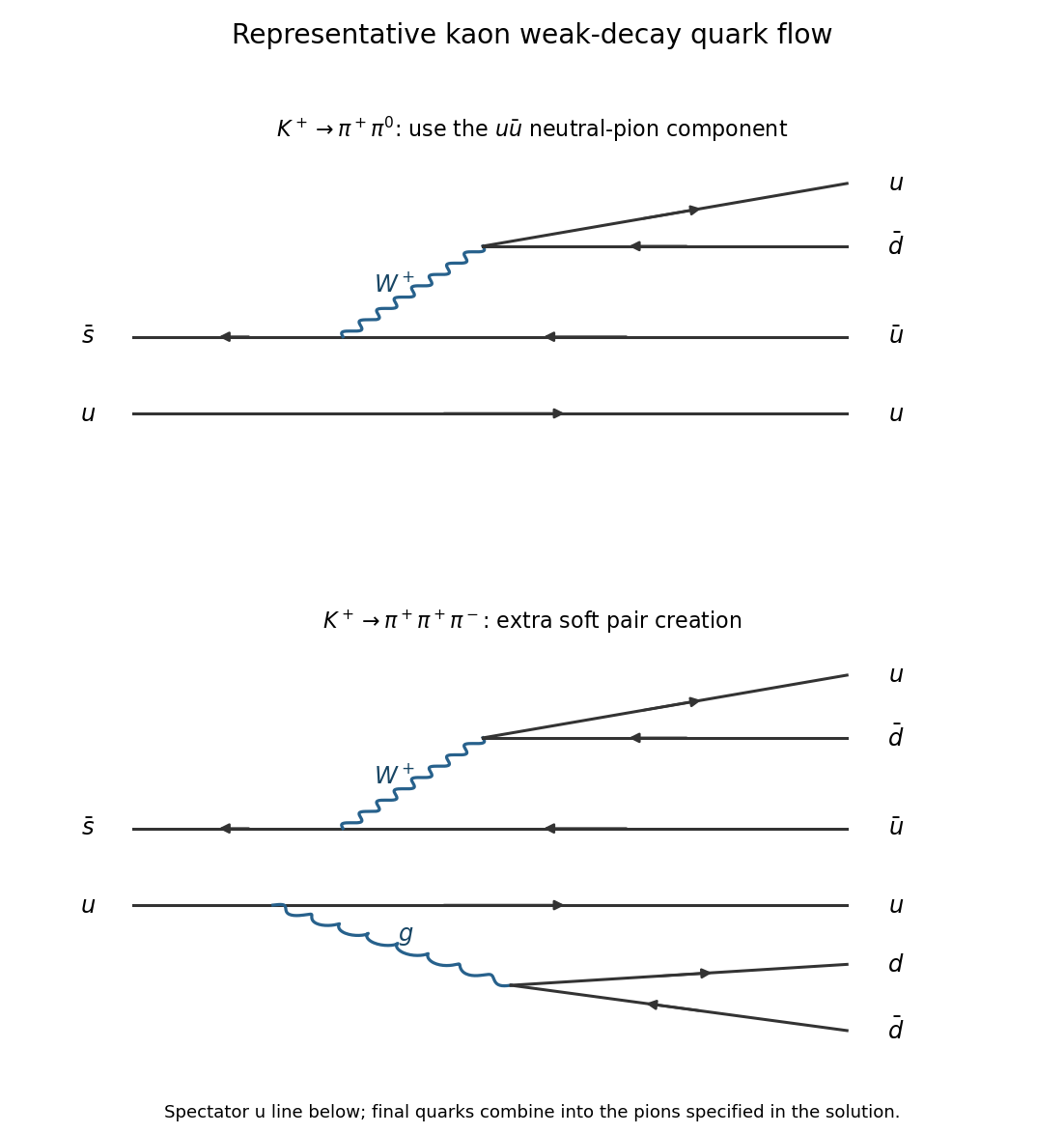
The three-pion assignment is , , and , matching . The extra soft pair creation is a schematic representation of hadronization, not a controlled perturbative prediction of the relative decay rates. Both processes are first order in the effective weak interaction.
There is an explicit error or hypothetical assumption to address: the original PDF assigns to all these mesons. Taken literally, the two-pion final state has , because all particles have zero spin and the initial is zero. Its parity is . For three spinless particles, use two Jacobi orbital angular momentum quantum numbers . Coupling to total zero requires , so the orbital parity is and the three-particle parity is also . Thus under the printed assignment, both channels conserve parity.
The named physical pions and kaons are instead pseudoscalar mesons with . With those physical assignments,ThereforeThese two opposite-parity final states from the same physical kaon are a classic illustration of parity violation in a weak decay. The physical conclusion requires correcting the printed parity assignment explicitly.
The antiquark in the specified is a spectator. For the charmed final state the leading external-W boson tree iswith and . For the charmless final state replace the active transition by , giving and the same . Their weak amplitudes have factors and , respectively, up to an irrelevant overall conjugation convention.
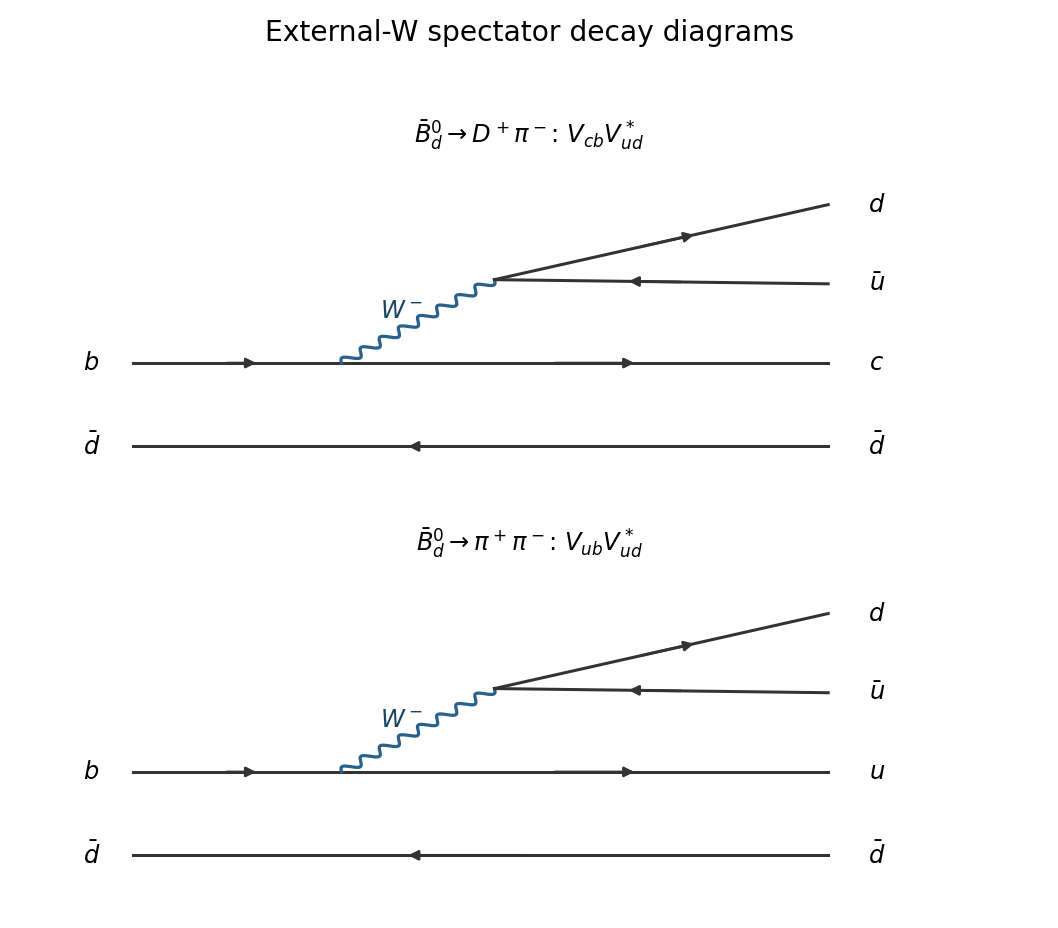
The diagrams determine the leading weak flavour factors. Strong-interaction matrix elements and, particularly for the charmless channel, additional loop diagrams can also contribute to physical branching fractions.
Ignoring the requested final-mass difference and initially taking equal hadronic matrix elements, the common factor cancels. A decay width is proportional to the squared decay amplitude, soWith the supplied Cabibbo angle,The quoted measurement, about , is larger by a factor . If that whole difference were attributed to a ratio of other amplitudes, it would require a factor .
This does not invalidate quark mixing. The supplied Cabibbo-Kobayashi-Maskawa matrix is only a schematic hierarchy in powers of , particularly for ; its omitted coefficients matter greatly after squaring. Equal phase space also does not imply equal hadronic decay amplitudes: the two transitions have different hadronic form factors and strong-interaction dynamics, and loop contributions can interfere with the charmless tree amplitude. Thus the calculation correctly predicts enhancement of the charmed channel, but the supplied CKM hierarchy alone does not quantitatively predict the measured ratio. It would be unjustified to treat as a precision prediction with only the quoted experimental error.
In the pion rest frame, write its four-momentum as and the charged lepton's as . By four-momentum conservation, the massless antineutrino has , with . ThereforeIts energy is , and for a massless antineutrino, . The final momenta are equal and opposite, soThe expression is positive precisely when the two-body decay is energetically allowed, , neglecting the neutrino mass.
The variable initial energy replaces in the kinematic expression before differentiation. The charged-lepton mass remains fixed:Thus the required Jacobian determinant in this one-dimensional change of variables isEquivalently, gives , so , the same result. It is dimensionless in natural units.
In the simple box-state counting used here, the final three-momentum lies in a spherical shell: , where the common constant contains the normalization volume and angular factor. Momentum conservation fixes the other final particle's momentum. Hence the density of states isCombining parts (a) and (b) givesWith the paper's rounded masses,By Fermi's golden rule, equal squared matrix elements make the rate ratio equal to this density ratio. Thus the naive constant-matrix-element estimate is , which favours the electronic decay by about to one.
This is the particular noncovariant state-counting convention in the question. A calculation with the Lorentz-invariant phase-space measure places factors in the measure and correspondingly normalizes its decay amplitude differently. Only the complete product of phase space and squared matrix element is convention-independent; mixing the two conventions would give a wrong rate.
The charged pion has valence content . Its constituents annihilate into a virtual W boson, followed by the lepton pair:
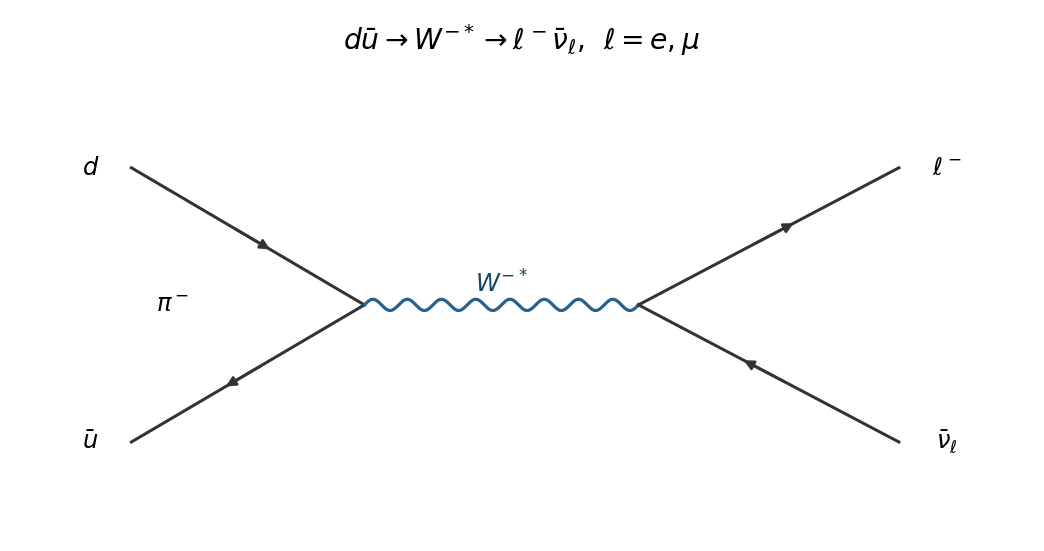
The quark vertex carries the -- Cabibbo-Kobayashi-Maskawa matrix element, and the leptonic vertex is the weak charged current. The pion's nonperturbative spatial structure is encoded in the pion decay constant when evaluating the decay amplitude.
A spin-zero pion has no preferred emission direction. Choose the antineutrino momentum along . A massless antineutrino has positive helicity, so its spin points along . The muon moves along , and total requires its spin to point along :
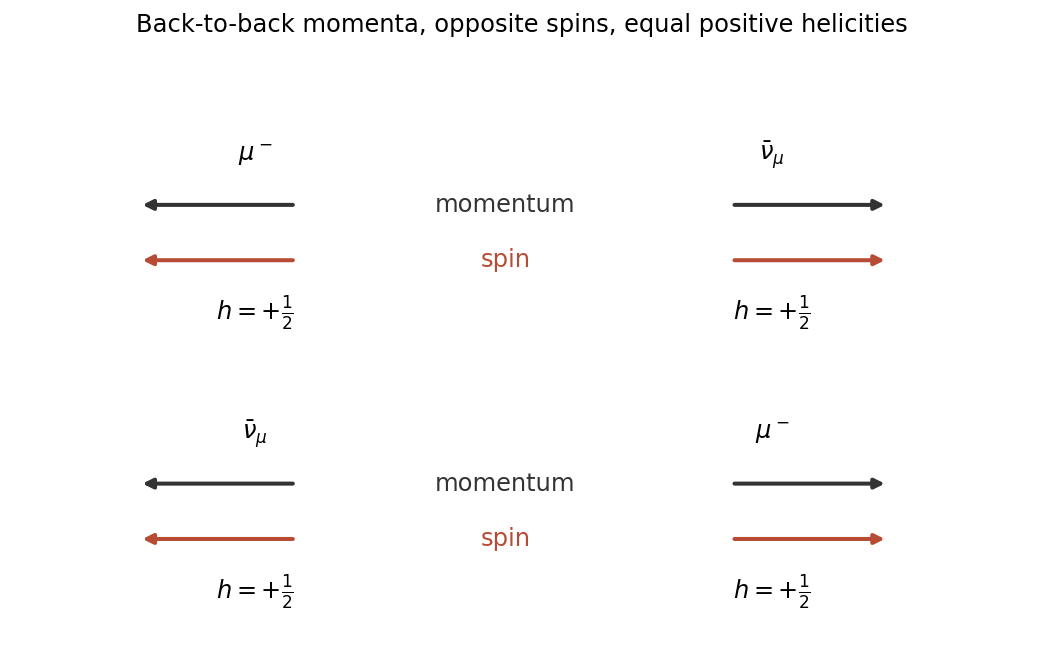
The reversed configuration is obtained by rotating the entire event and is equally allowed. The two spins are opposite, while each is aligned with its own particle's momentum; both outgoing helicities are positive. A negative-helicity muon with this fixed antineutrino direction would give a nonzero total spin projection and is forbidden for this two-body decay of a spin-zero parent. The required positive-helicity charged lepton is the suppressed component of the weak charged current.
For the charged lepton, and . Their ratio is therefore its speed in natural units. Using part (a),Numerically,The Electron is almost ultrarelativistic, while the muon is relatively slow. In ordinary units these are approximately and .
The weak charged current creates a negative charged lepton in a left-chiral state. For a massless particle, that would have negative helicity; part (e) instead requires positive helicity. A nonzero mass supplies the necessary wrong-helicity component. This helicity suppression is extremely strong for the fast Electron, but much weaker for the slow muon.
For a positive-helicity charged lepton with spinors normalized to unit probability, the left-chiral weight is . With the box-state normalization of part (c), this gives the useful consistent rate ratioIndeed cancels the extra energy-dependent factor in that density ratio, leaving the standard pion electron-to-muon decay ratio in inverted form:Using the rounded masses in this paper gives , close to the stated order of . Precision predictions require more accurate masses and electromagnetic radiative corrections. The essential mechanism is the charged-lepton-mass dependence of the decay amplitude; simply counting available final momenta misses it.
Use a high-energy proton beam on a target to produce secondary pions, then select and focus the negative ones. A magnetic horn and a charge-selecting dipole system remove positive pions, limiting wrong-sign contamination. Select a narrow range of magnetic rigidity; if additional species rejection is available, velocity or mass discrimination reduces negative kaon contamination at the same momentum.
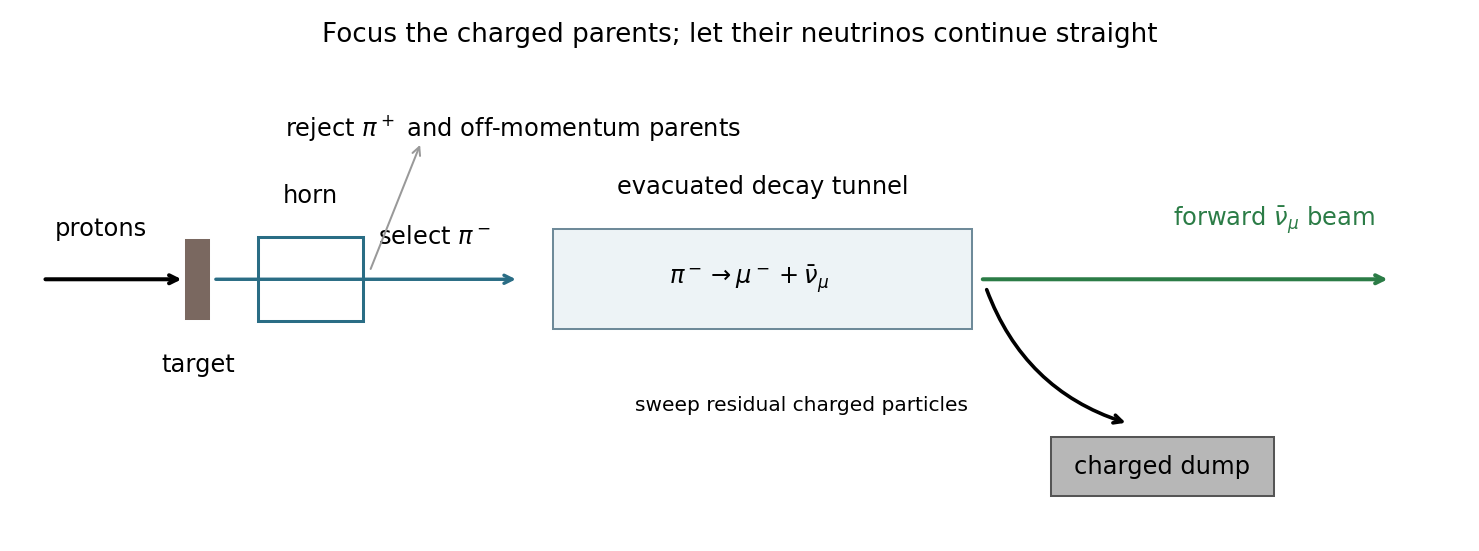


The selected travel through an evacuated decay tunnel and undergo . Their forward Lorentz boost concentrates the antineutrinos within an angle of order . Choose a tunnel long enough for substantial pion decay but short compared with the boosted muon decay length. Since is much longer than , this reduces secondary contamination.
Downstream magnets sweep the remaining charged particles into absorbers, and shielding stops residual hadrons and muons. The antineutrino beam continues straight through. Parent-particle collimation, charge selection, and a forward detector improve purity; neutral-kaon decays, remaining wrong-sign parents, and muon decays prevent perfect purity. Neutrinos themselves cannot be focused or charge-selected by these magnets. Neutrinos produced after stopped-muon decay or capture are much less forward and can be reduced by directional and energy selection.
There are three free-particle rest-energy terms and five nuclear corrections. In the paper's natural units, their meanings are:
- : the rest energy of free protons.
- : the rest energy of the atomic Electrons; including this term makes the result an atomic, rather than bare nuclear, mass. Small atomic binding energies are neglected.
- : the rest energy of the free neutrons.
- , with : the attractive volume term. The short-range nuclear force mainly binds each nucleon to nearby neighbours, so the leading attraction is extensive.
- : the surface correction. Surface nucleons have fewer neighbours and are less bound; surface area grows as at approximately constant nuclear density.
- : the nuclear Coulomb energy cost of repelling protons, scaling as with nuclear radius .
- : the nuclear symmetry energy, penalizing unequal neutron and proton populations. The Pauli exclusion principle forces an excess species into higher single-particle states; strong-interaction effects also contribute.
- : nuclear pairing. It lowers the mass for even-even nuclei, raises it for odd-odd nuclei, and vanishes for odd in the stated model.
The sign convention is significant: the quantity labeled in the supplied mass formula is added to the free-particle masses and is normally negative for a bound nucleus. It is the negative of the conventional positive nuclear binding energy :The coefficients must therefore retain their printed signs; using positive while still adding it to the masses would be inconsistent.
In the supplied signed convention, and omitting pairing, the four contributions per nucleon areThe volume contribution is the constant . The positive surface correction decreases with . At fixed proton fraction , the positive Coulomb correction grows as , while the asymmetry correction is constant. Along the beta-stable valley the fraction itself falls, and the asymmetry correction consequently grows.
Because the formula depends on both and , no unique plot against exists until a path is chosen. The original sketch below uses the continuous minimum of the nuclear Coulomb-plus-asymmetry terms,ignoring the small neutron-proton-electron rest-mass difference in locating that path. This is a stated smooth approximation to the valley of stability, not an assertion that nuclei have noninteger .
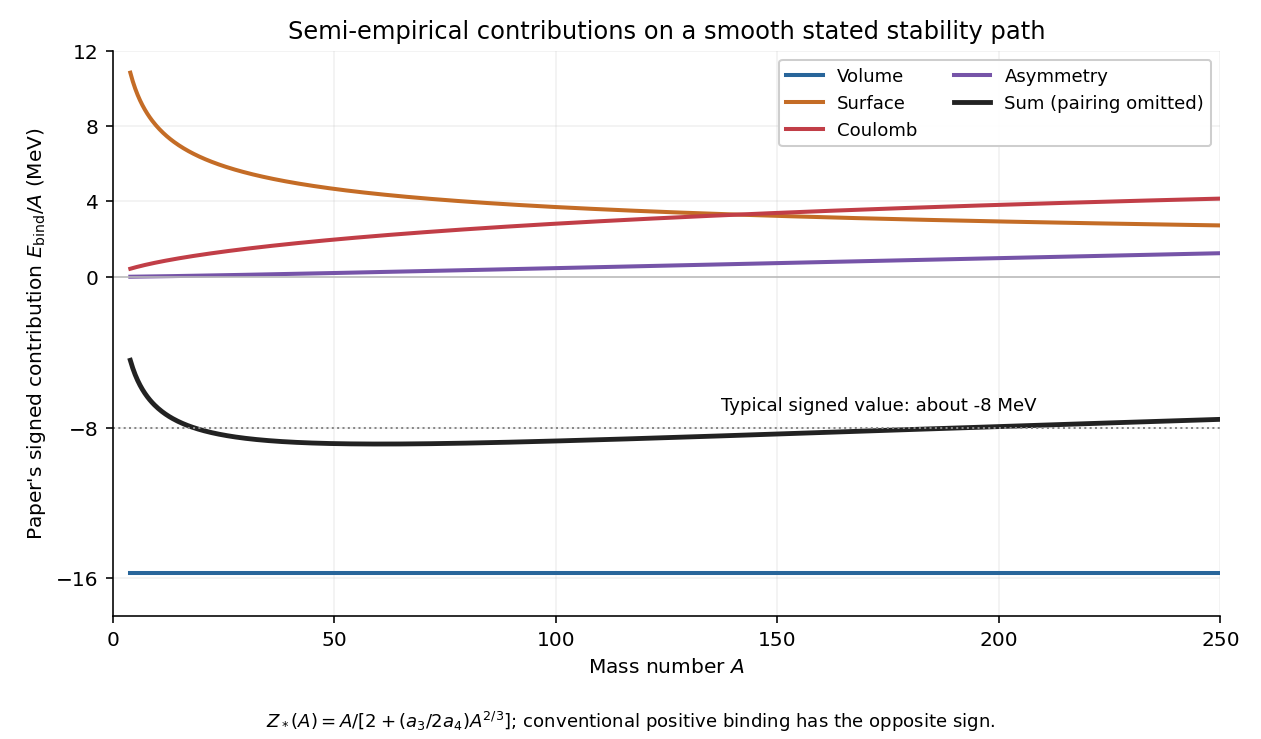
Signed semi-empirical binding-energy contributions along a stated smooth stability path
. Details. 
The four individual terms and their sum appear in one plot. A typical well-bound nucleus has in the paper's convention, equivalently conventional positive binding energy per nucleon . If a positive-binding-energy plot is preferred, every plotted contribution must have its sign reversed. The competition between the surface and Coulomb penalties gives the familiar maximum of positive binding per nucleon near the iron-group nuclei.
The qualitative explanation is nuclear pairing: is odd-odd (), while both and are even-even. At , moving from the odd-odd to either even-even branch lowers the pairing contribution to the atomic mass byTwo neighboring even-even nuclear isobars can therefore both be lower in mass than the intervening odd-odd member. The two possible directions areHowever, the particular coefficients printed in this paper do not quantitatively reproduce both allowed directions. Let . Using every supplied term, rather than pairing alone, givesThus this parametrization would forbid the calcium beta-minus branch. The physical atomic mass differences are instead approximately to argon and to calcium, so both physical directions are allowed.[ref]
The valid interpretation is therefore pairing explains how both directions can be possible, but the supplied smooth mass formula is insufficient to establish both for this isotope. The semi-empirical mass formula has MeV-scale residual errors and omits nuclear shell closure corrections; has the especially stable shell closures. One must use measured masses or a model with those corrections for a quantitative proof, rather than changing the printed numbers silently.
The two processes are electron capture and beta-plus decay:For neutral atomic masses, their available total energies obeyHence electron capture has approximately more available energy. Electron-hole energies and nuclear recoil give smaller corrections for capture from a particular shell. With the physical mass difference, and the positron kinetic-energy budget is only about .
Electron capture dominates the argon-producing decays. Energetic advantage alone is not a universal theorem about branching fractions: electron density at the nucleus and nuclear transition matrix elements and selection rules also matter. In this case capture can populate the approximately excited argon level, whereas positron emission cannot; this is an additional reason the physical capture branch is much larger.[ref]
The KDK experiment by KDK collaboration (2021). Dominant capture branch to the 1460.8-keV argon level and rare positron branch
The number of radioactive atoms is determined by the supplied isotope mass, rather than by the total body mass:The radioactive activity is , with nuclear decay constant . Using ,ThereforeA becquerel is one decay per second; this is total activity over all decay branches. Multiplying by the argon-producing branching fraction would give that branch's activity, not the total asked for. Activity alone is also distinct from an absorbed radiation dose.
Let be the surviving potassium-40 population and the accumulated radiogenic argon-40. The total nuclear decay constant sets . Only fraction of lost potassium atoms produces argon, so under the stated retention and zero-initial-argon assumptions,Dividing by the present potassium abundance eliminates the unknown initial population:With ,Thus the inferred potassium-argon dating age is about billion years, consistent with the proposed -year age to the accuracy of the supplied inputs. Omitting the branching fraction would seriously underestimate the age. At exactly billion years, the model predicts , consistent with the rounded measured .
This dates closure of the mineral to argon loss and potassium exchange under the assumptions, not necessarily its original crystallization or the first formation of the Earth's crust. The depth alone is not an age measurement. No uncertainty or argon-retention history is supplied, so the agreement is a consistency check rather than proof of a particular geological event.
Articles by others on the same topic
There are currently no matching articles.