Use the usual Feynman rule convention in which the diagonal quadratic terms of the free Lagrangian, including the physical W boson and Z boson masses, are incorporated into their propagators. Then there areA line joining two ends is a propagator, not an interaction vertex. Gauge boson self-interactions begin with cubic terms in the Yang-Mills theory Lagrangian. The question's name four families: they include eight gluon colour components and the two charged W bosons .
There is a convention to distinguish here: if a calculation expands around massless free fields, quadratic and terms may be drawn as two-leg mass insertions. Those two insertion types belong to that bookkeeping convention. Similarly, two-point self-energy corrections occur in loop diagrams. Neither is an additional fundamental interaction in the standard physical-mass, tree-level rules used for the count above.
There are three vertex types, with all legs labeled in the following original drawings: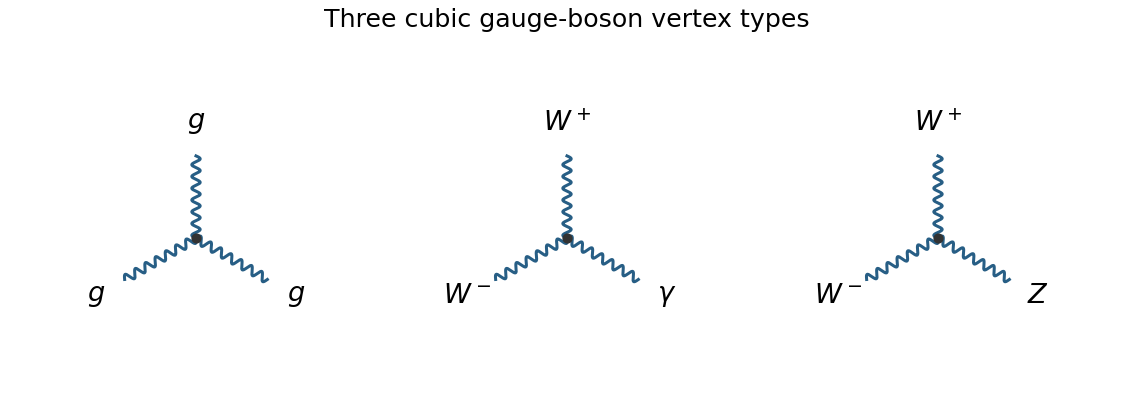
Figure 1.
The three fundamental cubic gauge-boson vertex types
. Details. 
The gluon cubic interaction vertex follows from the non-Abelian gauge field strength of Quantum chromodynamics. The electroweak Yang-Mills theory Lagrangian, after expressing the fields in the physical charged and neutral basis, produces the two charged-W boson vertices. In particular there are no fundamental , , , or vertices, and the separate colour and electroweak gauge factors do not generate a mixed or vertex. The count is by the boson labels requested, not by separate assignments of gluon colour indices.
There are five vertex types: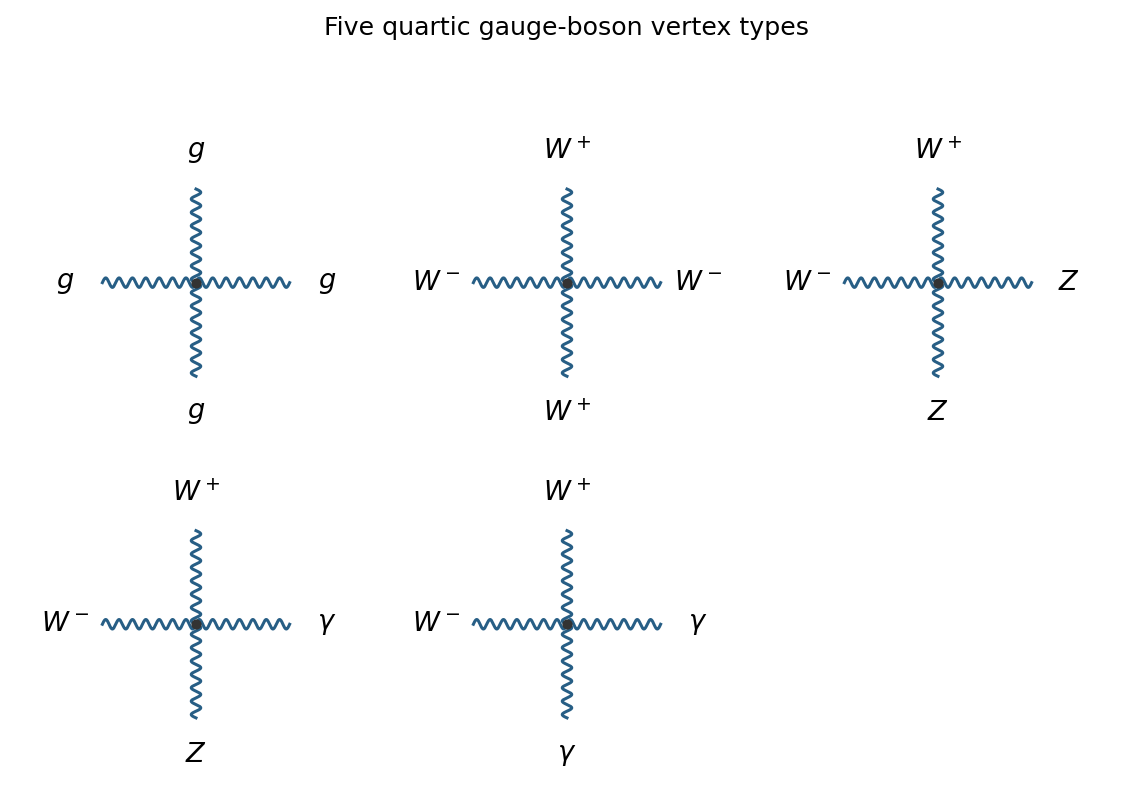
Figure 1.
The five fundamental quartic gauge-boson vertex types
. Details. 
The quartic terms arise from the square of the quadratic-field piece of the non-Abelian gauge field strength. Every electroweak quartic gauge boson self-interaction contains a pair. The absence of a fundamental purely neutral quartic vertex does not forbid amplitudes such as light-by-light scattering: those can be generated by loop diagrams, rather than by a single fundamental interaction vertex.
There areFor a Yang-Mills theory, schematically . The gauge kinetic Lagrangian is quadratic in , so its terms are at most quartic in the gauge fields:Thus there is no elementary five-leg pure-gauge interaction vertex in the renormalizable Standard Model. A five-boson scattering amplitude can still be assembled from several lower-valence vertices, or generated by loop diagrams. The number of external legs of a complete Feynman diagram is not the valence of a fundamental vertex.
Articles by others on the same topic
There are currently no matching articles.