All three processes are weak charged current transformations between neighboring nuclear isobars. Neglecting neutrino masses, and writing for a neutral atomic mass, their Q values are:
- Beta-minus decay: a neutron converts to a proton, emitting an Electron and an electron antineutrino,
- Beta-plus decay: a proton converts to a neutron, emitting a Positron and an electron neutrino,
These formulae use the paper's natural units. With energies in MeV, beta-plus decay requires an atomic mass-energy difference exceeding . The extra electron-mass subtraction arises from using neutral atomic rather than bare nuclear masses. Electron capture can occur when the atomic mass-energy difference is positive but below this threshold. For a particular capture shell or excited daughter, the available energy must also cover the electron-hole and nuclear excitation energies, and the small nuclear recoil. Small atomic binding corrections are suppressed in the displayed threshold formulae.
The question's fixed- family consists of nuclear isobars, rather than isotopes: isotopes have fixed . The semi-empirical mass formula gives a convex nuclear mass parabola as a function of at fixed . For odd , nuclear pairing does not split the family into two branches, so there is typically one beta-stable isobar, at the discrete minimum. Neighboring members can lower their mass by changing toward it.
For even , nuclear pairing lowers even-even nuclei and raises odd-odd nuclei, producing two offset nuclear mass parabolas. There are often two beta-stable even-even isobars, separated by an odd-odd member to which neither can energetically decay. The number is not an exact universal rule: some even- chains have one or more than two such minima against single beta decay, and a few light odd-odd nuclei are stable. Stability against single beta decay also does not guarantee stability against double beta decay.
Radiocarbon dating measures how long carbon-bearing material has been isolated from a carbon reservoir. Atmospheric cosmic rays produce secondary neutrons, which create carbon-14 chiefly throughThe carbon-14 enters atmospheric carbon dioxide and then living organisms through carbon exchange, including photosynthesis and food consumption. While exchange continues, the organism's ratio tracks the relevant environmental ratio approximately.
After exchange ceases, the remaining carbon-14 undergoes beta-minus decay,while stable carbon-12 remains. With half-life , the radioactive decay law givesThus measuring the isotope ratio , or the radioactive activity per fixed amount of carbon, givesHere is compared at equal carbon content; describe the appropriate initial reservoir. Accelerator mass spectrometry counts the rare carbon-14 relative to stable carbon directly; a decay-counting method instead measures its radioactive activity.
The initial ratio is not perfectly constant. Atmospheric production changes and reservoir differences therefore require radiocarbon calibration, often using independently dated tree rings. Contamination and subsequent carbon exchange must also be controlled. The date measures closure of the carbon system, not automatically the date of every later event involving the object. The physical half-life is about years; conventional radiocarbon ages historically use years and must be calibrated before interpretation as calendar dates.[ref]
Radiocarbon calibration by Oxford Radiocarbon Accelerator Unit. Physical versus conventional half-lives and calibration against tree rings
Use the usual Feynman rule convention in which the diagonal quadratic terms of the free Lagrangian, including the physical W boson and Z boson masses, are incorporated into their propagators. Then there areA line joining two ends is a propagator, not an interaction vertex. Gauge boson self-interactions begin with cubic terms in the Yang-Mills theory Lagrangian. The question's name four families: they include eight gluon colour components and the two charged W bosons .
There is a convention to distinguish here: if a calculation expands around massless free fields, quadratic and terms may be drawn as two-leg mass insertions. Those two insertion types belong to that bookkeeping convention. Similarly, two-point self-energy corrections occur in loop diagrams. Neither is an additional fundamental interaction in the standard physical-mass, tree-level rules used for the count above.
There are three vertex types, with all legs labeled in the following original drawings: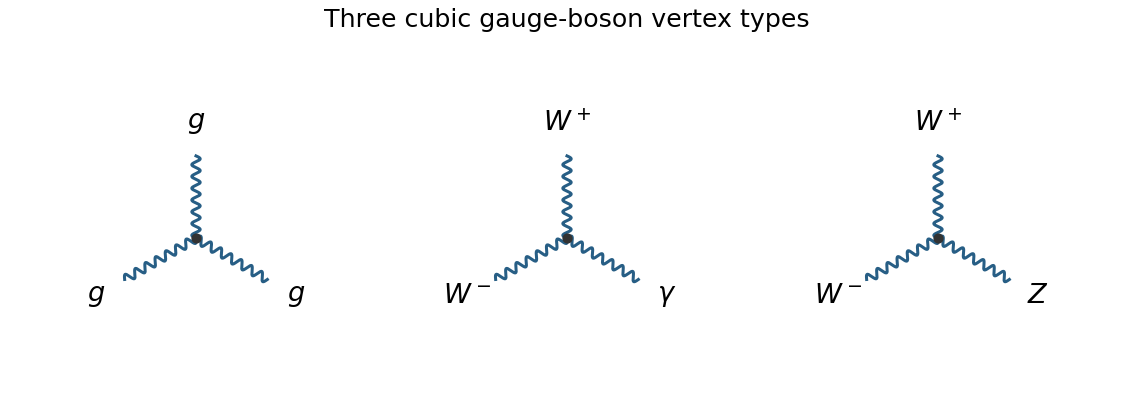
Figure 1.
The three fundamental cubic gauge-boson vertex types
. Details. 
The gluon cubic interaction vertex follows from the non-Abelian gauge field strength of Quantum chromodynamics. The electroweak Yang-Mills theory Lagrangian, after expressing the fields in the physical charged and neutral basis, produces the two charged-W boson vertices. In particular there are no fundamental , , , or vertices, and the separate colour and electroweak gauge factors do not generate a mixed or vertex. The count is by the boson labels requested, not by separate assignments of gluon colour indices.
There are five vertex types: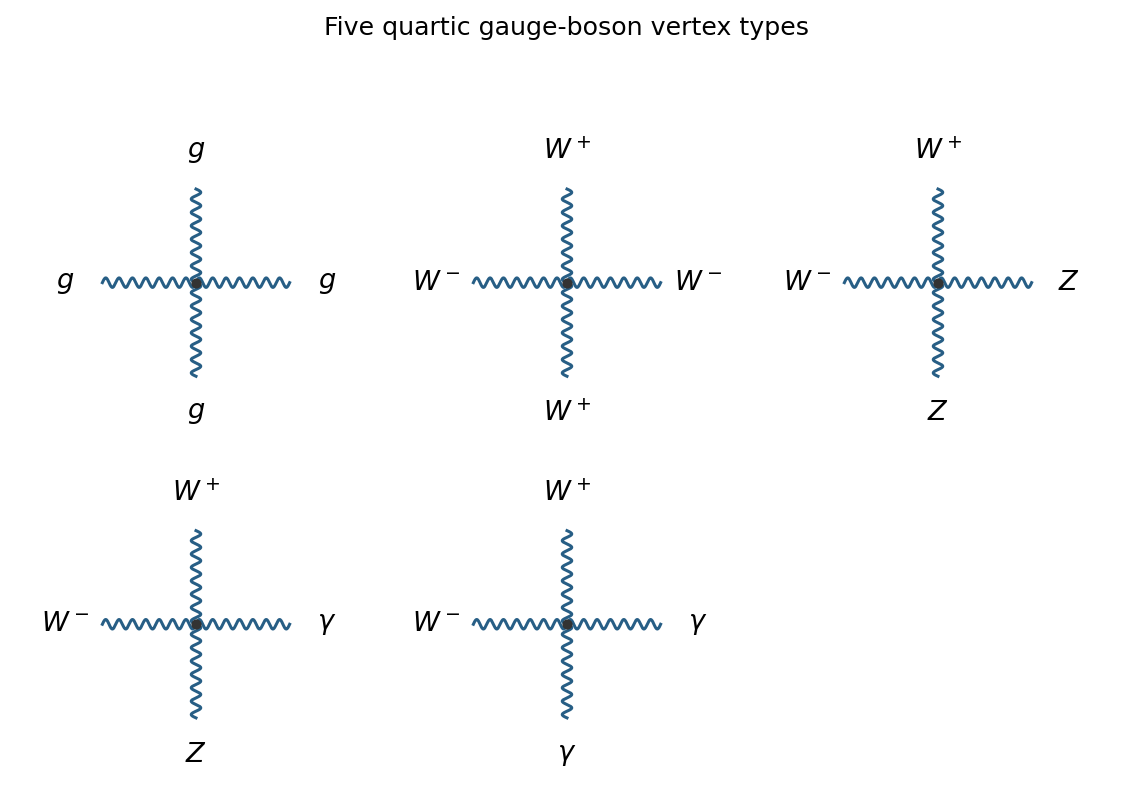
Figure 1.
The five fundamental quartic gauge-boson vertex types
. Details. 
The quartic terms arise from the square of the quadratic-field piece of the non-Abelian gauge field strength. Every electroweak quartic gauge boson self-interaction contains a pair. The absence of a fundamental purely neutral quartic vertex does not forbid amplitudes such as light-by-light scattering: those can be generated by loop diagrams, rather than by a single fundamental interaction vertex.
There areFor a Yang-Mills theory, schematically . The gauge kinetic Lagrangian is quadratic in , so its terms are at most quartic in the gauge fields:Thus there is no elementary five-leg pure-gauge interaction vertex in the renormalizable Standard Model. A five-boson scattering amplitude can still be assembled from several lower-valence vertices, or generated by loop diagrams. The number of external legs of a complete Feynman diagram is not the valence of a fundamental vertex.
Articles by others on the same topic
There are currently no matching articles.