For even A, nuclear pairing lowers even-even nuclei and raises odd-odd nuclei, producing two offset nuclear mass parabolas. There are often two beta-stable even-even isobars, separated by an odd-odd member to which neither can energetically decay. The number is not an exact universal rule: some even-Achains have one or more than two such minima against single beta decay, and a few light odd-odd nuclei are stable. Stability against single beta decay also does not guarantee stability against double beta decay.
The initial ratio is not perfectly constant. Atmospheric production changes and reservoir differences therefore require radiocarbon calibration, often using independently dated tree rings. Contamination and subsequent carbon exchange must also be controlled. The date measures closure of the carbon system, not automatically the date of every later event involving the object. The physical half-life is about 5730years; conventional radiocarbon ages historically use 5568years and must be calibrated before interpretation ascalendar dates.[ref]
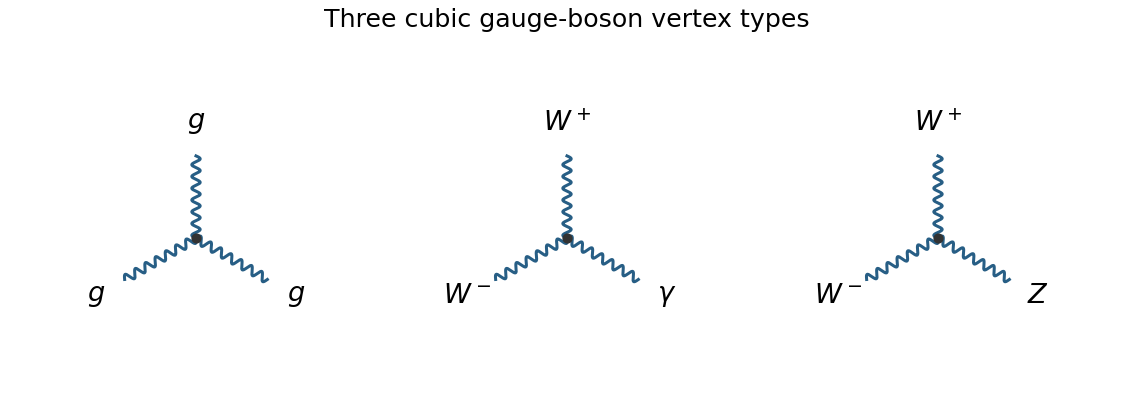
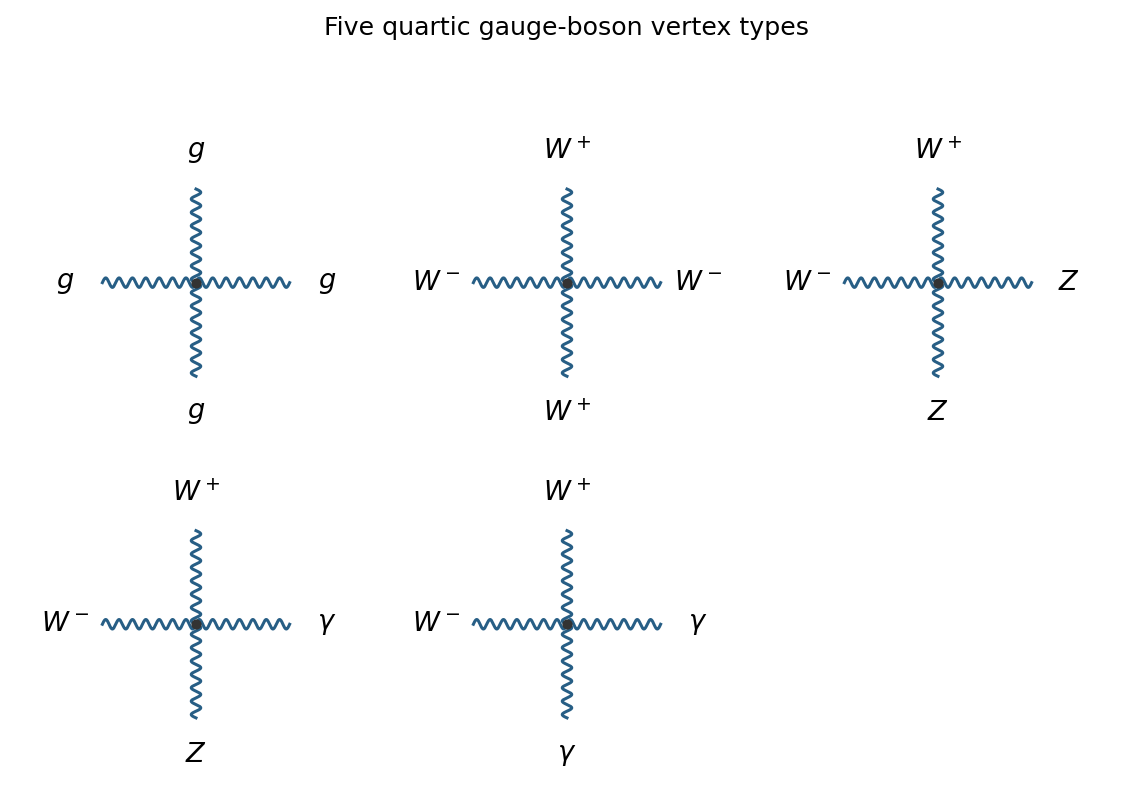
There is a convention to distinguish here: if acalculation expands around massless free fields, quadratic mW2Wμ+W−μ and mZ2ZμZμ/2 terms may be drawn as two-leg mass insertions. Those two insertion types belong to that bookkeeping convention. Similarly, two-point self-energy corrections occur in loop diagrams. Neither is an additional fundamental interaction in the standard physical-mass, tree-level rules used for the count above.
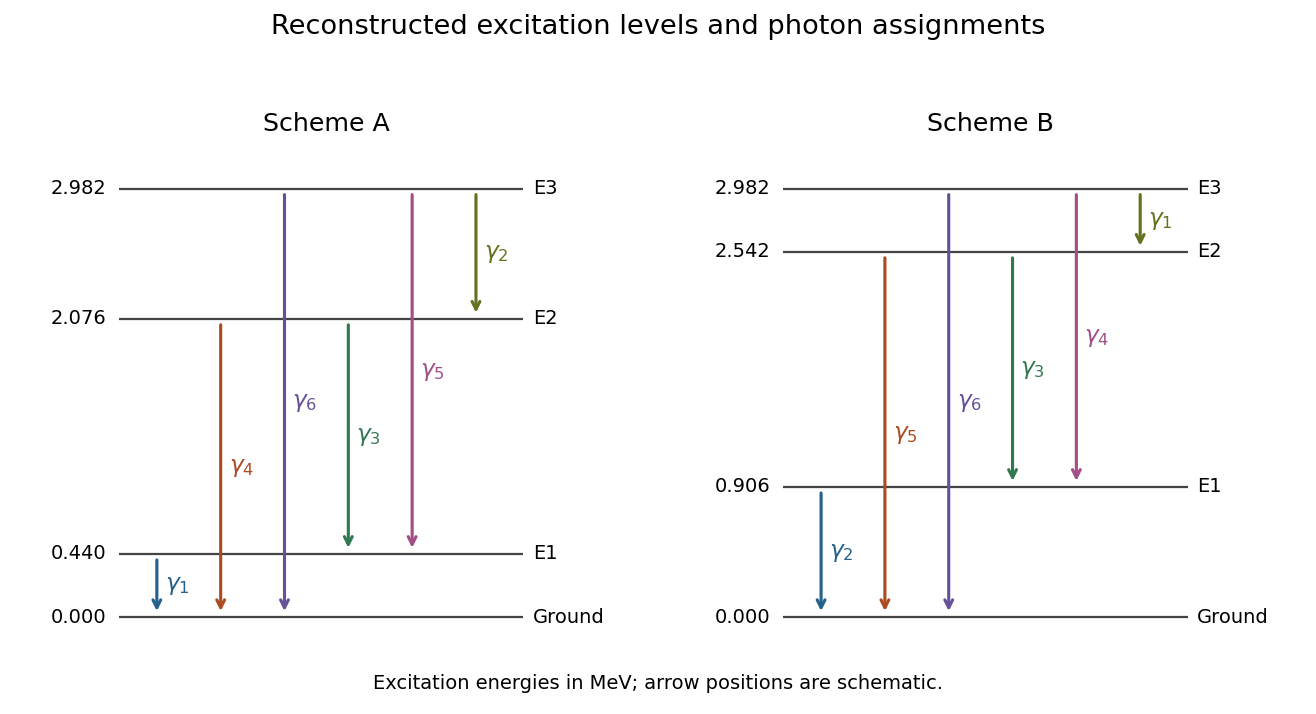
The largest difference fixes E3=2.982MeV. Since E1,E2 are themselves transitions to the ground state, each must occur among the measured energies. Testing those pairs gives exactly two level schemes:
They are reflections of one another about half the total span: replacing every level E by E3−E preserves the set of differences. The assignment of every observed line is
These original diagrams plot the inferred excitation energies to scale. They do not reproduce the source schematic. The reconstruction treats the supplied three-decimal gamma rayenergiesas the transition gaps, neglecting their much smaller nuclear recoil corrections.
For every daughter energy level, the total number leaving it must equal direct beta feeding plus cascades entering it. Direct feeding cannot be negative. This nuclear level population balance gives a decisive test without assuming any electromagnetic transition-strength model.
In schemeB, the first excited level is populated by 2→1 and 3→1, with counts N3+N4=38500+3770=42270. Its only downward transition is 1→0, whose count is N2=1. Its direct beta feeding would therefore have to be
All are non-negative. Thus schemeA is the compatible scheme. Under the stipulated complete decay sample and the six-transition model, schemeB is ruled out by population conservation, rather than merely being less probable. This inference assumes that the reported emitted-photon counts account for de-excitation: substantial unreported internal conversion or other decay paths would require additional terms.
Here the question's Γi are dimensionless branching fractions, despite the conventional use of Γ for a dimensionful decay width. Its “zeroth excited state” means the daughter ground state. Cascades through an excited level do not count as an additional direct beta branch to it.
For example, the 3→2 transition contributes KN2 to the population of level 2; it must be subtracted from the total leaving level 2 to obtain its direct beta feeding. Similarly, a photon in the strong 1→0 line need not imply a direct beta transition to level 1.
This also has a simple physical meaning: each decay that initially feeds an excited daughter eventually contributes exactly one of the three transitions into the ground state. The number of all emitted photons is not the correct normalization, because a single cascade can emit several.
Consequently the combined spin-and-flavour factor must be symmetric. The product notation in the question organizes the degrees of freedom; it need not mean that spin and flavour are separately unentangled. In particular the octet requires a correlated sum of products.
The symmetric spin quartet has total J=3/2; the two spin doublets have J=1/2.
For J=3/2, the spin factor is symmetric, so the flavour factor must also be symmetric: this gives the spin-3/2baryon decuplet. Its flavour content is four Δ states, three Σ∗ states, two Ξ∗ states, and one Ω state.
The residual correction has the form of a colour-magnetic spin-spin interaction. A nonrelativistic reduction of one-gluon exchange produces acontact contribution proportional to
For the spin-3/2 state, the same coupling gives (15/4−3/4−2)/2=1/2. Each uspaircorrelation is therefore 1/4, as expected for a fully symmetric spin state. Hence
Relative to the measured masses, these are +0.755% and −0.416%. The predicted spin-spin interaction splitting is 200.62MeV, compared with the measured 216.93MeV, a discrepancy of about 7.5% in the splitting.
This is an effective constituent-quark model, with a common spatial contact factor and a nonrelativistic spin-dependent interaction applied to light quarks. Relativistic motion, different spatial wavefunctions, and omitted strong-interaction corrections prevent an expectation of accuracy at the experimental 0.2--0.3MeV scale. Agreement at the level of several percent in absolute baryonmasses would already be useful for such a simple formula; the sub-percent absolute-mass agreement here is better than that rough expectation.
This tree-level estimate explains why the muonic branch dominates by roughly four orders of magnitude. The paper's table gives an electronic branching fraction1.230×10−4; electromagnetic corrections change the simple ratio by a few percent without changing the mechanism.
Both channels involve extra electromagnetic couplings relative to π0→γγ. The crucial distinction is the extra leptonic loop and helicity suppression of the two-lepton channel; counting final particles or couplings alone misses it. The pion-two-photon interaction itself already contains strong-interaction structure, so “extra loop” here compares the diagrams after representing that common interaction by an effective π0γγvertex.
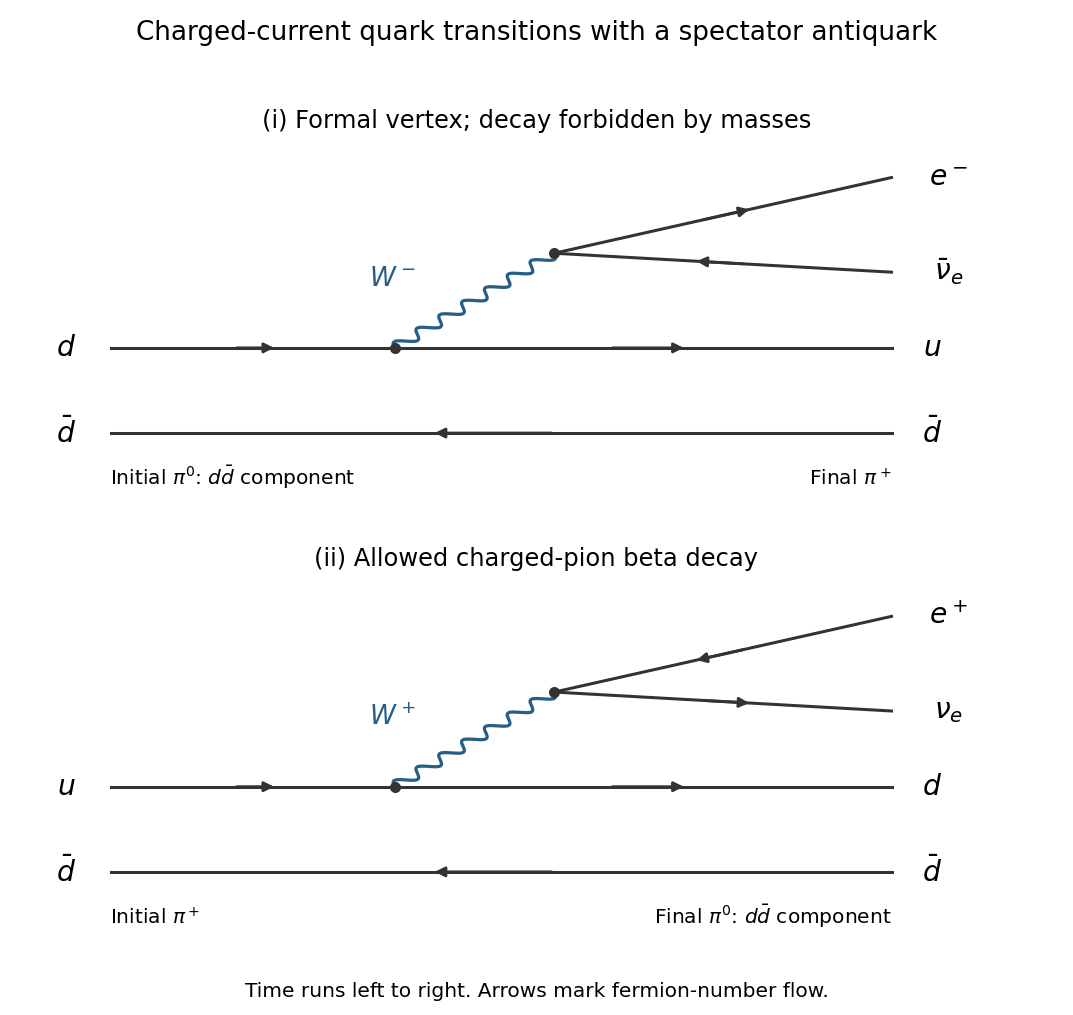
Both formal processes use one weak charged current transition, with a virtual W boson producing the leptonpair. Two representative lowest-order quark-line diagrams are shown below. They use the ddˉ component of π0; attachment to the antiquark line in the uuˉ component gives the other contribution to the same hadronic current.
In the first diagram, d→u+W− and W−→e−νˉe, with dˉa spectator quark. In the second, u→d+W+ and W+→e+νe, again with a spectator dˉ. The diagram for the first process describes the coupling but cannot make an energetically forbidden on-shell decay occur.
Its tiny branching fraction combines a weak interaction with an exceptionally small available energy. An allowed semileptonic transition has a decay width scaling approximately as GF2∣Vud∣2Δ5, where Δ=mπ+−mπ0, with electron-threshold and recoil corrections. The fifth power makes the few-MeV gap especially restrictive. Unlike direct π+→e+νe, this semileptonic channel is not forced to have an amplitude proportional to me; its primary extra suppression is the small phase space. Its approximately Cabibbo-favoured u↔d current does not supply a further large flavour suppression. The observed branching fraction corresponds to a partial decay rate of about (1.036×10⁻⁸)/(2.6033×10−8s)=0.398s−1, competing with the much faster dominant muonic decay.
For (i), CP symmetry relates the negative- and positive-pion radiative channels to excellent accuracy. The original positive-pion table therefore predicts
The comparison requires the same photon-energy and event-selection definition. The table attaches an unexplained footnote to this radiative channel; it does not specify those cuts in the supplied excerpt. An arbitrarily soft photon is not a separately infrared-finite exclusive observable, so the numerical value must retain the table'sdefinition.
Part (ii) contains an apparent notation error in the original PDFas well as the TeX: it prints e−νee−e+, rather than e−νˉee−e+. Taken literally, the charged leptons carry net electron-family lepton number2−1=+1, and the printed νe adds another +1. The initial pion has zero lepton number. This is a ΔLe=2 channel, not the charge conjugate of the listed positive-pion decay. In the ordinary lepton-number-conserving Standard Modelapproximation,
Allowing lepton-number-violating masses for Majorana neutrinos would require additional physical assumptions and does not justify assigning the tabulated number to that channel.
For the likely intended charge-conjugate process, the prediction is instead
It typically occurs on the 10−10s scale. The neutral pionalmost immediately converts to two photons, with τπ0=8.43×10⁻¹⁷s and Bγγ=0.98823. The Lambda baryon has τΛ=2.632×10⁻¹⁰s and two dominant routes.
This produces n+4γ by roughly the nanosecond scale. It is a long-lived intermediate state, not the final endpoint: the free neutron has τn=879.4s in the original table and eventually undergoes beta-minus decay,
Before selecting the two π0→2γ decays, the nπ0π0history has probability 0.99524×0.358=0.35630. The familiar rough description is therefore a 64% charged-pion route and a 36%neutron route; including the specified leading pion branches gives approximately 62.8% and 34.8% for the two displayed endpoints. The remainder includes Dalitz decays and other rare channels, not a failure of probability conservation.
These are particle decay cascades, treating the separated final proton, Electron, photons and neutrinosas stable asymptotic particles and neglecting subsequent collisions and rare extra radiation. An infinitely large box prevents escaping particles from being removed from the inventory. Neutrino labels specify their production flavours. Each lifetime describes astochastic waiting time, so there is no finite sharp instant at which every unstable particle has certainly decayed.