A topological defect can remain after spontaneous symmetry breaking when the field cannot be continuously put into the vacuum everywhere. If the vacuum manifold is , its topology classifies possible obstructions. Causally separated regions can settle into different local order-parameter configurations; joining them during a phase transition can trap defects. This is a formation mechanism, not an assertion that every transition creates every possible defect.
In three spatial dimensions the homotopy classification of cosmological defects gives areDisconnected vacua can meet across a wall; winding around a line can obstruct filling its core; a sphere around a point can carry monopole charge. Textures differ from permanent localized cores: they can collapse and unwind when the field leaves the vacuum manifold. Local gauge and global symmetry breaking also differ in their long-range fields and radiation. The original cosmological analysis connects vacuum topology with domain and string formation and their subsequent evolution.[ref]
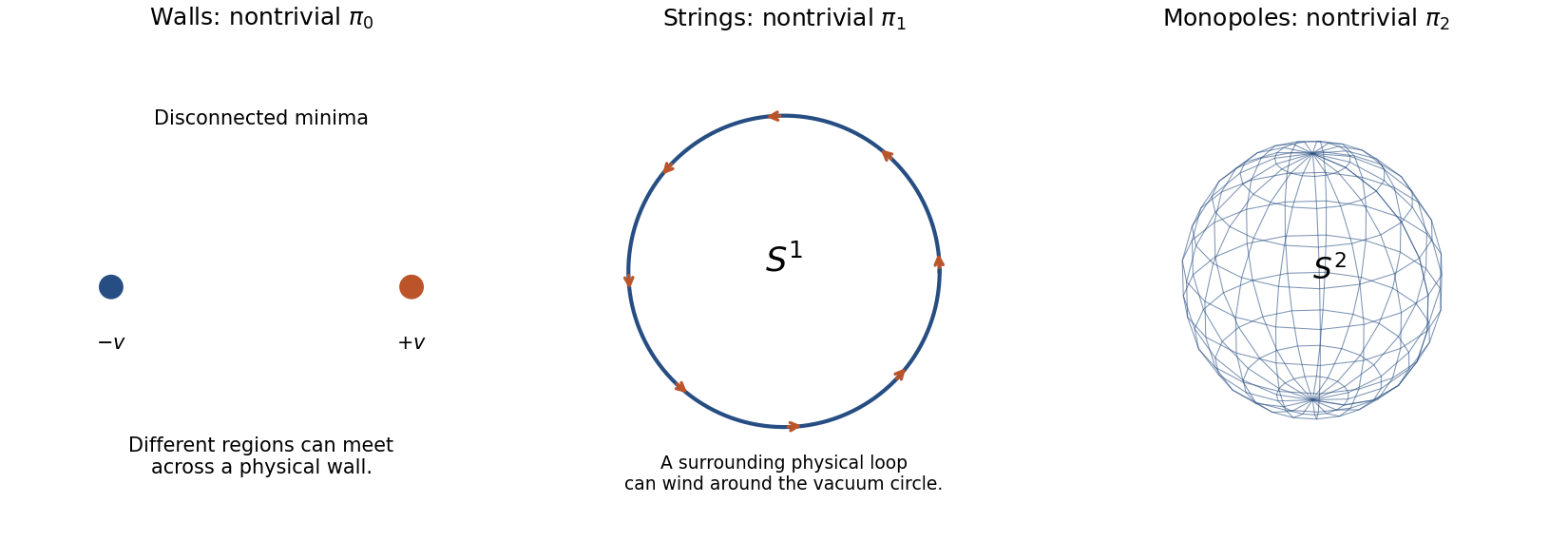
Disconnected, circular and spherical vacuum manifolds support different defects
. Original schematic vacuum spaces, not pictures of astronomical objects. The main text specifies the physical-space loops or spheres whose mappings classify walls, strings and monopoles. Details.
The energy budget determines cosmological importance. Nonrelativistic monopoles dilute approximately as , so a large primordial abundance can become unacceptable as radiation falls faster. Inflation can dilute an earlier population, provided the same defect-producing transition is not repeated afterwards. A slowly evolving wall network dilutes especially slowly and can dominate the energy budget or create excessive anisotropy.
Strings can lose energy by intercommutation and loop formation, with loops radiating gravitational waves or field quanta. A horizon-scaling cosmic string network whose characteristic separation is of order the horizon can have density in natural units, keeping a limited fraction of the total rather than accumulating indefinitely. This differs from an ideal frozen noninteracting network's simple dilution law. Similarly, a horizon-scaling domain wall network has , while a frozen wall network follows . The evolutionary assumptions must accompany any quoted scaling.
Defects can seed density wakes and other inhomogeneities, perturb the microwave background and generate non-Gaussian signatures. A sufficiently straight ideal cosmic string has conical spacetime and can create doubled background images; a cosmic-string network can generate gravitational-wave bursts and a stochastic background. Textures can produce localized microwave-background temperature features while collapsing. These signatures constrain defect abundance and symmetry-breaking scale; an isolated suggestive feature is not a unique defect detection.
The predictions depend on network evolution, reconnection, loop sizes, radiation channels and the relation between symmetry breaking and inflation. topology identifies which configurations are possible; formation and evolution determine whether they survive and whether their gravitational or radiative effects are observable. A defect's unseen energy does not automatically make it the dominant cold dark matter.
Articles by others on the same topic
There are currently no matching articles.