gravitational lensing measures the gravitational influence of matter without requiring that matter to shine. In general relativity a point mass produces small-angle deflectionFor a thin lens, with angular-diameter distances ,Image multiplicity, distortion and magnification therefore constrain projected gravitating mass, with source and lens geometry measured separately.
Strong lensing gives multiple images, arcs and Einstein rings. Their positions and, where available, time delays constrain a central mass distribution. Weak lensing measures correlated small image distortions over a larger field. Using the critical surface density for gravitational lensing and reduced gravitational shear, the convergence and shear satisfyBecause intrinsic galaxy shapes are unknown, weak shear is inferred statistically using many sources. Point-spread-function anisotropy, shear calibration, photometric redshifts, intrinsic alignments and foreground contamination must be controlled.
An inferred lensing mass can be compared with the independently estimated stellar and hot-gas mass. The bullet Cluster dark-matter separation provides a particularly informative separation of components: the collisional X-ray-emitting gas is displaced from the galaxies, while lensing mass peaks approximately follow the less-collisional galaxy component. The primary analysis combined wide-field and Hubble imaging rather than inferring lensing mass from X-ray hydrostatic equilibrium.[ref]
A direct empirical proof of the existence of dark matter by Douglas Clowe and others. arXiv:astro-ph/0608407, abstract and lensing/X-ray component comparison
This favors a dominant relatively collisionless unseen component. Translating a merger offset into a particle self-interaction cross section also requires a merger model and projection uncertainties; lensing does not directly reveal a WIMP's mass or quantum numbers.Microlensing tests a different possibility: dark matter in compact objects. A compact foreground lens can create an unresolved, time-dependent magnification of a background star. Event frequency and duration constrain the abundance and mass range of compact lenses only after survey cadence, detection efficiency, blending, source sizes and halo geometry are included. Achromaticity and the expected light-curve shape help distinguish simple lensing from intrinsic variability. A null survey result does not exclude every compact-object mass at every location.
Weak-lensing correlations and small-scale strong-lens structure also test the matter power spectrum and halo substructure, potentially distinguishing cold from warm free-streaming behavior. Baryonic feedback can change the same small-scale mass distribution. There are intrinsic inversion ambiguities: the mass-sheet transformationleaves reduced gravitational shear unchanged. Source-redshift information, absolute magnification or other data can restrict such degeneracies. Lensing establishes where gravitating matter is and tests its distribution and interactions; identification of its particle species requires complementary evidence.
Extra spatial dimensions offer mechanisms for unification and for the large separation between weak and gravitational scales. They are hypotheses about geometry and fields, not observations established by the hierarchy problem itself.
In a Kaluza-Klein theory construction, a compact extra coordinate can turn components of a higher-dimensional metric into four-dimensional gauge and scalar fields. For a field periodic on a circle of radius , momentum in that direction is quantized. In units ,The resulting tower explains why a small compact dimension can be hard to see at low energy: nonzero modes need energy of order . A realistic model must also explain its matter representations, chirality, internal geometry and stabilization of Lorentz scalar moduli; a compact coordinate alone does not reproduce the Standard Model.
Large-extra-dimension models instead use volume to weaken effective gravity. With a fixed unwarped compact space of volume , integrating the higher-dimensional Einstein-Hilbert action gives, in a consistent reduced-Planck-mass convention,The Standard Model can be localized on a brane while gravity propagates in the bulk. A large makes the observed four-dimensional gravitational scale large even if the fundamental higher-dimensional scale is much smaller. The proposal identifies gravitational dilution as a possible hierarchy mechanism, with deviations from ordinary gravity at sufficiently short distance.[ref]
The Hierarchy Problem and New Dimensions at a Millimeter by Nima Arkani-Hamed and others. arXiv:hep-ph/9803315, abstract and volume-dilution mechanism
For approximately flat dimensions of common size , gravity at distances much smaller than spreads through more directions and the force scales as , returning to at large distance.Warped models use a different mechanism. A five-dimensional metricredshifts a mass on a distant brane by . An exponential hierarchy can therefore arise without a large flat compact volume. The original Randall–Sundrum construction makes this distinction explicit and predicts characteristic massive spin-two excitations.[ref]
A Large Mass Hierarchy from a Small Extra Dimension by Lisa Randall and Raman Sundrum. arXiv:hep-ph/9905221, abstract and warped hierarchy mechanism
It still needs a consistent stabilization and phenomenology; the flat-volume formula and the warped redshift should not be treated as interchangeable explanations.Extra dimensions also occur in string-theory constructions, where consistency and compactification can organize gravitational and gauge degrees of freedom. That is a framework motivation, not proof that a particular compactification describes nature. Laboratory inverse-square-law tests, collider missing-momentum channels from escaping bulk modes, massive-mode resonances, and astrophysical or cosmological energy-loss constraints probe different parameter ranges. Background estimates and dependence on field localization matter: a brane model with invisible bulk emission need not share the signatures of a model with visible resonant decays. The useful claim is a testable mechanism for a specified hierarchy or unification problem, with compactification and stabilization assumptions stated.
A topological defect can remain after spontaneous symmetry breaking when the field cannot be continuously put into the vacuum everywhere. If the vacuum manifold is , its topology classifies possible obstructions. Causally separated regions can settle into different local order-parameter configurations; joining them during a phase transition can trap defects. This is a formation mechanism, not an assertion that every transition creates every possible defect.
In three spatial dimensions the homotopy classification of cosmological defects gives areDisconnected vacua can meet across a wall; winding around a line can obstruct filling its core; a sphere around a point can carry monopole charge. Textures differ from permanent localized cores: they can collapse and unwind when the field leaves the vacuum manifold. Local gauge and global symmetry breaking also differ in their long-range fields and radiation. The original cosmological analysis connects vacuum topology with domain and string formation and their subsequent evolution.[ref]
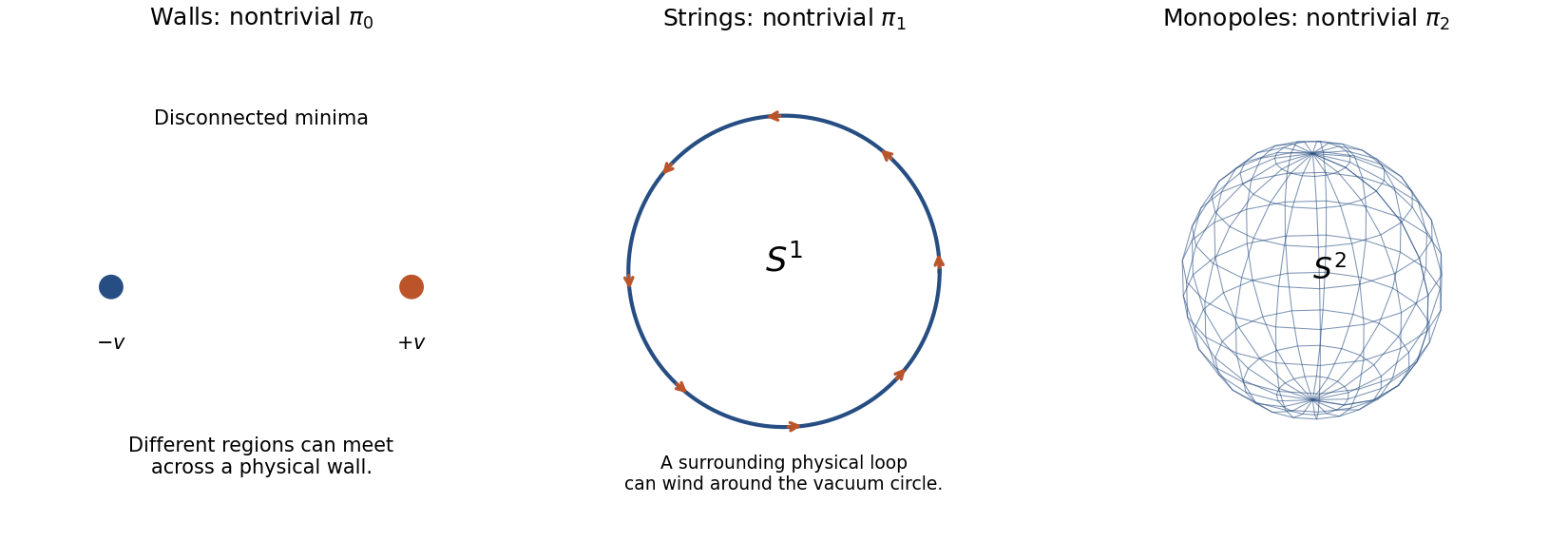
Disconnected, circular and spherical vacuum manifolds support different defects
. Original schematic vacuum spaces, not pictures of astronomical objects. The main text specifies the physical-space loops or spheres whose mappings classify walls, strings and monopoles. Details.
The energy budget determines cosmological importance. Nonrelativistic monopoles dilute approximately as , so a large primordial abundance can become unacceptable as radiation falls faster. Inflation can dilute an earlier population, provided the same defect-producing transition is not repeated afterwards. A slowly evolving wall network dilutes especially slowly and can dominate the energy budget or create excessive anisotropy.
Strings can lose energy by intercommutation and loop formation, with loops radiating gravitational waves or field quanta. A horizon-scaling cosmic string network whose characteristic separation is of order the horizon can have density in natural units, keeping a limited fraction of the total rather than accumulating indefinitely. This differs from an ideal frozen noninteracting network's simple dilution law. Similarly, a horizon-scaling domain wall network has , while a frozen wall network follows . The evolutionary assumptions must accompany any quoted scaling.
Defects can seed density wakes and other inhomogeneities, perturb the microwave background and generate non-Gaussian signatures. A sufficiently straight ideal cosmic string has conical spacetime and can create doubled background images; a cosmic-string network can generate gravitational-wave bursts and a stochastic background. Textures can produce localized microwave-background temperature features while collapsing. These signatures constrain defect abundance and symmetry-breaking scale; an isolated suggestive feature is not a unique defect detection.
The predictions depend on network evolution, reconnection, loop sizes, radiation channels and the relation between symmetry breaking and inflation. topology identifies which configurations are possible; formation and evolution determine whether they survive and whether their gravitational or radiative effects are observable. A defect's unseen energy does not automatically make it the dominant cold dark matter.
Articles by others on the same topic
There are currently no matching articles.