Direct formation in through one virtual photon selects the vector meson quantum numbers . The nonzero mode and absence of are consistent with this assignment: the two spin-zero kaons require odd orbital angular momentum for negative parity, whereas identical bosons cannot have an odd relative wave. This argument neglects the tiny CP violation in neutral kaons.
Assuming the decays conserve isospin, their equal rates indicate . The Clebsch-Gordan coefficients giveAn state lacks , while has squared coefficients rather than . The branching fractions alone determine neither nor these relative phases; the single-photon formation and approximate strong interaction isospin conservation are essential additional inputs.
For the resonant contribution only, subtract nonresonant Bhabha scattering and its interference before interpreting a fitted area. The integrated narrow vector resonance area follows from the Breit-Wigner resonance cross section, with , , and , becomesAcross a narrow scattering resonance, treat the prefactor and partial decay widths as constant and extend the integral over to the real line. Since ,A normalized beam-energy response convolves the line shape without changing this full area. It can completely change the observed peak height and apparent width. If a uniform acceptance is not already unfolded, use . The distinction between for this exclusive final state and for an inclusive final state is essential.
TODO: the numerical resonance-area reading is unavailable from the retained source. Page 6 retains the upper data panels but loses the lower part of the scanned data image, including the numerical horizontal energy calibration. A vertical cross section scale and an apparent peak cannot supply without that calibration. The decoded image contains 2,834,898 of 4,437,216 required RGB bytes; the archived bundle has the same truncation. No horizontal scale or natural decay width is inferred from the display width.
The recoverable numerical conversion is nevertheless definite. With , , , and , b givesThis coefficient assumes the plotted exclusive electronic sample has not already been corrected for acceptance. A restored area, with continuum subtraction and acceptance convention checked, would complete the estimate. A tabulated modern J/psi meson width would be external information rather than a reading of these data.
The narrow scattering resonance indicates suppressed strong interaction decay. In the quark model, is below the open-charm quark threshold, so its constituents cannot simply emerge in separate charmed mesons. The OZI rule suppresses annihilation into light hadrons; for a color-singlet state the leading purely gluonic channel needs three gluons. The observed leptonic channels remain competitive. Its mass and fit charmonium; the small width alone would not uniquely identify the new quark flavour without the wider spectrum and threshold evidence.
For a neutral bound state, meson parity and charge conjugation give and . In spectroscopic notation , the integer labels radial excitation, is orbital angular momentum, the total constituent spin, and their total angular momentum. The surviving level diagram contains eight states:
- : , , .
- : , , .
- : , , .
- : , , .
- : , , .
- : , , .
- : , , .
- : , , .
The spin-dependent splittings distinguish the singlet and triplet levels and the three triplet P levels. The radial excitation changes neither parity nor charge conjugation.
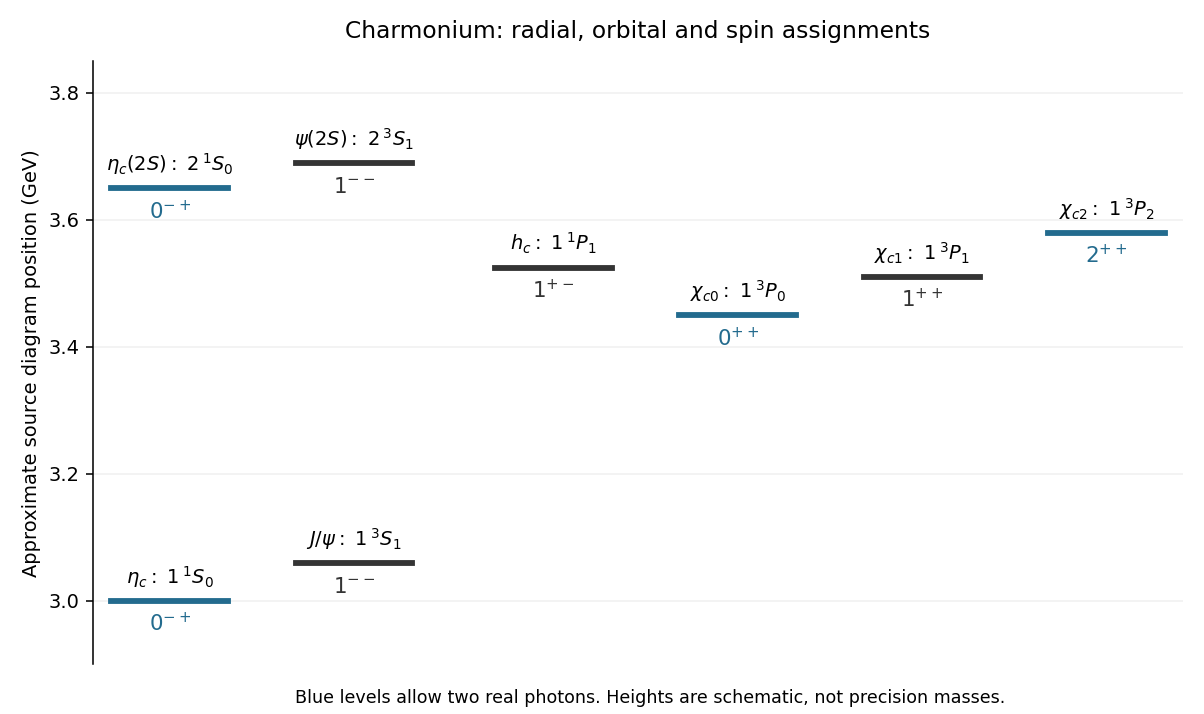
Charmonium assignments for the eight surviving source levels
. Original redraw with approximate vertical positions from the intact right-hand source diagram. Positions are schematic; labels and quantum-number assignments, rather than precision masses, are the content. Details.
The four allowed two-real-photon states are , , and . Two photons have , excluding , and ; the Landau-Yang theorem excludes because . Both scalar and pseudoscalar two-photon amplitudes exist, so and are allowed. The J/psi meson was discovered first because its assignment permits direct, resonantly enhanced single-photon formation in and a clean dilepton peak in hadron production. The lighter cannot be formed by one photon; it needs less favorable production channels and has a broader two-gluon decay.
A spin-zero at rest has no preferred axis, so is isotropic after summing final spins. A J/psi meson formed in unpolarized high-energy has transverse alignment. Its distribution can be writtenwhere contain the two independent helicity amplitudes. It is generally anisotropic; the approximate massless, helicity-conserving limit has . The tabulated branching fraction does not fix . An ensemble equally populated in all three spin projections would instead be isotropic: alignment of the production ensemble matters.
Articles by others on the same topic
There are currently no matching articles.